Harappan Warfare Technology
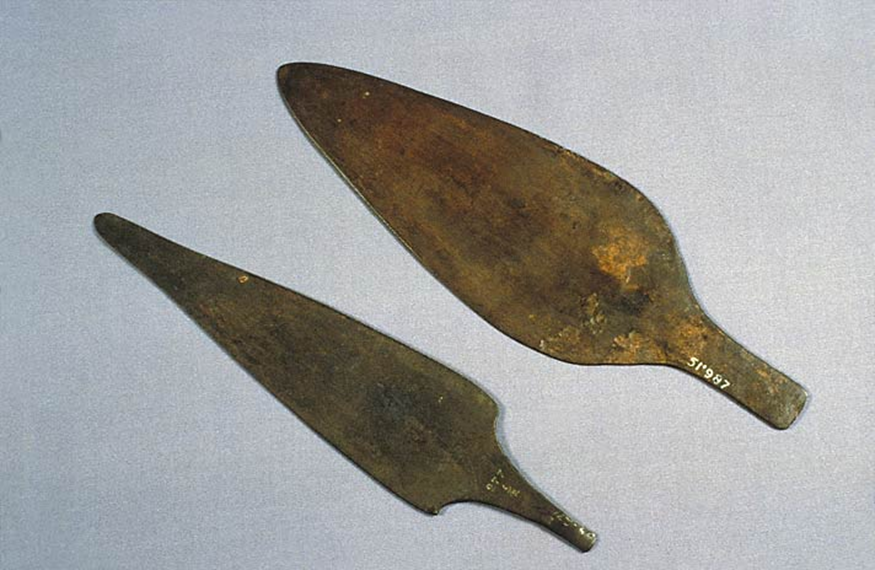
Copper-alloy blades from Mohenjo-daro and Harappa (Indus Valley). Harappans possessed basic bronze weaponry, though few specialized war implements or armor have been found.
Harappan sites have yielded a modest arsenal of copper/bronze tools and weapons. These include spear and arrow heads, short swords or daggers, and axe-like implements. Many such items could serve dual purposes as tools or weapons, reflecting a society without a dedicated military industry. Notably, Indus metallurgists did produce functional bronze points and blades – for example, caches of arrowheads and spearheads have been reported at Harappa and Mohenjo-daro. However, large offensive weapons (e.g. long swords) or heavy armor are conspicuously rare in the archaeological record. This paucity of overt “military” gear suggests that warfare was not technologically intensive in the Indus realm, or that weapons were made of perishable materials (wood, bamboo) that left little trace. It is likely Harappan combat, when it occurred, relied on simple arms: spears, bows and arrows, clubs, and perhaps slings. In fact, many Indus sites contain clay pellets or balls which archaeologists interpret as sling ammunition – cheap and effective defensive weapons for pelting intruders. Harappan art provides only scant hints: one seal illustration may show a warrior spearing an animal, and a few rare seals (possibly influenced by foreign styles) depict human combat. But overall, the Indus people did not celebrate martial imagery in their surviving art, and we have no depictions of chariots or cavalry from this culture.
In terms of defenses, the Indus cities were famously well-planned and often fortified with massive brick walls. City citadels and perimeter walls (e.g. at Harappa, Mohenjo-daro, Dholavira, Kalibangan, etc.) were built of mudbrick or stone masonry, sometimes tens of feet thick. These ramparts likely had multiple functions: they served as flood levees and as protective fortifications. Although not as explicitly military in design as Mesopotamian city walls, Indus fortifications featured gateways, bastions, and in some cases, ditch-moat features, indicating a concern for controlling access and deterring attacks. For example, small Harappan towns like Kanmer in Gujarat were “heavily fortified,” suggesting even minor settlements invested in defense. At Dholavira, a system of stone-faced ramparts with corner towers and wide gates guarded the city’s citadel and middle town. The design of these walls (sloping sides, compacted earth cores) would have been effective against both floods and human besiegers, though they lack the sophisticated bastion systems seen in later ages. Defensive weapons included the aforementioned sling balls and possibly bows stationed on the walls. There is no evidence of siege engines in this period; protection relied on the sheer bulk of walls and elevated citadels.
Mobility in Harappan warfare was limited by the available draft animals. Horses were not a significant part of Harappan fauna – horse remains are scant and controversial in Indus sites (some bones at Surkotada have been claimed as Equus caballus, but horse use was certainly not widespread). Instead, the Harappans used oxen to pull their carts and wagons. Many terracotta models of two-wheeled ox-carts have been found, indicating ox-drawn carts as the primary land transport for goods and possibly troops. These carts were heavy and slow, used for trade and farming rather than battlefield maneuver. For riverine transport, Indus people built boats – some depictions on seals and a massive dock at Lothal attest to a robust boat-building tradition, though again mainly for commerce. Thus, any military movement would have been on foot or by ox-cart. The lack of swift cavalry or chariots meant Harappan tactics likely relied on defending fixed positions and engaging in close-quarter combat rather than fast attacks (as would later be seen with horse-using cultures).
BMAC Arms and Fortifications
In the Oxus civilization (BMAC), archaeological finds suggest a more specialized set of weapons and formidable defensive works. Metalworking was advanced: BMAC bronze artifacts include daggers, shaft–hole axes, spearheads, and possibly maceheads. For instance, bronze axes – some with decorative motifs (a famous example is an anthropomorphic axe head from Bactria) – have been uncovered, hinting at both utilitarian weapons and ceremonial arms. Dagger blades and short swords of arsenical bronze appear at sites like Gonur and Sapalli, showing that stabbing/thrusting weapons were part of the arsenal. Small projectiles or arrowheads have also been found, though less frequently. Notably, the BMAC region yielded unique martial gear like bronze “flags” or standards and possibly scale armor fragments (these are more speculative – some metal scales could be pieces of armor or horse trappings). A compilation of bronze tools from various BMAC sites (Gonur, Sarazm, etc.) illustrates typical items: barbed points, leaf-shaped blades, and circular fittings【43†look】. Thus, compared to the Indus, the Oxus communities show a somewhat richer suite of weaponry, perhaps reflecting a need to arm guards or militias in a more conflict-prone environment.
BMAC’s most striking military feature was its fortified architecture. Major settlements were essentially fortresses: enclosed by thick mudbrick walls with towers, bastions, and multiple concentric ramparts. For example, Gonur Depe had an “elliptical” outer wall (330×460 m) with dozens of round towers along its circuit. Inside, a citadel (“Monumental Palace”) was itself ringed by a double wall. Similarly, sites like Togolok and Jarkutan were built as fortified enclosures (locally termed qila in later historical parlance). These forts could even have multiple rings of walls – Mallory notes some BMAC forts had up to three encircling walls, creating successive defensive perimeters. Walls were often 5–10 m thick and reinforced with external towers or buttresses for strength. Gates were narrow and controlled. In southern Margiana, a “Temenos” at Gonur South had a rectangular walled compound with towers at corners and mid-walls. Such robust fortifications indicate that BMAC elites invested heavily in passive defense, likely to protect against raids by nomadic groups or rival oasis communities. The presence of arrowheads in some BMAC layers could suggest archers on the walls, and the design of the forts (with ditch-and-rampart systems similar to steppe forts) implies a response to specific military threats. Indeed, after ca. 1800 BCE, new fortification styles emerged in Margiana that closely resemble the steppe Sintashta forts (e.g. circular ditches), hinting that BMAC communities were adapting to warfare with horse-riding or chariot-equipped adversaries from the north.
In terms of mobility, the BMAC people stood at a crossroads of innovation. Initially, oxen and donkeys would have been the main draft animals for carts in these oasis towns, much like in Harappan society. Evidence from trading outposts suggests donkeys were used in caravans connecting to the Indus. However, the BMAC horizon shows early traces of the horse-drawn vehicle. Notably, a grave at Gonur’s “Royal Necropolis” (c. 2200 BCE) contained a young horse skeleton alongside a four-wheeled wooden wagon with bronze-capped wheels. This remarkable find suggests that domestic horses and wagons were present (albeit perhaps as high-status symbols) in Bactria-Margiana even before the chariot’s invention. The wagon, with solid wheels, was a transport cart rather than a fast chariot. True spoked-wheel chariots appear to have reached Central Asia slightly later. By the post-urban phase (c. 1700 BCE), Andronovo influence likely introduced light chariots to the region – for example, Andronovo graves north of BMAC yield horse tack (bits, cheek-pieces) identical to those later used with chariots. BMAC sites themselves have yielded horse imagery (e.g. a horse-head bronze axe) and sporadic horse bones, indicating growing familiarity with equine transport. It’s therefore likely that by 1500 BCE, chariot technology was known in the Oxus and northern Indus regions, giving new mobility to warfare. Additionally, camels (Bactrian) were possibly domesticated in Central Asia by this time and could have been used for transport across deserts, though their role in battle was probably minimal.
Early Aryan Military Technology
The early Indo-Aryans brought with them the horse and chariot as defining military technologies. The Rigvedic tribes deployed fast, two-wheeled chariots drawn by a pair of horses – a revolutionary platform for Bronze Age warfare in South Asia. These rathas were light and spoked-wheeled, built for speed and maneuverability. A chariot typically carried a driver and a warrior (often armed with bow and arrows or javelins). While direct archaeological remains of chariots in 1500 BCE Punjab are slim, textual descriptions in the Rigveda leave no doubt: chariots and skilled charioteers (rathins) are lauded, and swift horses are frequently mentioned as prized war animals. Supporting evidence comes from finds like the Gandhara Grave Culture (c. 1400–1000 BCE in Swat Valley) which yielded horse remains and spoke-wheeled models, and a recently excavated chariot burial in Sanauli (though slightly east and possibly dating ~c. 1900 BCE) – all pointing to the presence of chariot warfare on the subcontinent by the late Bronze Age.
In terms of personal armaments, the Aryan warrior (Vedic kshatriya or noble) likely carried a bow, several spears/javelins, and possibly a bronze sword or long dagger. The bow was a primary weapon: Vedic hymns refer to archery in battle, and the bow (dhanus) with arrows is symbolically important. It’s possible that composite bows (reinforced with horn and sinew) had begun to spread from West Asia by this time, giving Vedic archers a punch, though simple self-bows were certainly used. Spears were used both for throwing from chariots and for hand-to-hand combat. The bronze sword in South Asia might have been a later 2nd-millennium development – some copper “antenna-hilt” swords appear in northern India toward 1300–1000 BCE, likely associated with these warlike cultures. Offensively, the early Aryans also used axes (the Vedic text mentions a battle-axe, parashu). Defensively, we have sparse evidence: shields made of ox-hide or wood are mentioned in later texts (the word dhala for shield occurs in post-Rigvedic literature). Helmets or armor are rarely noted in the Rigveda, though one hymn calls Indra “the one with a golden mail (armor)” – perhaps idealizing protective gear. In all likelihood, typical warriors fought unarmored or with leather tunics, relying on agility and the protection of their chariot.