Weapons and Armor: Early Bronze Age weapons evolved significantly from their Neolithic precursors. During the Longshan period, warriors wielded polished stone implements and the first metal knives or dagger-axes made of copper. Archaeologists have found stone arrowheads, spears, and axe-heads from late Neolithic contexts, alongside a few primitive copper or low-tin bronze blades – enough to show experimentation with metal weaponry by 3rd millennium BCE. By the Erlitou (Xia) phase, true bronze weapons appeared: the earliest bronze ge (dagger-axe) blades, bronze yue battle-axes, as well as bronze arrowpoints, have been unearthed at Erlitou. (Erlitou’s tombs even yielded jade ceremonial versions of dagger-axes, suggesting a ritual status for these weapons.) In Shang times, metallurgy and weapon production reached new heights – bronze was cast in large quantities for war as well as ritual. Shang arsenals included bronze dagger-axes and spears as the main polearms, ge blades mounted on shafts forming lethal halberds. Short bronze swords or daggers, bronze-tipped arrows for composite bows, and heavy two-handed yue axes (often with monster-face decorations) were all part of the Shang armory. The tomb of the Shang general-queen Fu Hao contained 468 bronze artifacts, “including many weapons,” such as great axes, indicating both the variety and quantity of arms used by Shang elite warriors. By late Shang, bronze weapons were diverse and standardized, mass-produced via piece-mold casting – a process that allowed the Shang to equip large forces and also to create elaborate ritual weapons.
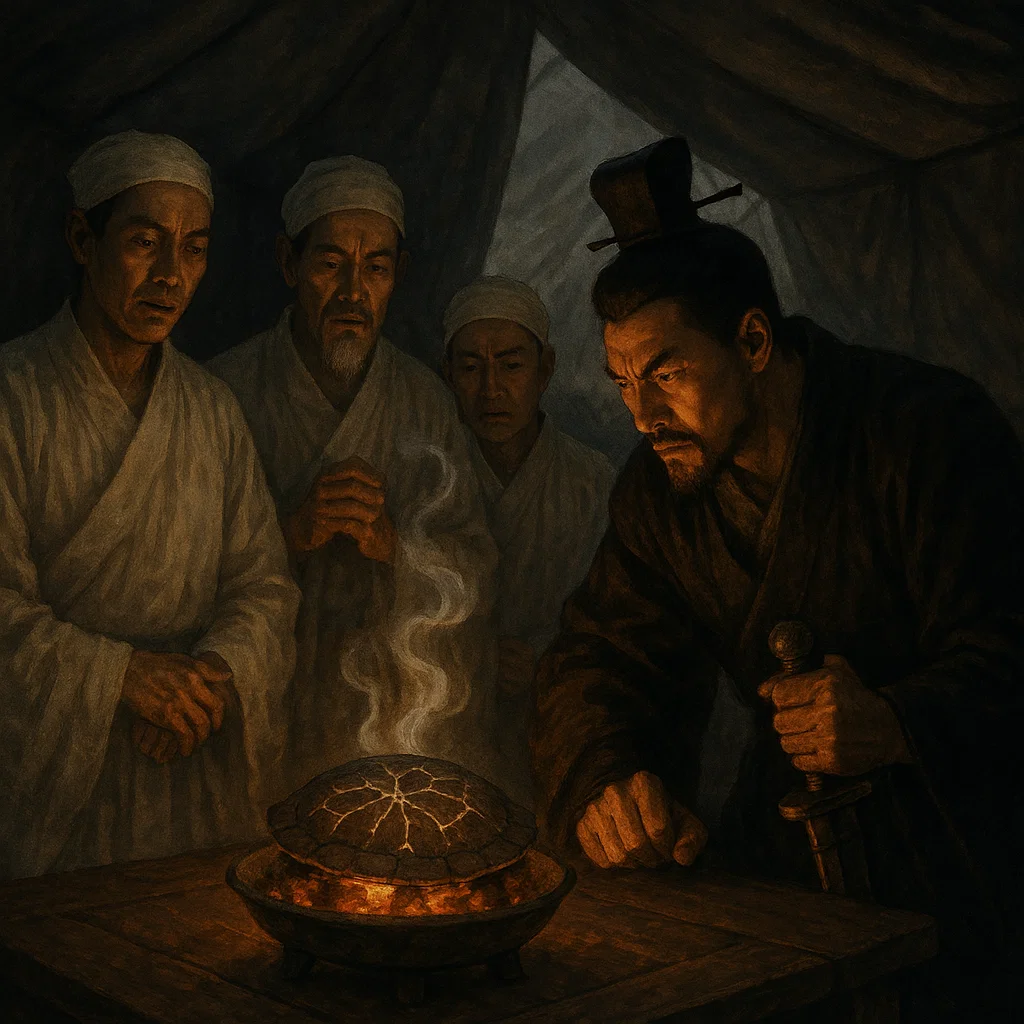
Armor and helmets became evident only in the Shang era, setting them apart from earlier periods where no clear armor remains have been found. The earliest Chinese armor, as suggested by archaeology, consisted of leather cuirasses and helmets reserved for high-ranking warriors. Shang nobles and their bodyguards wore one-piece breastplates of hardened rawhide (sometimes made from rhino or elephant hide, materials available in the region then). Helmets were crafted from bronze – often a bronze cap or mask adorned with animal motif designs, fitted over a leather liner (though the leather has decomposed in excavations, leaving behind bronze frontpieces). Some fully cast bronze helmet pieces have been discovered, indicating that by the end of Shang or onset of Zhou, a few elite charioteers or heavy infantry may have worn metal helmets or partial bronze armor. Such armor was rare and symbolized status; most common soldiers likely fought with minimal protection (perhaps quilted cloth or leather shields). Notably, Shang oracle bone characters for “helmet” exist, suggesting the concept of head protection in warfare. The introduction of bronze armor and helmets in late Shang/early Zhou is a significant technological difference from Longshan and Erlitou times, where warriors would have been far more exposed to injury.
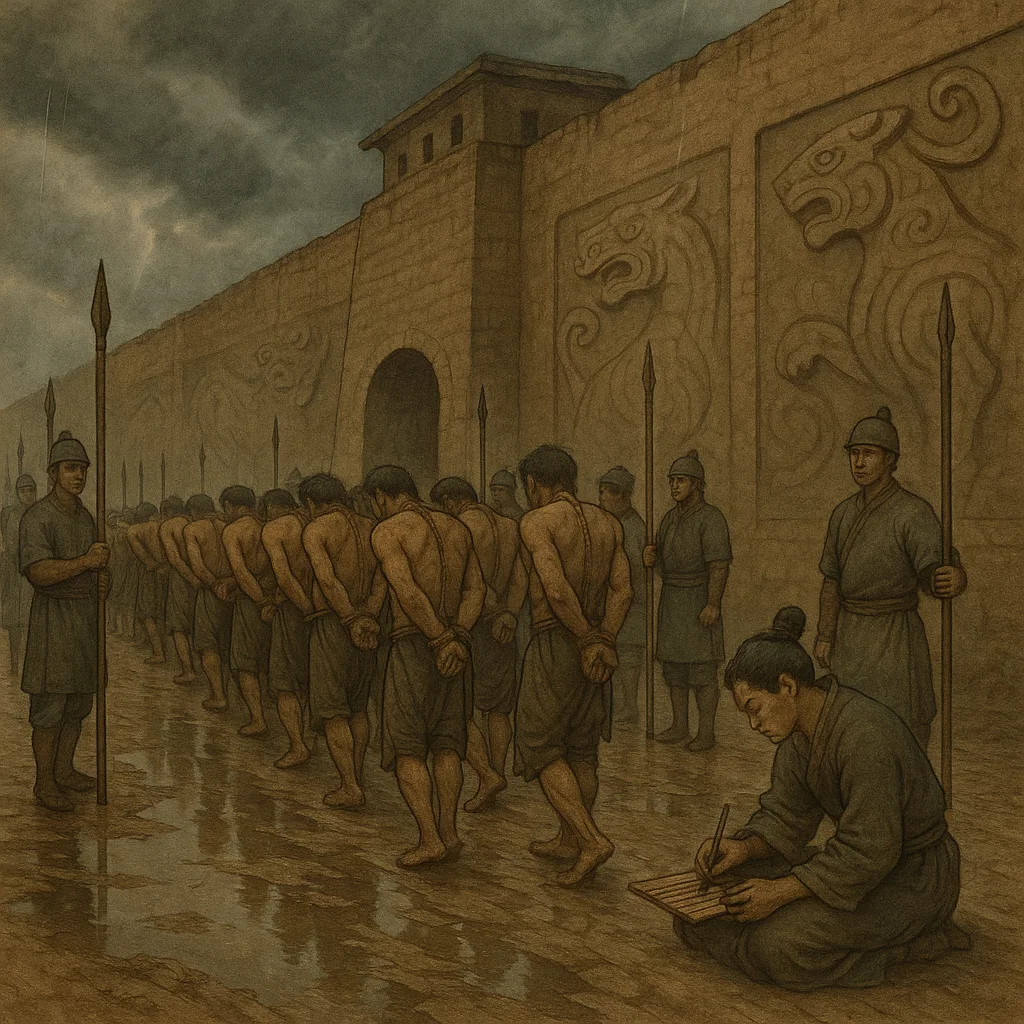
Fortifications: Fortified settlements were already present in the Neolithic, but they grew more massive and sophisticated through the Bronze Age. Longshan-era towns built rammed-earth walls on raised earth platforms – an early example of large-scale defensive engineering. For instance, the Longshan type-site Chengziya had a rectangular rammed-earth wall (with an earthen core 6–7 m thick) encircling the town, surrounded by a deep moat fed by a nearby river. Some late Longshan walls reached astonishing dimensions: over 25 m wide at the base in certain sites. These early walls, made by pounding layers of earth until rock-hard, required huge labor investment (hundreds of people working in unison) and served both to demarcate and defend communities. Archaeologists debate why such walls were so thick – one view is they doubled as flood levees along unstable rivers, while also providing protection against attacks. Shimao, a late Neolithic walled city in Shaanxi (c. 2300–1800 BCE), exemplifies the era’s martial landscape. Shimao was “a city designed to face constant danger” – it boasted stone fortifications 6 miles long and 8 ft thick, with multiple concentric walls and advanced features like barbicans, bastions, maze-like gates, and “draw attackers in” angular projections. At Shimao’s eastern gate, archaeologists found pits of decapitated human skulls (about 80 in total) placed as foundation deposits – grisly evidence that captives were sacrificed during wall construction, a ritual believed to consecrate the defenses or terrorize enemies. These fortification practices of late Longshan foreshadowed the militarized cities of the dynasties.
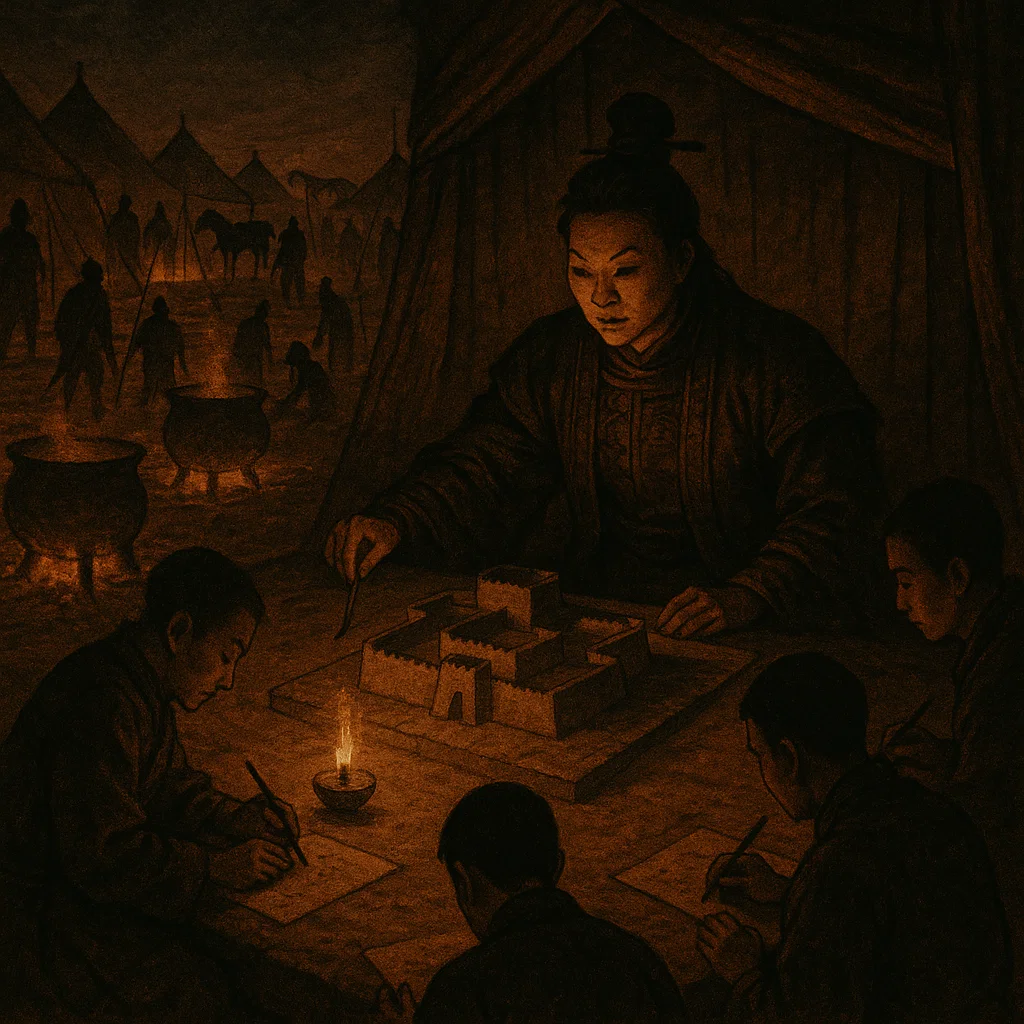
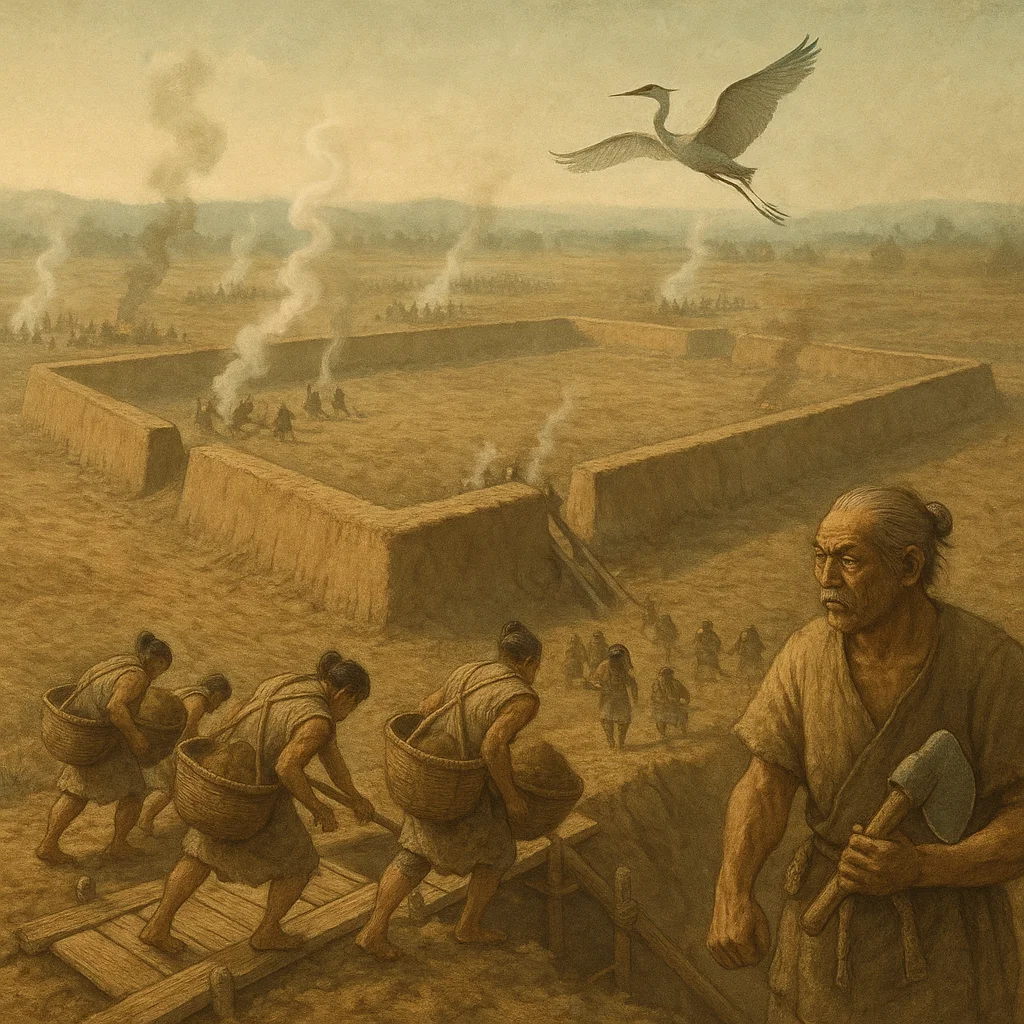
By the early dynastic period, city walls remained central. The Erlitou capital had a walled palatial precinct (rammed-earth enclosure) though apparently no large outer wall for the whole city. It may be that the early Xia polity relied on its palace-fort and perhaps natural barriers, until the rise of competing powers forced larger defenses. Around 1600 BCE (start of Shang era), a full-fledged walled city was built at Yanshi (only 6 km from Erlitou) with a stamped-earth rampart, marking a shift to higher defensive needs. The early Shang Erligang culture site at Zhengzhou (Bo capital) likewise had a gigantic rammed-earth wall (estimated ~20 m thick, 10 m high) forming a roughly rectangular enclosure many kilometers in circumference – testimony to Shang’s ability to mobilize and control large labor forces. These Shang walls enclosed royal compounds and workshops, protecting the urban core. Notably, the last Shang capital Yin (Anyang) did not have a single continuous city wall encircling all its sectors; instead, Anyang was a sprawling complex of palaces, temples, and cemeteries along the Huan River with smaller walled sections. It’s possible the Shang kings at Yin relied on strategic location and their field armies for security, or that ephemeral wooden palisades (now vanished) complemented natural moats. Nevertheless, fortified regional centers and frontier forts did exist in Shang times. The Shang also built internal partition walls within cities (compartmentalizing royal quarters, workshops, residential zones) – a practice starting in late Longshan and accelerating under Shang to control movement and enhance security. Early Zhou continued using rammed-earth fortification technology. After conquering Shang, the Zhou established a new stronghold at Chengzhou (Luoyang), constructing a walled city to serve as an eastern administrative capital. Many Western Zhou regional states likewise built fortified towns and border walls as needed. In sum, massive earthworks were a constant of Bronze Age warfare in the Yellow River region – from Neolithic ramparts to the defensive walls of Shang and Zhou – with a trend towards increasingly organized design and symbolic displays of power.
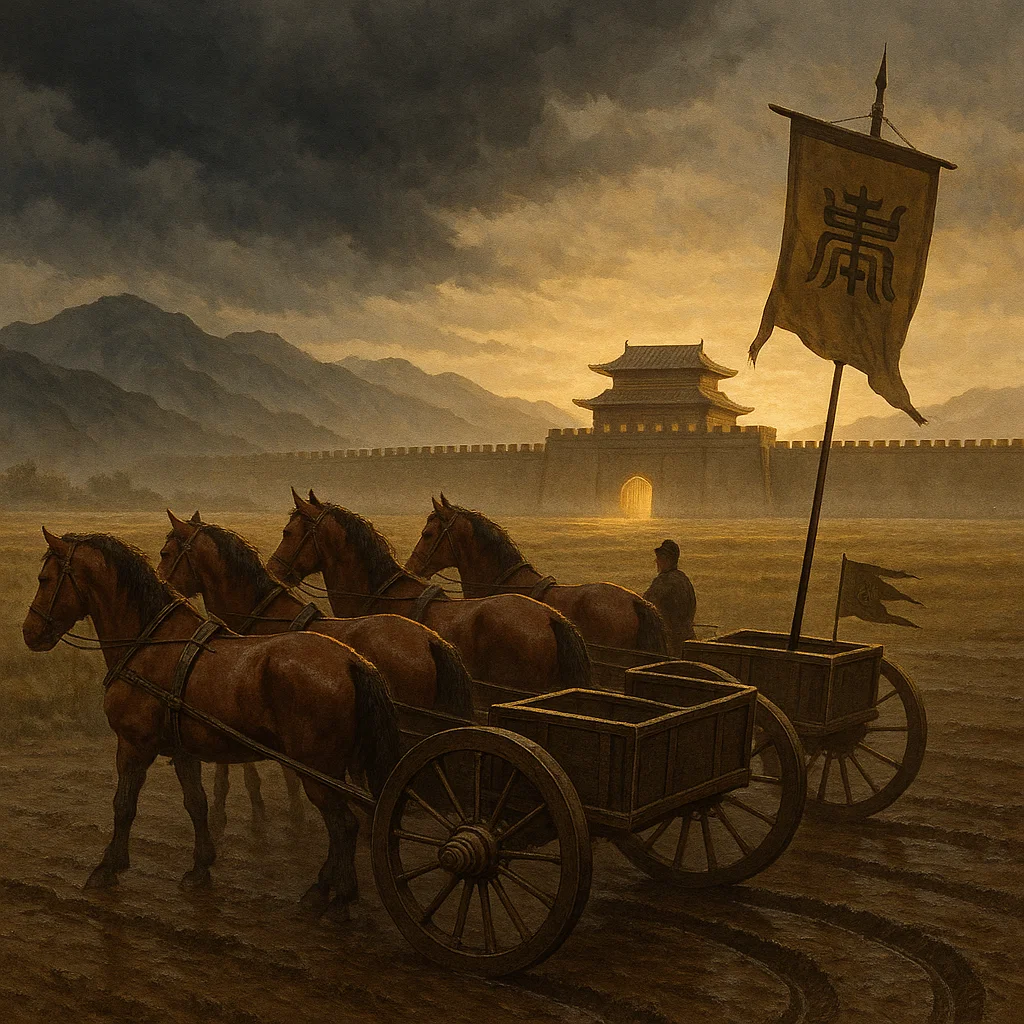
Mobility Systems – Chariots and Horses: A major military innovation that distinguishes the late Shang (and Zhou) from earlier periods is the horse-drawn war chariot. No evidence of chariots exists in Longshan or Xia contexts; transport was limited to human portage or possibly ox-carts for heavy loads (Erlitou yielded some wagon track ruts near the palace, hinting that ox-drawn carts or wooden wagons were in use by ~1700 BCE). However, the concept of swift, horse-drawn vehicles for battle only arrived in China around the mid-2nd millennium BCE. The Shang dynasty aggressively adopted spoked-wheel chariots, likely via contact with Central Asian steppe cultures, and assimilated these vehicles into their military. Archaeological finds at Anyang (Late Shang) include chariot burials: horses and chariots interred together to accompany high-status individuals in the afterlife. Typically, a Shang chariot was a light, two-wheeled carriage carrying a driver, an archer, and sometimes a halberdier. The remains of chariots at Yinxu show standardized construction – e.g. wheels with 18–26 wooden spokes and a bronze hub, axles about 2 m wide – and teams of two horses (occasionally four) hitched to pull them. The image below shows an excavated Late Shang chariot burial at Anyang, with horse skeletons and the outline of the wooden chariot (which has decayed). These finds date to roughly 1200–1046 BCE, aligning with oracle bone records that Shang King Wu Ding and his successors deployed chariots in campaigns.
Chariots gave the Shang (and later, the Zhou) a mobile striking force unprecedented in earlier times. On the flat North China Plain, chariots could rapidly transport commanders, break enemy infantry lines, or pursue fleeing foes. They were likely used as shock vehicles and elevated archery platforms – Shang charioteers could rain arrows from a moving cart, an effective tactic against footmen. By tradition, the Shang employed only modest numbers of chariots (perhaps in the hundreds). For example, one oracle inscription asks if a deployment of “thirty chariots” would be favorable in battle. However, at the climactic Battle of Muye (1046 BCE), the Zhou-led army fielded a large chariot contingent (later texts claim up to ~300 chariots from Zhou and several thousand from allies) – indicating how the new dynasty further embraced chariot warfare. Aside from chariots, horseback riding did not yet play a direct combat role, but early Zhou nobility may have begun riding horses for scouting or courier duties (an art they would refine in subsequent centuries). The introduction of the horse–and-chariot complex thus marks a key technological and tactical shift from Longshan/Xia to Shang/Zhou: earlier armies were entirely pedestrian, whereas late Bronze Age Chinese armies now had a fast, prestigious wing of chariot troops.