Source page: McKinsey & Company
Commentary
Cutting back on quick bites
Consumer | Retail
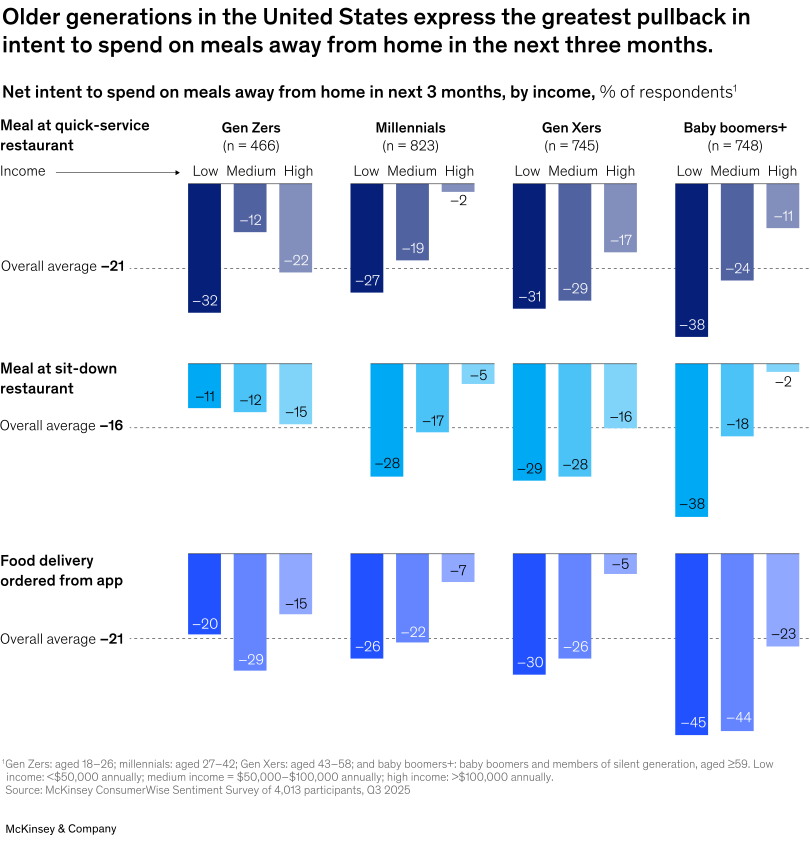
April 1, 2026 – Amid persistent inflation and economic uncertainty, diners in the United States are planning to pull back on spending at quick-service restaurants in the coming months, according to a McKinsey consumer survey. But there are some variations in this trend depending on age and income, note McKinsey’s Ben Mathews and Katharine Mattox and their coauthors. Older generations, particularly baby boomers and Gen Xers, show the strongest intent to reduce their spending. Low-income consumers across all generations are planning the most significant cuts, while high-income millennials, in contrast, report almost no change in their spending plans.
To read the article, see “What US consumers want from restaurants in 2026,” January 8, 2026.
customizer here
Visual form
Bar Chart: grouped net-spending-intent comparison for US meals away from home by generation and income tier.
Layout / body structure
The graphic is organized into three spending categories: quick-service restaurants, sit-down restaurants, and food delivery ordered through an app. Within each category, grouped bars separate generations and income levels so the reader can compare pullback patterns across age and household economics.
What is being compared
It compares net intent to spend on meals away from home over the next three months among Gen Zers, millennials, Gen Xers, and baby boomers+, with each generation split into low-, medium-, and high-income respondents.
Measurement system
The measurement is percentage-point net intent, meaning the share planning to spend more minus the share planning to spend less. Negative values show a planned reduction in spending.
Visible structure inside the graphic
Most bars extend into negative territory, and the deepest negatives cluster among low-income consumers and older generations. The category averages are shown alongside the demographic bars, giving a reference point for each restaurant channel.
Main takeaway from the visual
The chart shows that consumers are broadly planning to cut restaurant spending, but the pullback is not uniform. Baby boomers+, Gen Xers, and low-income consumers show the strongest retreat, while high-income millennials are closest to flat.
Key standout values or extremes
The overall averages are -21 percent for quick-service restaurants, -16 percent for sit-down restaurants, and -21 percent for food delivery. Low-income baby boomers+ reach -38 percent for QSR and sit-down restaurants and -45 percent for delivery, while high-income millennials are only -2 percent for QSR and -5 percent for sit-down restaurants.
Controls / sequence, when applicable
This is a static grouped bar chart; there are no in-chart controls to operate.
Companion media, when applicable
There is no separate companion audio or video; the restaurant spending-intent grouped bar chart is the full visual on this page.