Source page: McKinsey & Company
Commentary
Aging meets healthcare capacity crunch
Healthcare | Workforce
February 11, 2026 – Rising healthcare demand from an aging population in the United States is clashing with persistent clinical workforce shortages. The resulting widening gap between demand and capacity is further straining access, quality, and affordability for patients, as well as cost pressures for the industry. The population of those aged 70 and older is projected to grow faster than any other group in the latter half of the decade, which will continue to accelerate medical utilization. Technology—especially AI—offers a potential bright spot to streamline workflows, expand clinical capacity, and improve the patient experience, say McKinsey Senior Partners Akshay Kapur and Shubham Singhal.
To read the article, see “Gathering storm 2.0: Succeeding in healthcare despite the turbulence,” November 18, 2025.
customizer here
Visual form
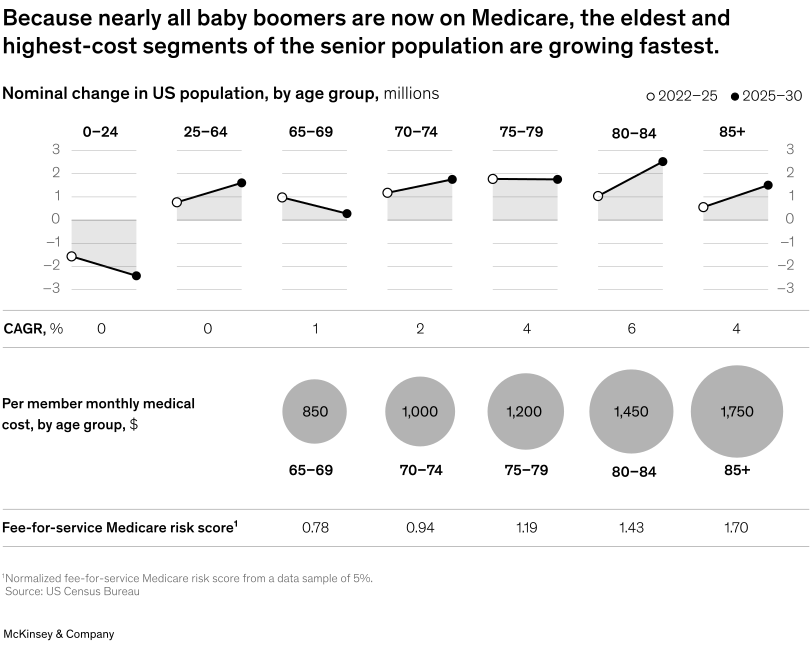
Bar Chart and Table (with Visual Encoding): US age-cohort population growth paired with medical-cost and risk-score measures.
Layout / body structure
The top section uses bars to show nominal population changes by age group across two periods, 2022 to 2025 and 2025 to 2030. The lower section works like a table, aligning each age group with per-member-per-month medical costs and normalized Medicare risk scores.
What is being compared
It compares projected US population changes across age cohorts and links those cohorts to medical cost intensity and risk scores.
Measurement system
Population change is measured in millions of people. Medical costs are per member per month in US dollars, and risk is shown as a normalized fee-for-service Medicare risk score.
Visible structure inside the graphic
The largest positive bars sit in the oldest cohorts, especially ages 80 to 84 and 85+. Younger cohorts, especially those under 24, move negative, while the cost and risk rows climb steadily with age.
Main takeaway from the visual
The chart shows healthcare demand shifting toward older, higher-cost groups at the same time the younger population base is shrinking. That demographic mix raises utilization pressure and worsens the capacity challenge.
Key standout values or extremes
Ages 80 to 84 grow by 1.04 million from 2022 to 2025 and 2.53 million from 2025 to 2030, with a 6 percent CAGR. Ages 85+ grow by 0.56 million and then 1.51 million, while their average monthly medical cost reaches $1,750 with a 1.70 risk score.
Controls / sequence, when applicable
This is a static bar-and-table demographic cost chart; there are no in-chart controls to operate.
Companion media, when applicable
There is no separate companion audio or video; the healthcare aging and cost chart is the full visual on this page.