Source page: McKinsey & Company
Commentary
Banking's agentic AI opportunity
Artificial Intelligence | Banking
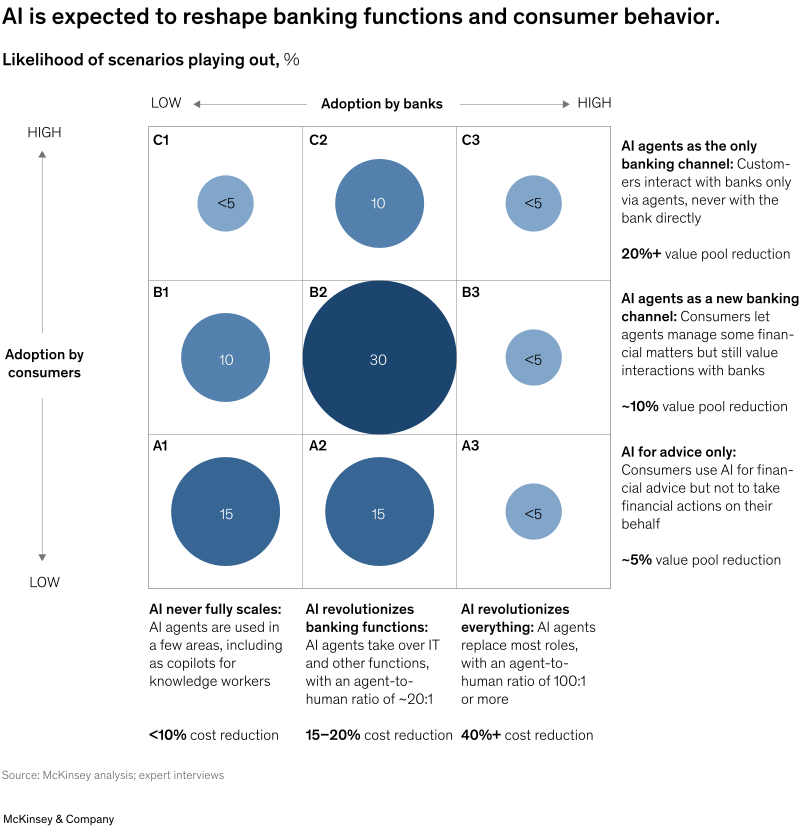
December 17, 2025 – As banks grapple with falling revenues, some are exploring opportunities to use AI for productivity gains. AI’s potential effect on banking will depend on factors such as banks’ ability to become fully agentic and the extent to which banking customers adopt AI to manage their finances. In the most likely scenario, according to McKinsey’s Darius Imregun, Ido Segev, Jon Steitz, Klaus Dallerup, Marti Riba, Miklós Dietz, Pradip Patiath, Saptarshi Ganguly, and coauthors, consumers will use AI agents as a new banking channel for some financial matters but will continue to value interactions with banks. This moderate adoption could enable banks to reshape functions and achieve cost reductions of 15 to 20 percent.
To read the report, see “Global Banking Annual Review 2025: Why precision, not heft, defines the future of banking,” October 23, 2025.
customizer here
Visual form
Scatter Plot and Table (with Visual Encoding): three-by-three bubble scenario grid for bank adoption and consumer adoption of AI agents.
Layout / body structure
The chart uses bank adoption as the horizontal axis and consumer adoption as the vertical axis, each moving from low to high. Nine labeled scenario cells fill the grid, with cost-reduction notes below the columns and value-pool notes beside the rows.
What is being compared
It compares possible combinations of AI-agent adoption by banks and AI-agent adoption by consumers, then ties each scenario to likelihood, bank cost reduction, and banking value-pool reduction.
Measurement system
Scenario likelihood is measured in percent and encoded by bubble size and label. The outside notes show cost-reduction ranges by bank-adoption level and value-pool-reduction ranges by consumer-adoption level.
Visible structure inside the graphic
Each cell contains a scenario code from A1 through C3 and a bubble. The B2 cell is the largest and darkest bubble, while most edge and corner scenarios are smaller, showing that the extreme combinations are less likely.
Main takeaway from the visual
The chart shows the most likely banking outcome as moderate adoption on both sides: AI agents reshape bank functions and become a consumer channel, but they do not fully replace customer relationships with banks.
Key standout values or extremes
B2 is the largest scenario at 30 percent likelihood. A1 and A2 are next at 15 percent each, B1 and C2 are 10 percent each, and several more extreme scenarios are below 5 percent. The highest bank-adoption column is tied to 40 percent-plus cost reduction, while the highest consumer-adoption row is tied to 20 percent-plus value-pool reduction.
Controls / sequence, when applicable
This is a static bubble scenario grid; there are no in-chart controls to operate.
Companion media, when applicable
There is no separate companion audio or video; the banking AI-agent scenario grid is the full visual on this page.