Source page: McKinsey & Company
Commentary
Canada’s needed health shift for women
Healthcare | Public Health
December 16, 2025 – Women’s health and productivity are tightly linked, but Canadian women spend 24 percent more time than men in poor health. More than half of the top ten conditions in the country affect women disproportionately and differently compared with men. For example, heart attack symptoms manifest differently, and 78 percent of early warning signs in women are missed. Canada needs a clear, national or provincial strategy to narrow this women’s health gap, say McKinsey’s Laurie Lanoue, Liza Vityuk, Lucy Pérez, Marie-Renée B-Lajoie, and Sandrine Devillard. Targeting specific diseases can improve health, reduce early deaths, and strengthen families and communities—in turn potentially boosting the country’s economy by $37 billion annually by 2040—a high-impact investment for the nation.
To read the article, see “Closing the women’s health gap: Canada’s $37 billion opportunity,” October 22, 2025.
customizer here
Visual form
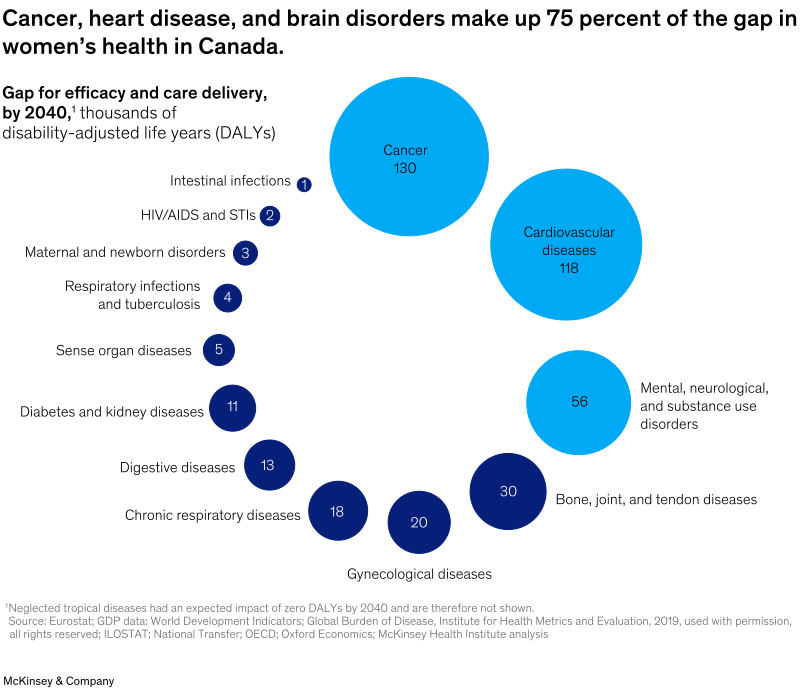
Single KPI / Metric: proportional bubble ranking of Canada’s projected women’s health gap by condition category.
Layout / body structure
The chart arranges condition bubbles in a loose ranked cluster, with the largest categories placed most prominently and smaller categories stepping around the edges.
What is being compared
It compares the projected 2040 gap in efficacy and care delivery across women’s health condition categories in Canada.
Measurement system
The values are thousands of disability-adjusted life years. Bubble area and direct labels show the size of each condition category’s contribution to the gap.
Visible structure inside the graphic
Cancer and cardiovascular diseases appear as the largest circles, followed by mental, neurological, and substance use disorders. Smaller circles for bone, joint, tendon, gynecological, respiratory, infectious, and maternal conditions show the long tail of lower-burden categories.
Main takeaway from the visual
The chart shows Canada’s women’s health gap as highly concentrated. Cancer, cardiovascular disease, and brain-related disorders make up about three-quarters of the measured gap.
Key standout values or extremes
Cancer is the largest category at 130 thousand disability-adjusted life years, followed by cardiovascular diseases at 118 and mental, neurological, and substance use disorders at 56. The next largest categories fall to 30 for bone, joint, and tendon diseases, 20 for gynecological diseases, and 18 for chronic respiratory diseases.
Controls / sequence, when applicable
This is a static proportional bubble ranking; there are no in-chart controls to operate.
Companion media, when applicable
There is no separate companion audio or video; the Canadian women’s health gap bubble ranking is the full visual on this page.