Source page: McKinsey & Company
Commentary
Amped up battery demand
Automotive | Manufacturing
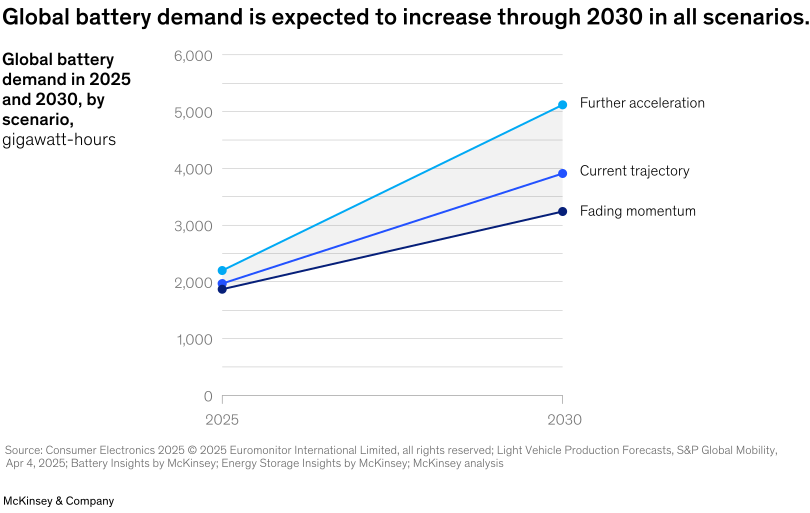
October 21, 2025 – Although electric-vehicle sales have eased from their peak, battery technology continues to advance rapidly. While global trends point to market oversaturation, McKinsey analysis by Senior Partner Martin Linder and colleagues identifies distinct regional opportunities. Their review of the global market examined three demand scenarios—fading momentum, steady growth (base case), and acceleration. In the base case, global demand is projected to climb from roughly 1,970 gigawatt-hours (GWh) in 2025 to about 3,910 GWh by 2030. To seize regional opportunities, companies must anticipate demand shifts, develop a clear view of evolving regional supply–demand dynamics, and quickly secure reliable and cost-effective supply.
To read the article, see “The hidden trends in battery supply and demand: A regional analysis,” August 26, 2025.
customizer here
Visual form
Three-scenario line chart comparing battery-demand paths between 2025 and 2030.
Layout / body structure
The chart is a single chart with three rising lines running from the left 2025 point to the right 2030 point. The scenario labels sit at the line ends on the right, so the reading order is left to right from the shared starting year into the three scenario outcomes.
What is being compared
It compares projected global battery demand under three scenarios: fading momentum, current trajectory, and further acceleration.
Measurement system
The vertical axis is gigawatt-hours and the horizontal axis uses the two end years 2025 and 2030. Color differentiates the scenarios, and the line endpoints show how far demand could rise under each path.
Visible structure inside the graphic
All three series start from a tight cluster around 2025 and then fan upward to different 2030 endpoints. The lightest blue line is the steepest and ends highest, the medium blue line ends in the middle, and the darkest line ends lowest.
Main takeaway from the visual
Every scenario points upward, so the chart’s core message is that battery demand rises strongly regardless of the path, with the scale of the increase depending on how much momentum the market keeps.
Key standout values or extremes
The 2025 starting points cluster around roughly 1,900 to 2,200 gigawatt-hours. By 2030, the fading-momentum case reaches about 3,300, the current-trajectory case about 3,950, and the further-acceleration case a little above 5,100 gigawatt-hours.
Controls / sequence, when applicable
This is a static chart image with no in-chart controls to operate.
Companion media, when applicable
There is no separate companion audio or video; the chart image is the full visual on this page.