Source page: McKinsey & Company
Commentary
Robotics grasps new possibilities
Artificial Intelligence | Advanced industries
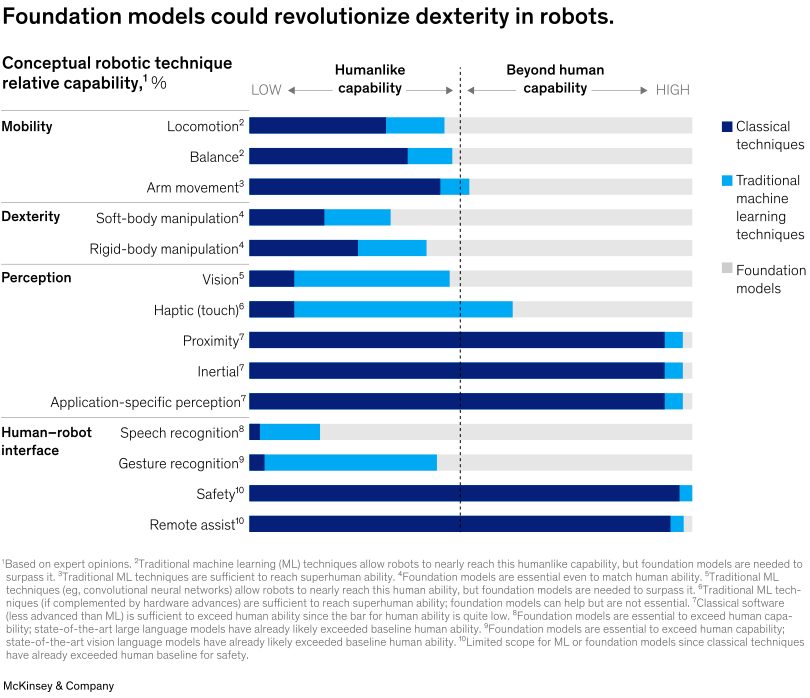
September 17, 2025 – The robotics field is pivoting toward general-purpose robots. Foundation models, which identify patterns that allow robots to perform multiple tasks, could improve their dexterity, according to Partner Ani Kelkar and coauthors. Classical techniques have been sufficient for safety and remote assistance, while traditional machine learning techniques can nearly achieve human-like capabilities in mobility, such as arm movement and balance. And now, researchers are developing multimodal foundation models that would allow robots to perform actions based on visual inputs and spoken commands.
To read the article, see “A leap in automation: The new technology behind general-purpose robots,” July 28, 2025.
customizer here
Visual form
Horizontal segmented bar chart.
Layout / body structure
The chart is a single matrix-like panel read top to bottom by capability row. Category labels on the left group the rows into mobility, dexterity, perception, and human-robot interface, and each row stretches horizontally from low to high capability.
What is being compared
It compares different robotic techniques across specific capability types such as locomotion, balance, arm movement, soft-body manipulation, rigid-body manipulation, vision, haptic touch, proximity, inertia, application-specific perception, speech recognition, gesture recognition, safety, and remote assist. Within each row, it compares how far classical techniques, traditional machine learning, and foundation models can take that capability.
Measurement system
The chart uses relative capability in percent, arranged along a horizontal low-to-high scale. A dashed vertical line marks the threshold between humanlike capability and beyond-human capability, and the legend identifies dark navy as classical techniques, bright blue as traditional machine learning, and light gray as foundation models.
Visible structure inside the graphic
Each row is built from stacked horizontal segments that extend different distances across the scale. In mobility rows, the dark and bright blue portions cover much of the bar before the gray extension continues farther right. In perception and human-robot-interface rows, some classical techniques already run nearly to the far-right edge, while foundation-model extensions appear most important for dexterity tasks such as soft-body and rigid-body manipulation. The dotted divider and the humanlike and beyond-human labels organize the whole panel.
Main takeaway from the visual
The chart argues that foundation models matter most where robotics still struggles with dexterity and more advanced interaction tasks, while older methods already perform strongly in areas like safety, remote assist, and several perception functions.
Key standout values or extremes
Safety and remote assist reach almost the full width of the scale already, and proximity, inertia, and application-specific perception also sit very near the top end. The biggest visible room for foundation-model improvement appears in dexterity rows, where soft-body and rigid-body manipulation start much lower and gain noticeably from the gray extension.
Controls / sequence, when applicable
This is a static chart image with no in-chart controls to operate.
Companion media, when applicable
There is no separate companion audio or video; the chart image is the full visual on this page.