Source page: McKinsey & Company
Commentary
R&D recharged by AI
Artificial Intelligence | Innovation | R&D
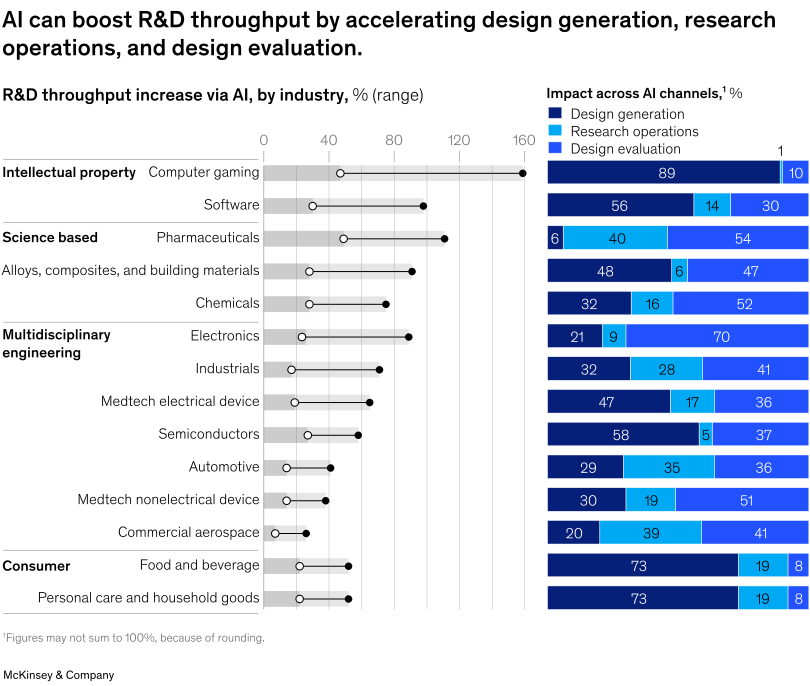
August 12, 2025 – In many sectors, R&D investment has been yielding less innovation over time. AI, though, has the power to substantially accelerate R&D across a set of industries that account for 80 percent of large corporate R&D spending, say Senior Partner Lareina Yee and coauthors. For example, in computer gaming, where intellectual property is paramount, AI could boost output by 150 percent. In industries closely aligned with scientific discovery, such as chemicals and pharmaceuticals, AI could enhance R&D throughput by up to 75 and more than 100 percent, respectively. In electronics, which demands multidisciplinary engineering, AI could nearly double the pace of product design, while commercial aerospace could see a 25 percent increase.
To read the article, see “The next innovation revolution—powered by AI,” June 20, 2025.
customizer here
Visual form
Bar Chart and Stacked Bar / Stacked Column: two-panel R&D throughput uplift and AI-contribution comparison by industry.
Layout / body structure
The left panel lists industries by sector family and shows an estimated throughput-uplift range for each. The right panel aligns to the same industry rows and breaks the AI contribution into three stacked components.
What is being compared
It compares potential R&D throughput gains across industries and then compares how much of each gain comes from design generation, research operations, and design evaluation.
Measurement system
The left panel uses percent uplift ranges with endpoint markers. The right panel uses percentage shares that add to roughly 100 percent across the three contribution categories.
Visible structure inside the graphic
Horizontal range bars on the left show the possible throughput increase for each industry. Stacked horizontal bars on the right use three colors to show whether the gain is driven more by generation, operations, or evaluation.
Main takeaway from the visual
The chart shows that AI can raise R&D throughput across many industries, but both the size of the uplift and the source of the uplift vary sharply by sector.
Key standout values or extremes
Computer gaming has the widest upside, extending to about 160 percent, with design generation accounting for 89 percent of the contribution. Pharmaceuticals reaches more than 100 percent uplift, and design evaluation is especially large in electronics at 70 percent and pharmaceuticals at 54 percent.
Controls / sequence, when applicable
This is a fixed two-panel bar chart; there are no in-chart controls to operate.
Companion media, when applicable
There is no separate companion audio or video; the R&D throughput and contribution chart is the visual on this page.