Source page: McKinsey & Company
Commentary
Following educational footsteps
Education | Europe
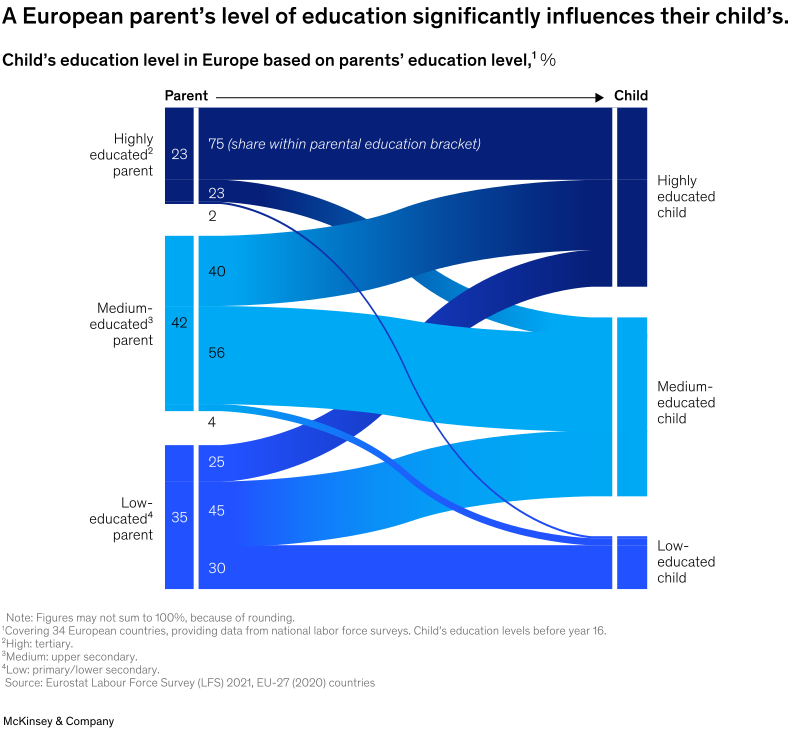
April 29, 2025 – In Europe, a parent’s education level strongly predicts their child’s educational attainment. Children of highly educated parents are three times as likely as their peers with less-educated parents to achieve high levels of education themselves, note Senior Partner Tania Holt and coauthors. Children whose parents attended only primary or lower-secondary (middle) schools are 15 times more likely to drop out of school by age 16, decreasing the likelihood they can land high-income careers.
To read the report, see “Breaking the standstill: How social mobility can boost Europe’s economy,” March 27, 2025.
customizer here
Visual form
Sankey-style flow diagram. The chart maps how a parent’s education bracket is connected to the child’s eventual education level in Europe.
Layout / body structure
The layout is a left-to-right flow graphic with parent categories stacked on the left and child categories stacked on the right. Reader starts at the parental education blocks, follows the width of the connecting bands across the center, and then lands on the child outcome blocks.
What is being compared
The visual compares three parental education groups – highly educated, medium educated, and low educated – with three corresponding child outcomes. It is comparing how strongly children remain in the same education bracket versus moving up or down relative to their parents.
Measurement system
The flows are percentages, and the labels inside the bands show the share moving from one parent bracket to one child bracket. The left and right columns also carry bracket totals, so the width of each flow and the printed values work together.
Visible structure inside the graphic
The diagram has three source blocks on the left, three destination blocks on the right, and curved blue bands of different widths connecting them. The darkest top-to-top band is the widest flow, medium-blue bands dominate the center, and thinner lower flows show the smaller movement into the low-educated child category from higher parental brackets.
Main takeaway from the visual
The visible takeaway is that educational attainment is strongly inherited rather than evenly redistributed. The thickest flows stay within the same bracket, and the top bracket in particular sends a dominant share straight into the highly educated child outcome.
Key standout values or extremes
Children of highly educated parents have a 75 percent flow into the highly educated child category, while children of low-educated parents have a 30 percent flow into the low-educated child category and a 45 percent flow into the medium-educated category. The small flows from highly educated parents into the low-educated outcome and from low-educated parents into the highly educated outcome are visibly thin by comparison.
Controls / sequence, when applicable
This is a static chart image with no in-chart controls to operate.
Companion media, when applicable
There is no separate companion audio or video; the chart image is the full visual on this page.