Source page: McKinsey & Company
Commentary
Degree divide
Economic Development | Diversity & Inclusion | Small business
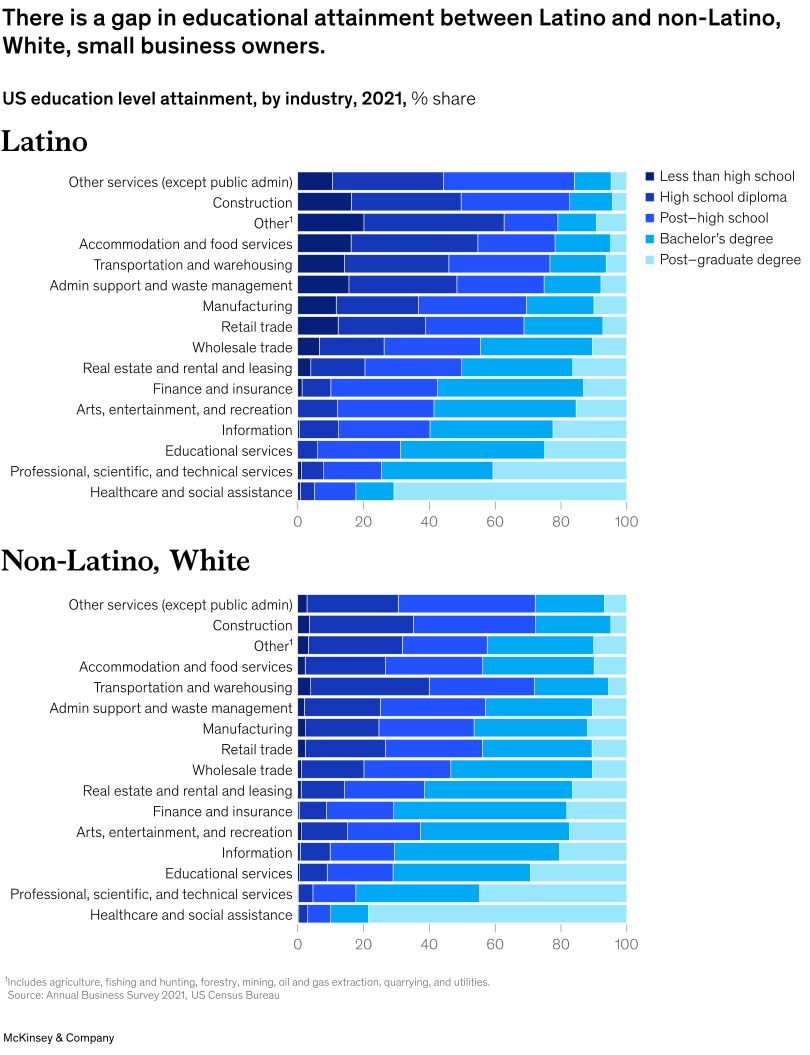
February 26, 2025 – Educational attainment among Latinos in the United States has increased in recent years, yet it hasn’t matched that of non-Latino White people. Among small-business leaders, 40 percent of those who are Latino hold a bachelor’s degree, compared with 55 percent of those who are non-Latino White, according to Senior Partner Alberto Chaia and colleagues. In industries with a higher concentration of Latino small-business owners, however, the educational attainment gap is less pronounced.
To read the report, see “The economic state of Latinos in America: Building up small businesses,” December 16, 2024.
customizer here
Visual form
Two-panel stacked horizontal bar chart.
Layout / body structure
The chart is arranged in two large sections, with Latino small business owners on top and Non-Latino, White small business owners below. Within each section, industries are listed vertically and each row is a 100 percent horizontal stack, so the reader can compare both within an industry row and between the two population panels.
What is being compared
It compares educational attainment by industry for two owner populations. Each industry row shows the distribution across less than high school, high school diploma, post-high school, bachelor’s degree, and post-graduate degree.
Measurement system
The bars are measured as percentage share and each row totals to 100 percent. Color segments encode the attainment bands, and the same five-category legend applies to both the Latino and Non-Latino, White panels.
Visible structure inside the graphic
The graphic is organized as two vertically separated blocks of horizontal stacked bars, one for each population group. Within each block, industry rows repeat the same five-color educational stack, making gaps in degree attainment visible as changes in the size of the darker lower-attainment segments versus the lighter degree segments.
Main takeaway from the visual
The visual shows a persistent educational-attainment gap between Latino and Non-Latino, White small business owners across many industries. In the Latino panel, the lower-attainment segments take up more of the bar in many rows, while the bachelor’s and post-graduate segments tend to be larger in the Non-Latino, White panel.
Key standout values or extremes
Healthcare and social assistance shows one of the strongest degree-heavy mixes in both panels, but the Non-Latino, White row still carries a visibly larger post-graduate share. Construction and several service-oriented industries show much heavier lower-attainment segments overall, with the Latino rows typically pushing farther toward the less-than-high-school and high-school categories than their counterparts below.
Controls / sequence, when applicable
This is a static chart image with no in-chart controls to operate.
Companion media, when applicable
There is no separate companion audio or video; the chart image is the full visual on this page.