Source page: McKinsey & Company
Commentary
A massive global workforce
Public Sector | Organization | Management
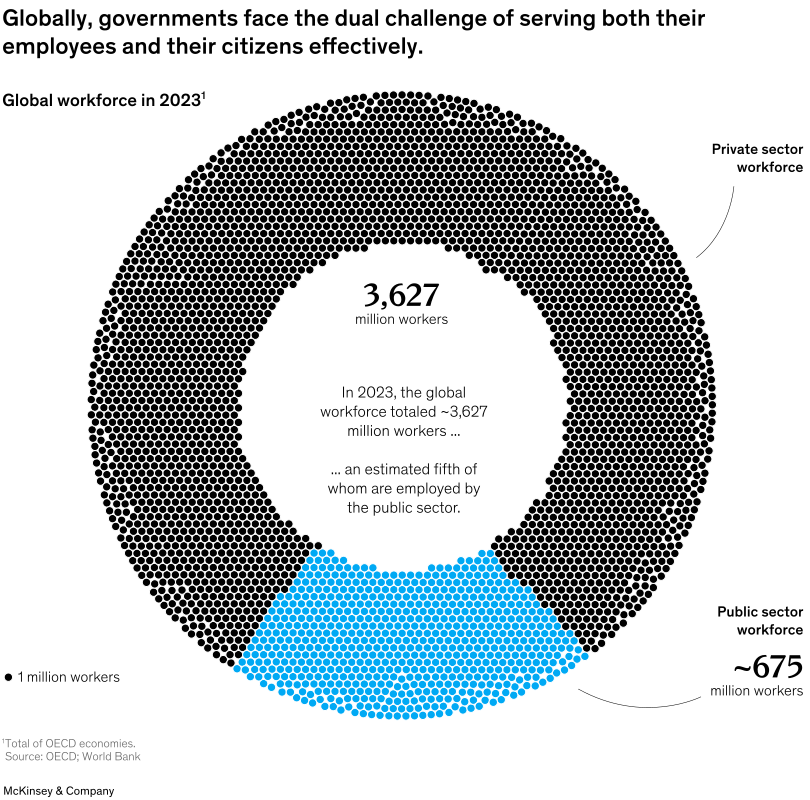
January 30, 2025 – In 2023, the global workforce consisted of 3.627 billion workers. Approximately one-fifth of these people, or 675 million, were employed in the public sector, note senior partner Arne Gast and coauthors. Governments must serve their constituents and take care of their employees, including their professional development and job security. This dual mission can be challenging, given constraints such as public scrutiny, competing priorities and stakeholders, politics, budget, and citizen dissatisfaction with government.
To read the article, see “Improving organizational health in the public sector: Achieving tangible impact,” November 12, 2024.
customizer here
Visual form
Large segmented pictorial donut chart.
Layout / body structure
The chart is a single circular workforce composition graphic. Read the central total first, then compare the large black outer section for the private-sector workforce against the blue lower segment that represents the public-sector workforce.
What is being compared
It compares the size of the total global workforce with the public-sector workforce embedded inside it, leaving the remainder as the private-sector workforce. The chart is designed to show the scale of public employment as a share of the overall labor base.
Measurement system
The chart is measured in millions of workers. The center gives the total at about 3,627 million workers, and the highlighted blue segment is labeled at about 675 million workers in the public sector.
Visible structure inside the graphic
The visual is made from hundreds of small dot units arranged into a thick donut ring, with one color for the much larger private-sector share and another for the public-sector share. Large text labels in the center and at the right anchor the totals while the segmented ring shows the proportion visually.
Main takeaway from the visual
The graphic shows that governments employ an enormous workforce but still represent only about a fifth of the overall global workforce. The blue public-sector wedge is substantial, yet it occupies a much smaller portion of the ring than the dominant black private-sector section around it.
Key standout values or extremes
The total workforce is labeled at roughly 3,627 million workers, while the public-sector workforce is labeled at about 675 million workers. That leaves the overwhelming majority of the ring in the private sector, making the public workforce large in absolute terms but much smaller in relative share.
Controls / sequence, when applicable
This is a static chart image with no in-chart controls to operate.
Companion media, when applicable
There is no separate companion audio or video; the chart image is the full visual on this page.