Source page: McKinsey & Company
Commentary
Phishing with AI is cybersecurity’s new hook
Artificial Intelligence | Generative AI | Cybersecurity
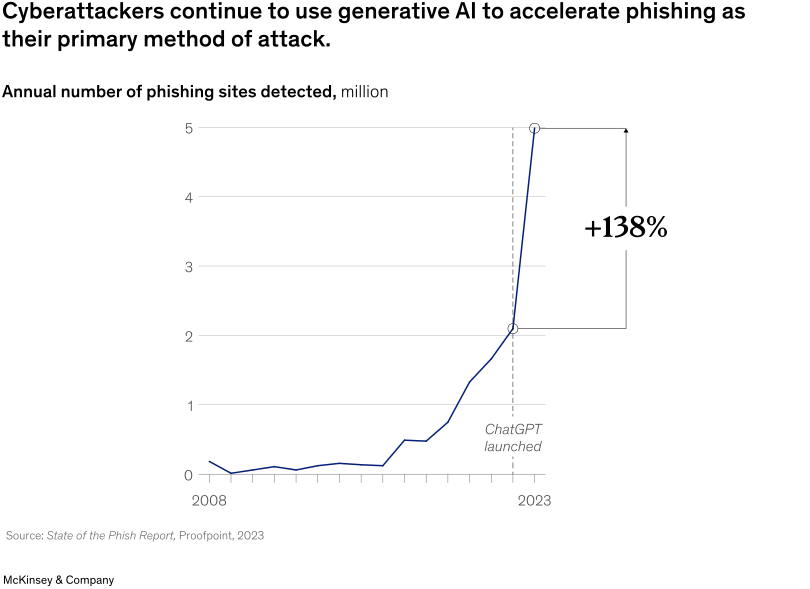
January 29, 2025 – Cybersecurity has always been a field with shifting threats. And with the recent rise of AI and generative AI, companies are now dealing with new challenges while existing ones have been intensified, note partner Marc Sorel and colleagues. For example, generative AI is enabling attackers to create more realistic phishing emails and deepfakes to deceive employees into divulging sensitive information. Since ChatGPT launched, the number of detected phishing sites surged 138 percent.
To read the article, see “The cybersecurity provider’s next opportunity: Making AI safer,” November 14, 2024.
customizer here
Visual form
Single line chart with a major annotation callout.
Layout / body structure
The chart is a one-panel time-series chart running from 2008 to 2023. Read it left to right along the annual timeline, then use the dashed vertical marker for the ChatGPT launch and the large right-side callout to interpret the acceleration at the end of the series.
What is being compared
It compares the annual number of phishing sites detected over time. The chart is built to show how that count changes before and after the recent generative-AI turning point rather than comparing multiple categories or regions.
Measurement system
The vertical axis is measured in millions of phishing sites detected annually. The horizontal axis is year, and the line is paired with a percentage-growth callout rather than a second series or stacked breakdown.
Visible structure inside the graphic
The chart is a single rising line with point markers at the late-stage values, plus a dashed vertical line at the ChatGPT launch. A bold bracketed annotation on the right highlights the jump between roughly 2.1 million and 5 million sites.
Main takeaway from the visual
The visual shows that phishing activity was already rising but then accelerated sharply as generative AI tools became part of the attack landscape. The steep climb at the far right is much sharper than most earlier changes in the series and is explicitly tied to the postlaunch period.
Key standout values or extremes
The series climbs to about 2.1 million phishing sites and then jumps to roughly 5 million at the latest point shown, which the chart labels as a 138 percent increase. Earlier years remain far lower, often near or below half a million, making the final surge the clear outlier on the page.
Controls / sequence, when applicable
This is a static chart image with no in-chart controls to operate.
Companion media, when applicable
There is no separate companion audio or video; the chart image is the full visual on this page.