Source page: McKinsey & Company
Commentary
Rising risks in insurance
Financial services | Risk
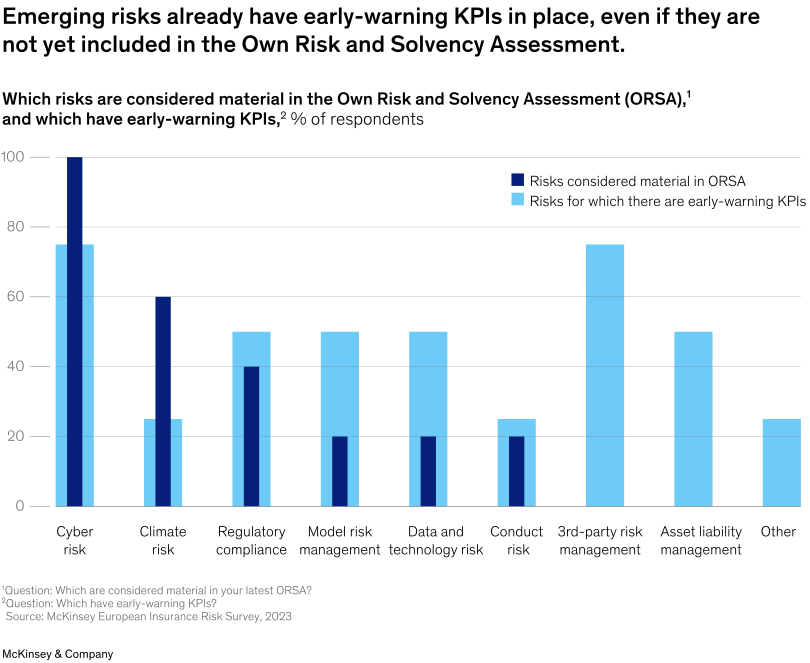
January 23, 2025 – The insurance sector is facing a rapidly evolving risk landscape, evidenced by the fact that most insurance chief risk officers (CROs) use early-warning KPIs for more risks than those considered material under their Own Risk and Solvency Assessment, per a McKinsey European Insurance Risk Survey. For example, while only 20 percent of survey respondents deem data and technology risks material, 50 percent have early-warning KPIs in place. Climate risk is an exception: 60 percent cite its materiality, but 25 percent have early-warning KPIs. Senior partner Luca Pancaldi and coauthors recommend that European insurers reorganize their risk functions and elevate the leadership status of CROs to better manage risks.
To read the article, see “Elevating the risk function in insurance: Building a strategic advantage,” November 12, 2024.
customizer here
Visual form
Grouped vertical bar chart.
Layout / body structure
The chart is a single comparison chart with risk types arranged along the horizontal axis and two bars for each category. Read left to right by risk type, comparing the dark bar for risks considered material in ORSA against the lighter bar for risks with early-warning KPIs in place.
What is being compared
It compares which insurance risks are already considered material in the Own Risk and Solvency Assessment and which have early-warning KPIs. The paired bars show where institutions have monitoring in place even when formal materiality treatment in ORSA is not yet as high.
Measurement system
The vertical axis is measured in percent of respondents. Color distinguishes the two measures, and each risk category occupies one grouped position on the horizontal axis.
Visible structure inside the graphic
The graphic is organized as pairs of bars for cyber risk, climate risk, regulatory compliance, model risk management, data and technology risk, conduct risk, third-party risk management, asset liability management, and other. Several categories have one bar with no corresponding second bar or a visibly larger light-blue bar, which makes the monitoring-versus-formality gap easy to spot.
Main takeaway from the visual
The visual shows that early-warning KPI coverage already extends to several emerging risks even when those risks are not yet treated as material in ORSA to the same degree. The light-blue bars for model risk management, data and technology risk, third-party risk management, and asset liability management stand noticeably above the dark ORSA-materiality bars.
Key standout values or extremes
Cyber risk is the highest formal ORSA category at 100 percent and still shows a large early-warning KPI share near 75 percent. Third-party risk management is the clearest monitoring-heavy outlier, with about 75 percent showing early-warning KPIs and effectively no corresponding dark ORSA bar, while climate risk shows the reverse pattern with about 60 percent material in ORSA but only about 25 percent with early-warning KPIs.
Controls / sequence, when applicable
This is a static chart image with no in-chart controls to operate.
Companion media, when applicable
There is no separate companion audio or video; the chart image is the full visual on this page.