Source page: McKinsey & Company
Commentary
Global trade shifts
Geopolitics | Global Trade | Supply Chain Management
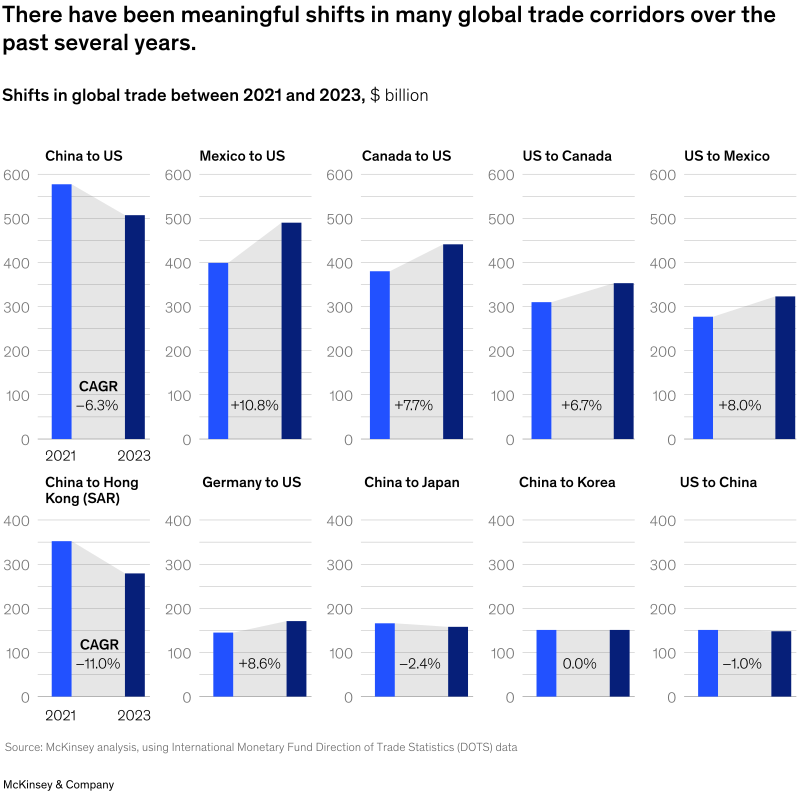
January 8, 2025 – Against today’s geopolitical backdrop, global trade flows are shifting. In just the past three years, adjustments in trade corridors have reshaped industries, note senior partner Cindy Levy and colleagues. In particular, trade routes to the United States from China and from Mexico experienced notable changes from 2021 to 2023. Business leaders will need to assess what growth looks like for them—and may find opportunities from new tariffs or trade agreements to attract more market share—as geopolitical conditions continue to change.
To read the article, see “A proactive approach to navigating geopolitics is essential to thrive,” November 12, 2024.
customizer here
Visual form
Bar Chart: small-multiple paired-bar comparison of major trade corridors in 2021 and 2023.
Layout / body structure
Ten mini-panels each show one trade corridor. Within each panel, a 2021 bar is paired with a 2023 bar, with a change label placed between them.
What is being compared
It compares trade value changes across corridors such as China to US, Mexico to US, Canada to US, US to Canada, US to Mexico, China to Hong Kong, Germany to US, China to Japan, China to Korea, and US to China.
Measurement system
The bars are measured in billions of dollars. CAGR or percentage-change labels summarize the 2021-to-2023 movement for each corridor.
Visible structure inside the graphic
Each corridor repeats the same two-bar structure, so growth and decline are visible panel by panel. North American corridors generally rise, while several China-linked corridors fall.
Main takeaway from the visual
The chart shows trade corridors shifting noticeably in just two years, with North American flows gaining while several China-linked flows contract.
Key standout values or extremes
China to US falls from about $580 billion to about $505 billion, with a labeled CAGR of -6.3 percent, and China to Hong Kong falls at -11.0 percent. Mexico to US rises from about $400 billion to nearly $490 billion, with a labeled CAGR of +10.8 percent.
Controls / sequence, when applicable
This is a fixed small-multiple bar chart; there are no in-chart controls to operate.
Companion media, when applicable
There is no separate companion audio or video; the trade-corridor paired-bar chart is the visual on this page.