Source page: McKinsey & Company
Commentary
Sustainable farming takes root
Agriculture | Sustainability | Technology
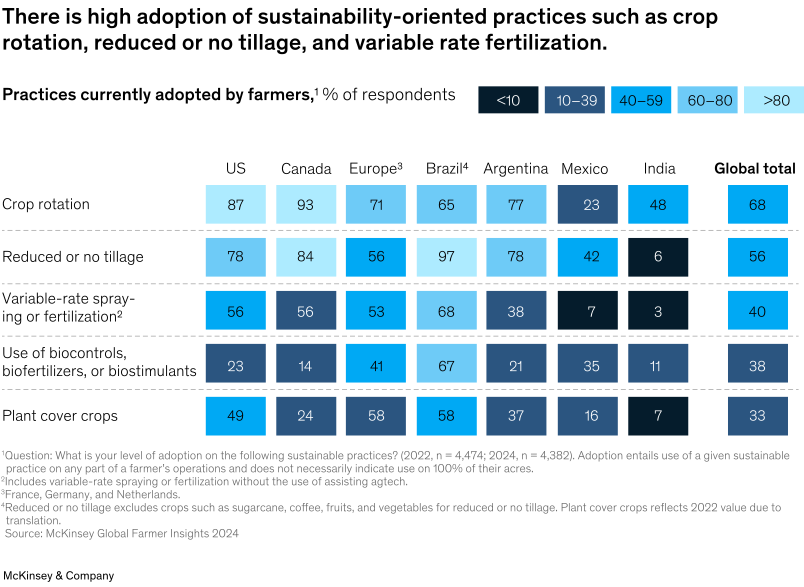
December 11, 2024 – Farmers have adopted several sustainability-oriented practices, particularly crop rotation and reduced or no tillage. Senior partner David Fiocco and coauthors find that, globally, 68 percent and 56 percent of farmers, respectively, use these practices. Economic considerations tend to be the motivator: the top driver for adoption of sustainable practices in India, Latin America, and North America is increased yield; in Europe, it is additional revenue streams.
To read the article, see “Global Farmer Insights 2024,” October 16, 2024.
customizer here
Visual form
Heatmap table.
Layout / body structure
The visual is a grid with farming practices in rows and countries plus the global total in columns. Read across a row to compare how widely a specific practice has been adopted by country, then read down a column to see each market’s adoption profile across the five practices.
What is being compared
It compares adoption rates for sustainability-oriented farming practices across the United States, Canada, Europe, Brazil, Argentina, Mexico, India, and the global total. The practices include crop rotation, reduced or no tillage, variable-rate spraying or fertilization, use of biocontrols or biofertilizers or biostimulants, and plant cover crops.
Measurement system
Each cell is measured as a percentage of respondents and colored by value band. The legend groups the values into less than 10, 10 to 39, 40 to 59, 60 to 80, and greater than 80 percent adoption ranges.
Visible structure inside the graphic
The chart is a rectangular heatmap with numeric values printed inside each colored cell. The grid structure makes it easy to spot bright high-adoption cells such as Brazil and North America in some practices and much darker low-adoption cells such as India or Mexico in others.
Main takeaway from the visual
The visual shows that some sustainability practices are already widely used, especially crop rotation and reduced or no tillage, but adoption remains uneven across countries and practice types. The brightest cells cluster around crop rotation and reduced tillage, while more specialized practices such as biocontrol use and plant cover crops remain patchier.
Key standout values or extremes
Canada reaches 93 percent for crop rotation, Brazil reaches 97 percent for reduced or no tillage, and the global totals are 68 percent for crop rotation and 56 percent for reduced or no tillage. Variable-rate spraying or fertilization falls to 3 percent in India and 7 percent in Mexico, while use of biocontrols rises to 67 percent in Brazil and plant cover crops reach 58 percent in both Europe and Brazil.
Controls / sequence, when applicable
This is a static chart image with no in-chart controls to operate.
Companion media, when applicable
There is no separate companion audio or video; the chart image is the full visual on this page.