Source page: McKinsey & Company
Commentary
Waning workforce participation
Economy | Talent
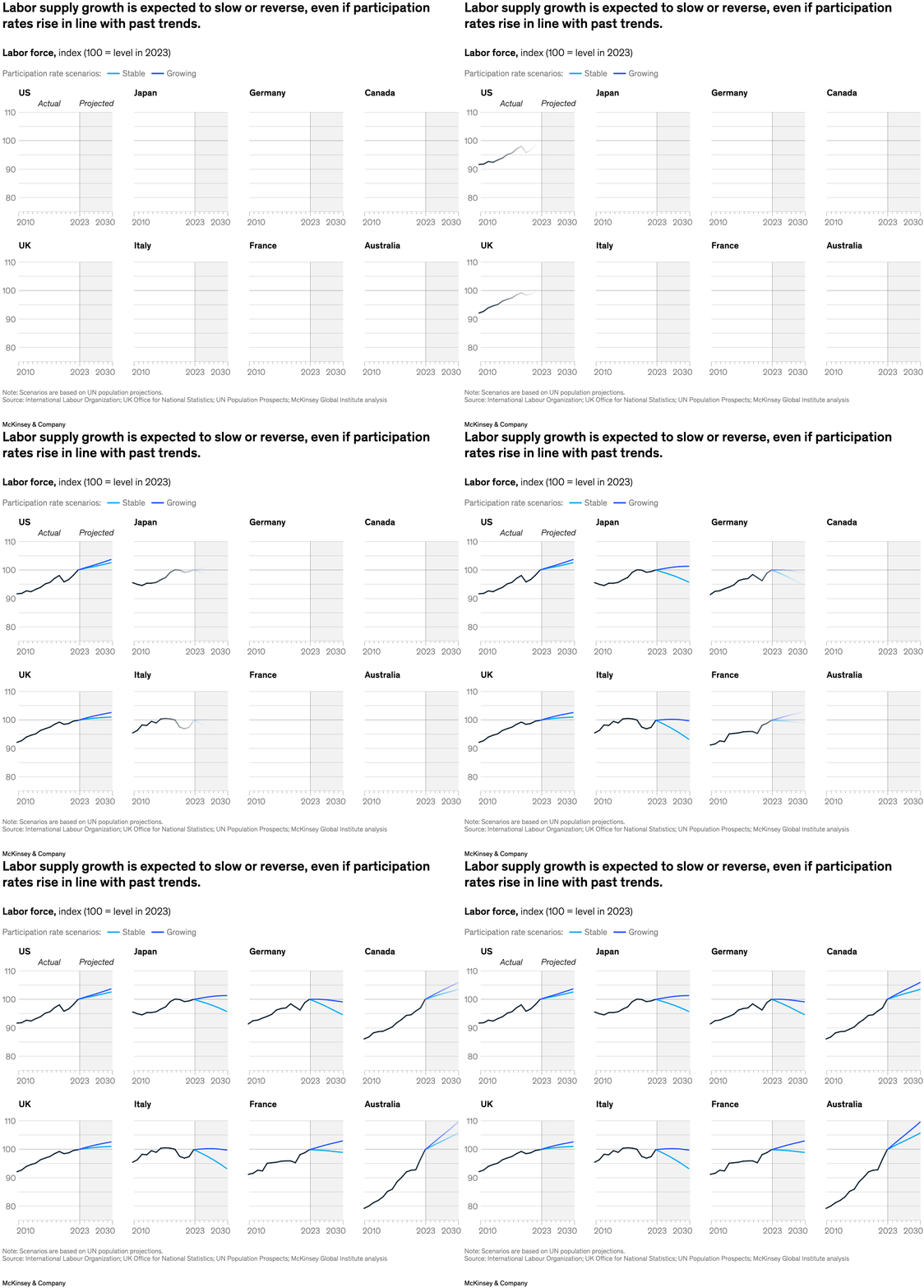
July 29, 2024 – Labor force participation rates in advanced economies is expected to slow or even reverse in the coming years. McKinsey Global Institute partner Anu Madgavkar and colleagues find that even if participation rates rise in line with past trends, the shrinking working-age population in many advanced economies is pushing down the potential for labor force growth through 2030. Some countries, such as Australia and Canada, are projected to continue to see increases in labor supply, but these increases will be smaller than in the past.
To read the article, see “Help wanted: Charting the challenge of tight labor markets in advanced economies,” June 26, 2024.
customizer here
Visual form
Small-multiple forecast line charts.
Layout / body structure
The page uses eight country panels arranged in a grid, and each panel is split visually into an actual period on the left and a projected period on the right with two scenario lines extending from the same 2023 starting point.
What is being compared
It compares labor-force levels for the US, Japan, Germany, Canada, the UK, Italy, France, and Australia under two participation-rate scenarios – stable and growing – after 2023.
Measurement system
Each panel uses an index where 100 equals the 2023 level, so all countries are normalized to the same baseline and the reader can compare direction and scale of change rather than raw labor-force counts.
Visible structure inside the graphic
A black historical line runs through the actual period, a gray forecast zone begins at 2023, and then a light blue line for the stable scenario and a darker blue line for the growing scenario diverge to show whether labor force levels fall, flatten, or continue rising.
Main takeaway from the visual
Even with stronger participation, labor supply growth looks weak across much of the set, and under the stable-scenario path several countries visibly flatten or decline after 2023 rather than sustaining the earlier rise.
Key standout values or extremes
Canada and Australia show some of the strongest upward projected paths under the growing-scenario line, while Japan, Germany, and Italy visibly sag under the stable-scenario line; the UK and France hover close to flat under the more conservative path rather than rising materially.
Controls / sequence, when applicable
This is a static chart image with no in-chart controls to operate.
Companion media, when applicable
There is no separate companion audio or video; the chart image is the full visual on this page.