Source page: McKinsey & Company
Commentary
The tides of tokenization
Financial services | Technology | Fintech
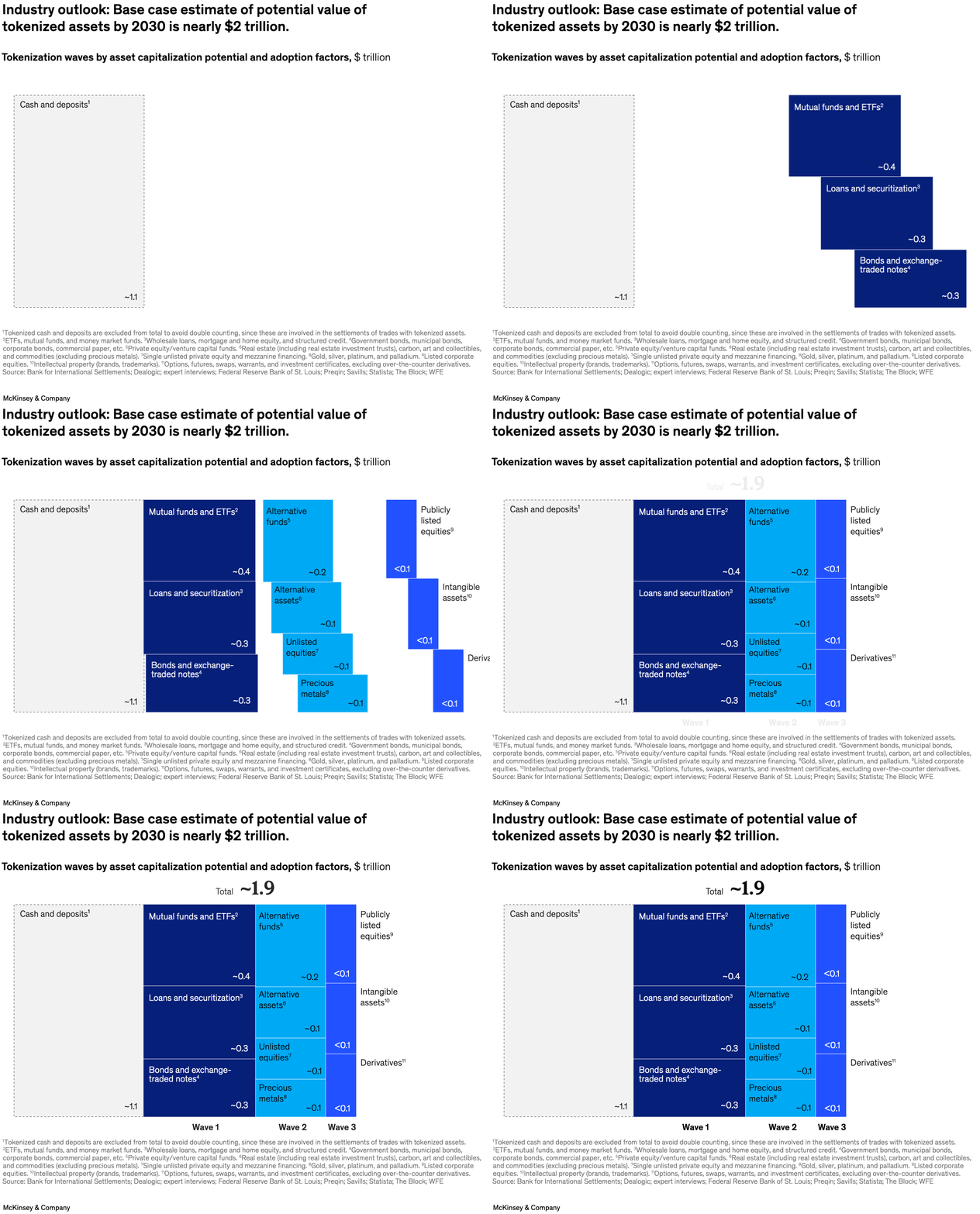
July 22, 2024 – Tokenization, the process of creating a unique digital representation of an asset on a blockchain network, offers many benefits for the financial system: it’s efficient, transparent, and secure. Partner Anutosh Banerjee and colleagues predict that tokenization will likely occur in waves, beginning with asset classes that are technically and regulatorily feasible and where efficiency and value gains are relatively large. These include cash and deposits, mutual funds and exchange-traded funds, loans and securitization, and bonds and exchange-traded notes.
To read the article, see “From ripples to waves: The transformational power of tokenizing assets,” June 20, 2024.
customizer here
Visual form
Treemap-style market-sizing chart.
Layout / body structure
The chart is built as one large rectangular market map divided into three vertical waves, with a dashed left-side block for excluded cash and deposits and progressively smaller Wave 2 and Wave 3 columns to the right of the much larger Wave 1 section.
What is being compared
It compares the potential value of tokenized asset classes by 2030 and groups them into three adoption waves.
Measurement system
Values are measured in trillions of dollars, with the total base-case estimate called out as about $1.9 trillion and each block labeled with an approximate asset-class value.
Visible structure inside the graphic
Wave 1 is made up of three large dark blocks for mutual funds and ETFs, loans and securitization, and bonds and exchange-traded notes; Wave 2 stacks medium blue blocks for alternative funds, alternative assets, unlisted equities, and precious metals; Wave 3 uses a thin bright blue strip for publicly listed equities, intangible assets, and derivatives, while cash and deposits sit outside the total in a dashed box.
Main takeaway from the visual
Most of the tokenization value is concentrated in the first wave rather than spread evenly across the market, with the largest, most finance-native categories occupying the bulk of the total and the later-wave categories remaining comparatively small.
Key standout values or extremes
The chart shows about $1.9 trillion in total potential value, with roughly $0.4 trillion in mutual funds and ETFs, about $0.3 trillion each in loans and securitization and in bonds and exchange-traded notes, about $0.2 trillion in alternative funds, and less than $0.1 trillion each for the Wave 3 categories.
Controls / sequence, when applicable
This is a static chart image with no in-chart controls to operate.
Companion media, when applicable
There is no separate companion audio or video; the chart image is the full visual on this page.