Source page: McKinsey & Company
Commentary
Travel takes off from new markets
Travel | India | Asia-Pacific
June 17, 2024 – Summer has arrived in the Northern hemisphere. All this week, our daily charts will focus on travel and tourism. We’ll explore shifting travel preferences, new business models, luxury travel, disruptions affecting the industry, and more.
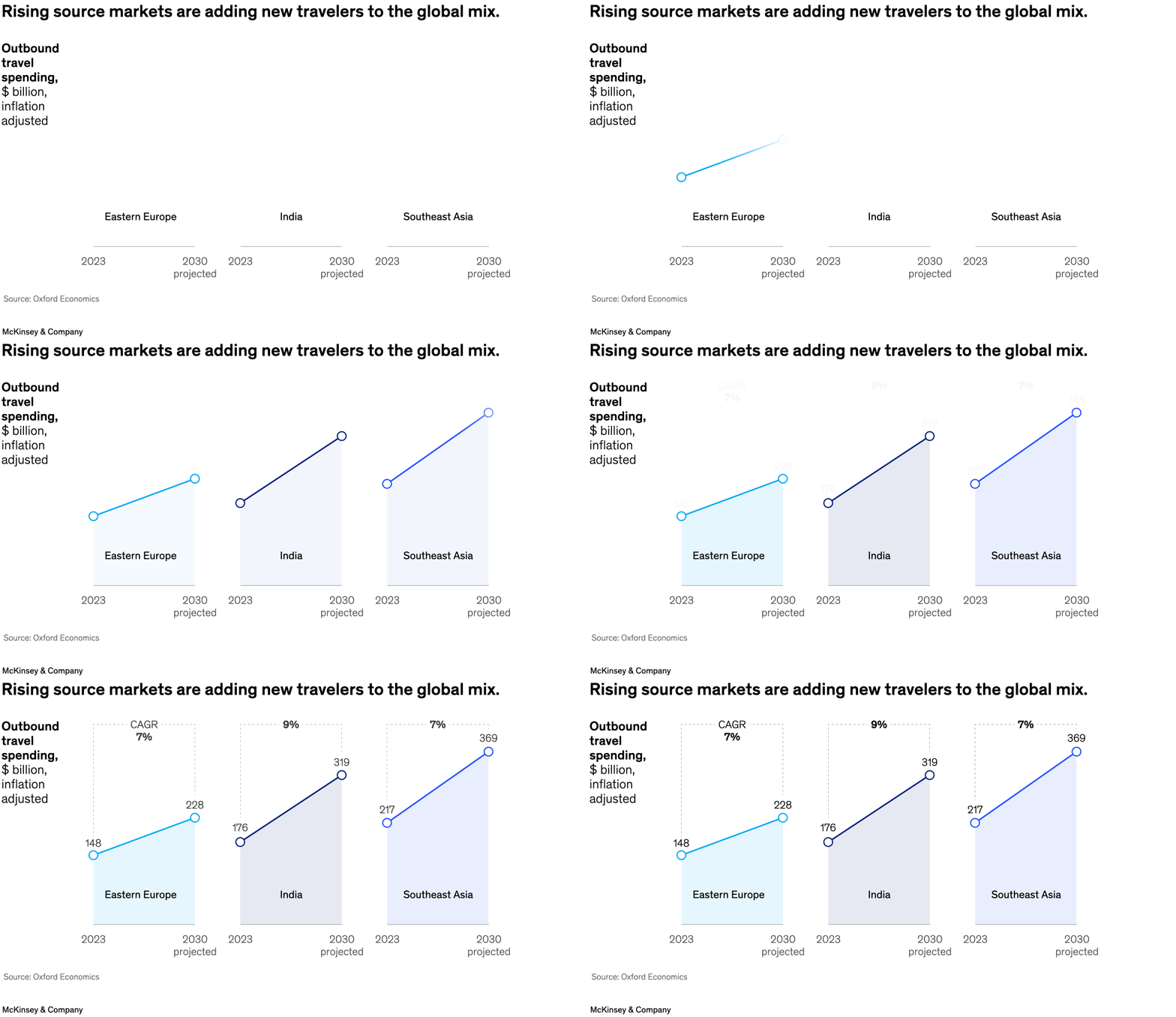
Eastern Europe, India, and Southeast Asia have fast-growing pools of first-time tourists, senior partner Caroline Tufft and coauthors find. These are comparatively small source markets, and their travelers spend less per person per night than Western European travelers, but travel spending from these regions is expected to grow by 7, 9, and 7 percent, respectively, between 2023 and 2030.
To read the article, see “Now boarding: Faces, places, and trends shaping tourism in 2024,” May 29, 2024.
customizer here
Visual form
Line chart.
Layout / body structure
The page uses a three-panel small-multiple layout, with one mini chart each for Eastern Europe, India, and Southeast Asia. Read the panels left to right and within each panel follow the line from 2023 to the 2030 projection.
What is being compared
It compares outbound travel spending growth across three rising source markets: Eastern Europe, India, and Southeast Asia.
Measurement system
The measure is inflation-adjusted outbound travel spending in billions of dollars. Each mini chart labels the 2023 starting point, the 2030 projected endpoint, and the CAGR printed above the panel.
Visible structure inside the graphic
Each region is shown as a simple two-point slope line with the starting and ending values marked by dots. A shaded column behind the line provides a panel frame, and the CAGR label above each panel summarizes the steepness of the rise.
Main takeaway from the visual
The chart shows all three markets growing strongly, with India rising the fastest, while Eastern Europe and Southeast Asia also add sizable outbound demand by 2030.
Key standout values or extremes
Eastern Europe rises from about $148 billion to $228 billion, India from about $176 billion to $319 billion, and Southeast Asia from about $217 billion to $369 billion, with India posting the highest CAGR at 9 percent.
Controls / sequence, when applicable
This is a static chart image with no in-chart controls to operate.
Companion media, when applicable
There is no separate companion audio or video; the chart image is the full visual on this page.