Source page: McKinsey & Company
Commentary
The hidden cost of women's health disparities
Healthcare | Life Sciences | Public Health
June 7, 2024 – The inequality between women’s and men’s health represents $1 trillion in potential economic growth, say senior partner Lucy Pérez and colleagues. Women’s health covers a spectrum of health experiences that affect women uniquely, differently, or disproportionately versus men. The difference in these experiences results in women having more health problems, despite living longer. Addressing the disparities could enhance the quality of life for women across their lifespan and improve future generations’ health and wealth.
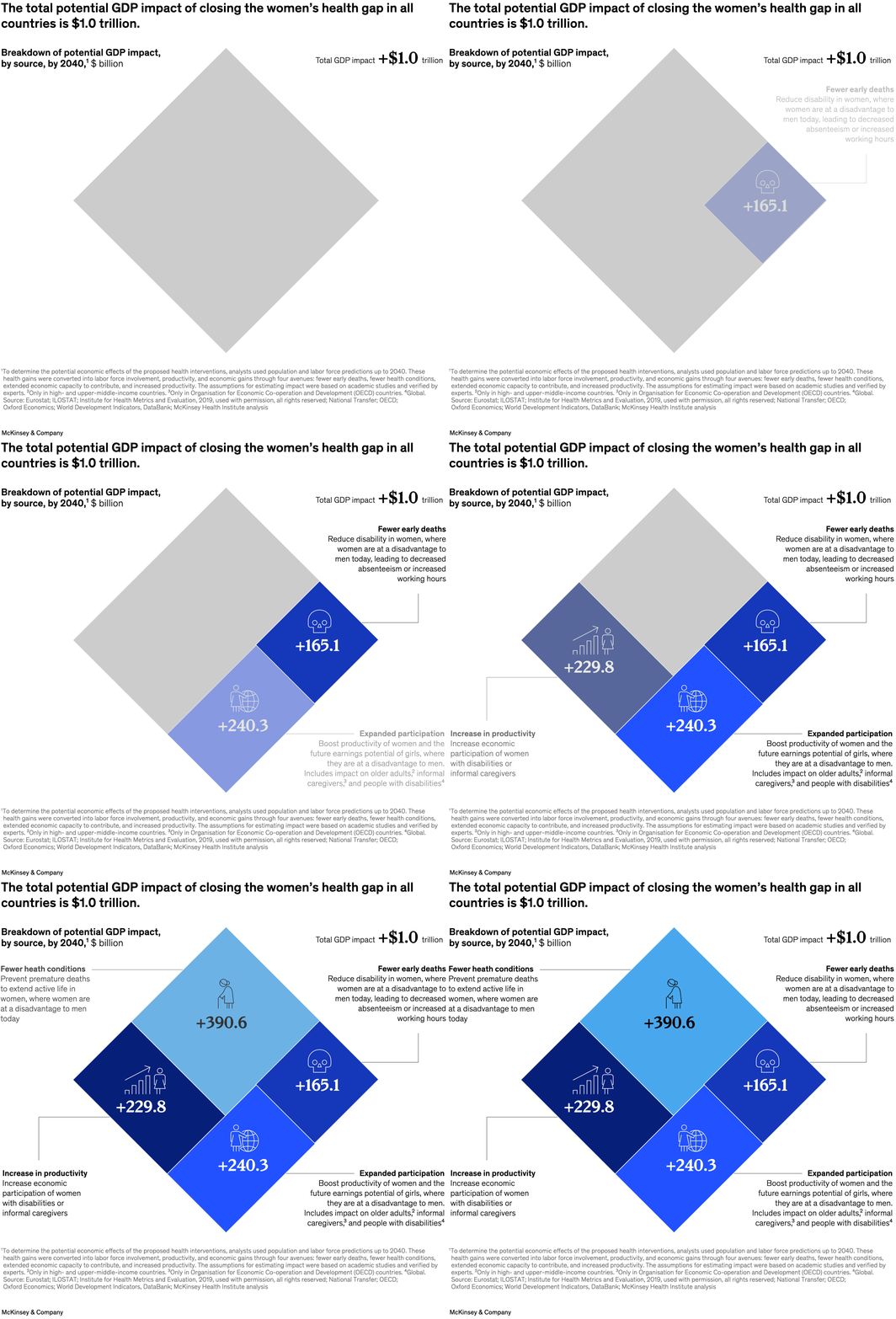
To view the interactive, see “Bridging the women’s health gap: A country-level exploration,” May 2024.
customizer here
Visual form
Comparison infographic.
Layout / body structure
The page is arranged around a large diamond of four colored tiles, with explanatory callouts placed around the outside edges. The reading order starts from the diamond segments and then moves to the surrounding text that names each source of impact.
What is being compared
It compares four sources of potential GDP impact from closing the women’s health gap: fewer health conditions, fewer early deaths, increased productivity, and expanded participation.
Measurement system
The values are billions of dollars by 2040, and the total is also summarized separately as $1.0 trillion. Each diamond tile carries one numeric contribution, and the side callouts explain what each contribution represents.
Visible structure inside the graphic
Four diamond tiles meet at the center, each with its own icon and numeric value. The largest tile sits on top, with smaller left, right, and lower tiles forming the rest of the diamond, and connector lines tie them to the explanatory text blocks on either side.
Main takeaway from the visual
The chart shows that closing the women’s health gap has a trillion-dollar economic upside spread across several channels, with fewer health conditions and expanded participation providing the largest pieces of the total.
Key standout values or extremes
The biggest component is fewer health conditions at $390.6 billion. Expanded participation contributes $240.3 billion, increased productivity $229.8 billion, and fewer early deaths $165.1 billion, together summing to the stated $1.0 trillion total.
Controls / sequence, when applicable
This is a static chart image with no in-chart controls to operate.
Companion media, when applicable
There is no separate companion audio or video; the chart image is the full visual on this page.