Source page: McKinsey & Company
Commentary
A revenue boost with vertical integration
Healthcare | Innovation
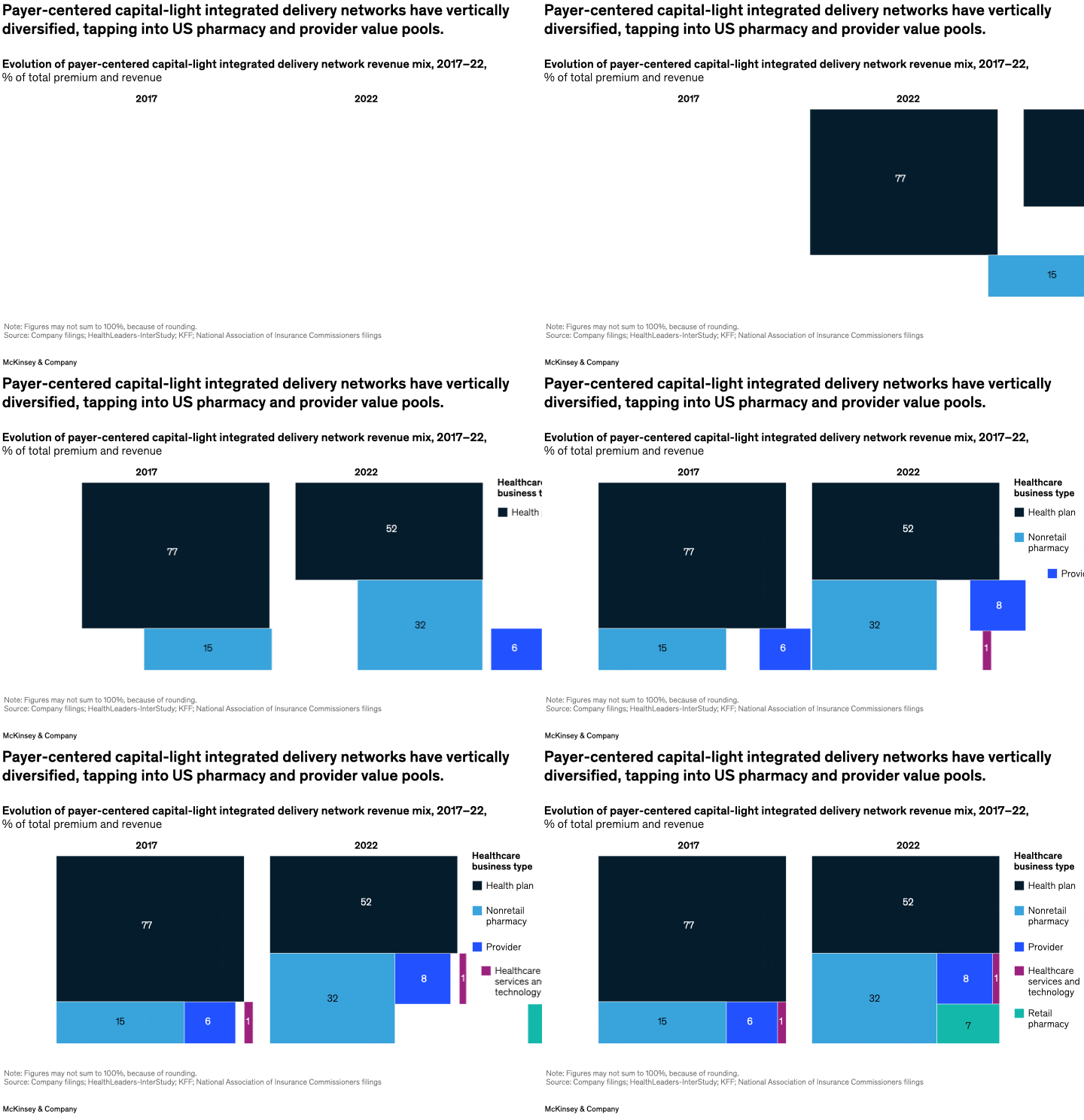
May 8, 2024 – Over the past few years, US healthcare businesses that have prioritized vertical integration have experienced the strongest growth, and those with a payer at the center that owns or is strongly aligned with traditional pharmacy and provider functions but doesn’t own capital-intensive acute-care facilities have seen the quickest revenue gains, note senior partner Shubham Singhal and coauthors. For these payer-centered capital-light integrated delivery networks, the proportion of revenue from nonpayer businesses has increased to almost half.
To read the article, see “Value creation through business model innovation in US healthcare,” April 16, 2024.
customizer here
Visual form
Comparison infographic.
Layout / body structure
The page uses a side-by-side two-period comparison, with one stacked revenue block for 2017 and one for 2022. The reading order is left to right, using the legend on the right to decode the business lines inside each block.
What is being compared
It compares the revenue mix of payer-centered capital-light integrated delivery networks across healthcare business types between 2017 and 2022.
Measurement system
The measure is share of total premium and revenue, expressed as percentages. Each colored segment inside the blocks represents one business type, and the segment labels print the corresponding share.
Visible structure inside the graphic
Two tall stacked rectangles dominate the visual. The dark health-plan segment is largest in both years, while the lighter provider, provider-related, healthcare-services-and-technology, and retail-pharmacy segments sit beneath and beside it to show how the mix changed over time.
Main takeaway from the visual
The graphic shows that these networks became less concentrated in the core health-plan business and more diversified into provider, pharmacy, and related healthcare value pools by 2022.
Key standout values or extremes
The health-plan segment falls from 77 percent in 2017 to 52 percent in 2022. Nonretail pharmacy rises from 15 percent to 32 percent, provider grows from 6 percent to 8 percent, and retail pharmacy appears as a 7 percent segment in 2022.
Controls / sequence, when applicable
This is a static chart image with no in-chart controls to operate.
Companion media, when applicable
There is no separate companion audio or video; the chart image is the full visual on this page.