Source page: McKinsey & Company
Commentary
Gen AI’s productivity possibilities
Artificial Intelligence | Public Sector
January 18, 2024 – Davos—the World Economic Forum’s annual meeting—is in full swing through January 19. All this week, our daily charts will focus on some of the key themes of the event, including resilience, sustainability, reimagining globalization, generative AI, and inclusive, equitable growth. For more, see “McKinsey and the World Economic Forum 2024.”
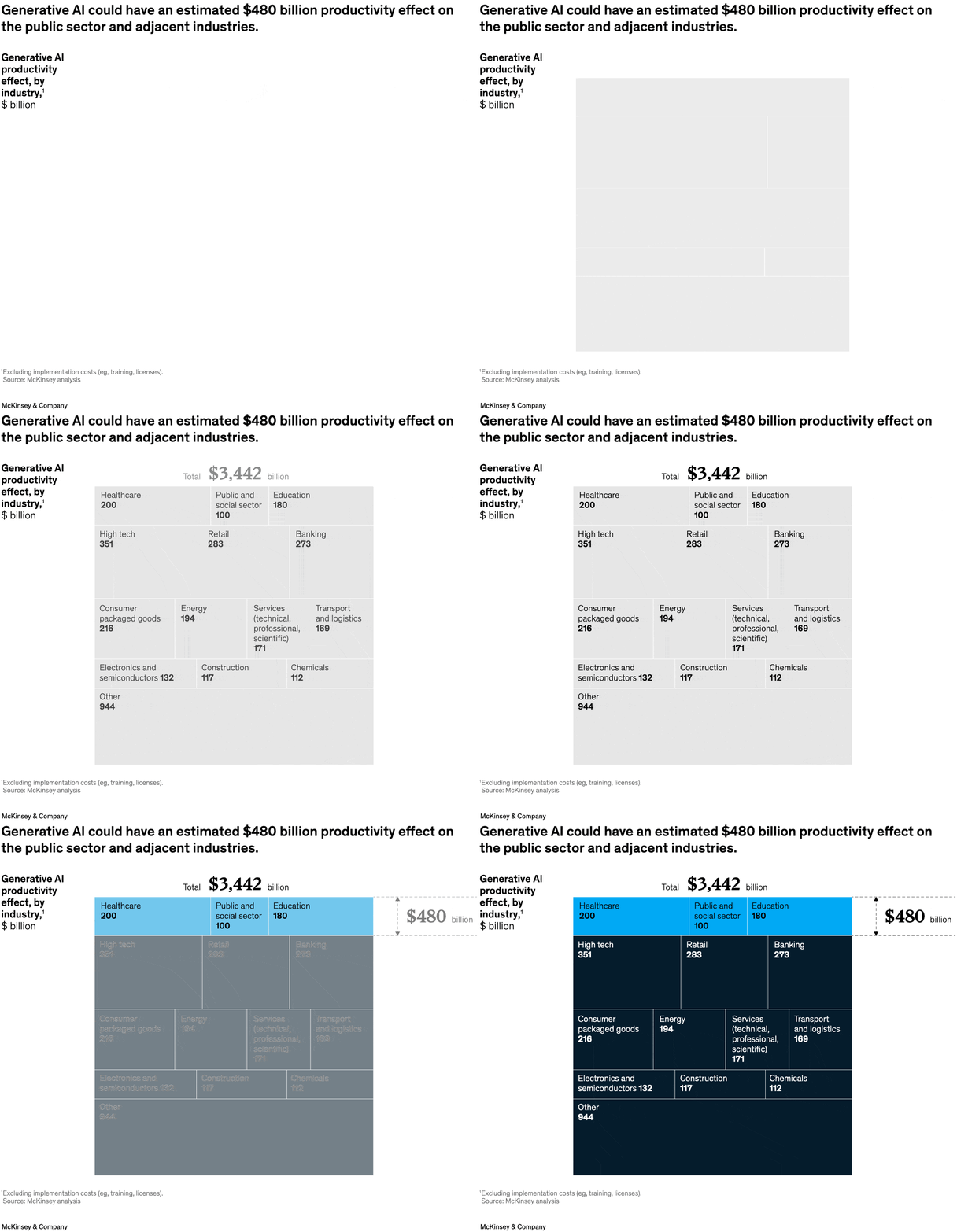
Using generative AI capabilities in the public sector, healthcare, and education could realize global productivity gains of nearly half a trillion dollars. Government agencies in Asia, Europe, and the United States already have implemented generative AI programs to streamline customer service and generate internal reports, senior partner Damien Bruce and colleagues explain. AI models could also help to speed software development, summarize content, and create drafts of proposals.
To read the article, see “Unlocking the potential of generative AI: Three key questions for government agencies,” December 7, 2023.
customizer here
Visual form
Treemap with a public-sector callout.
Layout / body structure
The chart is one large treemap of industry productivity effect, with a bracketed callout isolating the public sector and adjacent industries on the right side of the chart.
What is being compared
It compares the estimated productivity effect of generative AI across industries and then highlights the portion attributable to the public sector, healthcare, and education.
Measurement system
The blocks are measured in billions of dollars, with the full treemap total shown at 3,442 billion and the public-sector-and-adjacent portion called out separately at 480 billion.
Visible structure inside the graphic
The chart is divided into labeled rectangles by industry, with healthcare, public and social sector, and education highlighted in a brighter band across the top of the treemap.
Main takeaway from the visual
Most of the total productivity effect sits outside the public-sector cluster, but the public sector plus adjacent industries still add up to a very large standalone opportunity.
Key standout values or extremes
The highlighted top band shows healthcare 200, public and social sector 100, and education 180, while larger dark blocks elsewhere include high tech 361, retail 283, banking 273, consumer packaged goods 216, energy 194, and an Other block of 944.
Controls / sequence, when applicable
This is a static chart image with no in-chart controls to operate.
Companion media, when applicable
There is no separate companion audio or video; the chart image is the full visual on this page.