Source page: McKinsey & Company
Commentary
Don't ask me, AI just work here
Artificial Intelligence | Jobs | Digital
August 22, 2023 – All this week, our daily charts will focus on one of the hottest topics in business: AI. We’ll take a closer look at the technology’s implications for growth, industries, the workforce, and more.
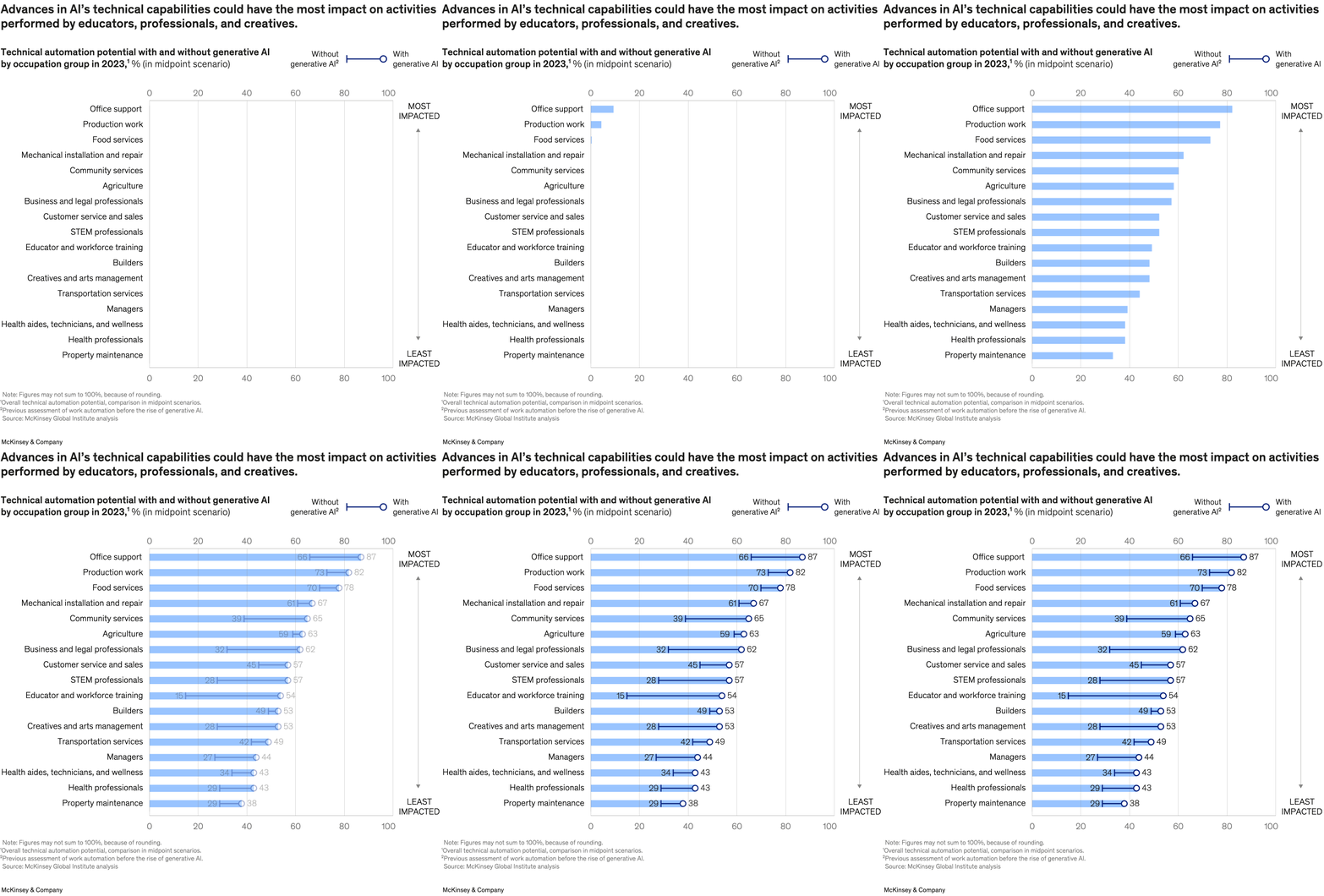
Generative AI is poised to transform roles across sectors, from sales to software development and more. As much as 40 percent of workers’ current tasks require a general understanding of natural language. Jobs involving communication and documentation have the potential to be automated by generative AI, note senior partner Lareina Yee and coauthors. This could accelerate the transformation of work in education and technology, which had been expected to occur later.
To read the report, see “The economic potential of generative AI: The next productivity frontier,” June 14, 2023.
customizer here
Visual form
Horizontal dumbbell chart.
Layout / body structure
A single chart stacks occupation groups from top to bottom, and each row uses two endpoints connected by a line so the reader compares the left and right values on every line before moving to the next row.
What is being compared
It compares technical automation potential by occupation group before generative AI is added and after generative AI is included in the estimate.
Measurement system
The measure is percent of activities with automation potential on a 0-to-100 scale, with one endpoint for the baseline estimate and the other for the with-generative-AI estimate.
Visible structure inside the graphic
Each occupation row has a connecting rule, two labeled markers, and a rank order that runs from the most impacted occupations near the top to the least impacted near the bottom.
Main takeaway from the visual
Every row shifts to the right when generative AI is added, and the top of the chart concentrates the biggest automation potential in educator, professional, and creative work rather than only in routine support roles.
Key standout values or extremes
The visible endpoints reach into the high 80s at the top of the chart, while lower rows stay much closer to the 40s and 50s even after the generative-AI uplift.
Controls / sequence, when applicable
This is a static chart image with no in-chart controls to operate.
Companion media, when applicable
There is no separate companion audio or video; the chart image is the full visual on this page.