Source page: McKinsey & Company
Commentary
Reaching for the stars
Space | Aerospace | Telecommunications
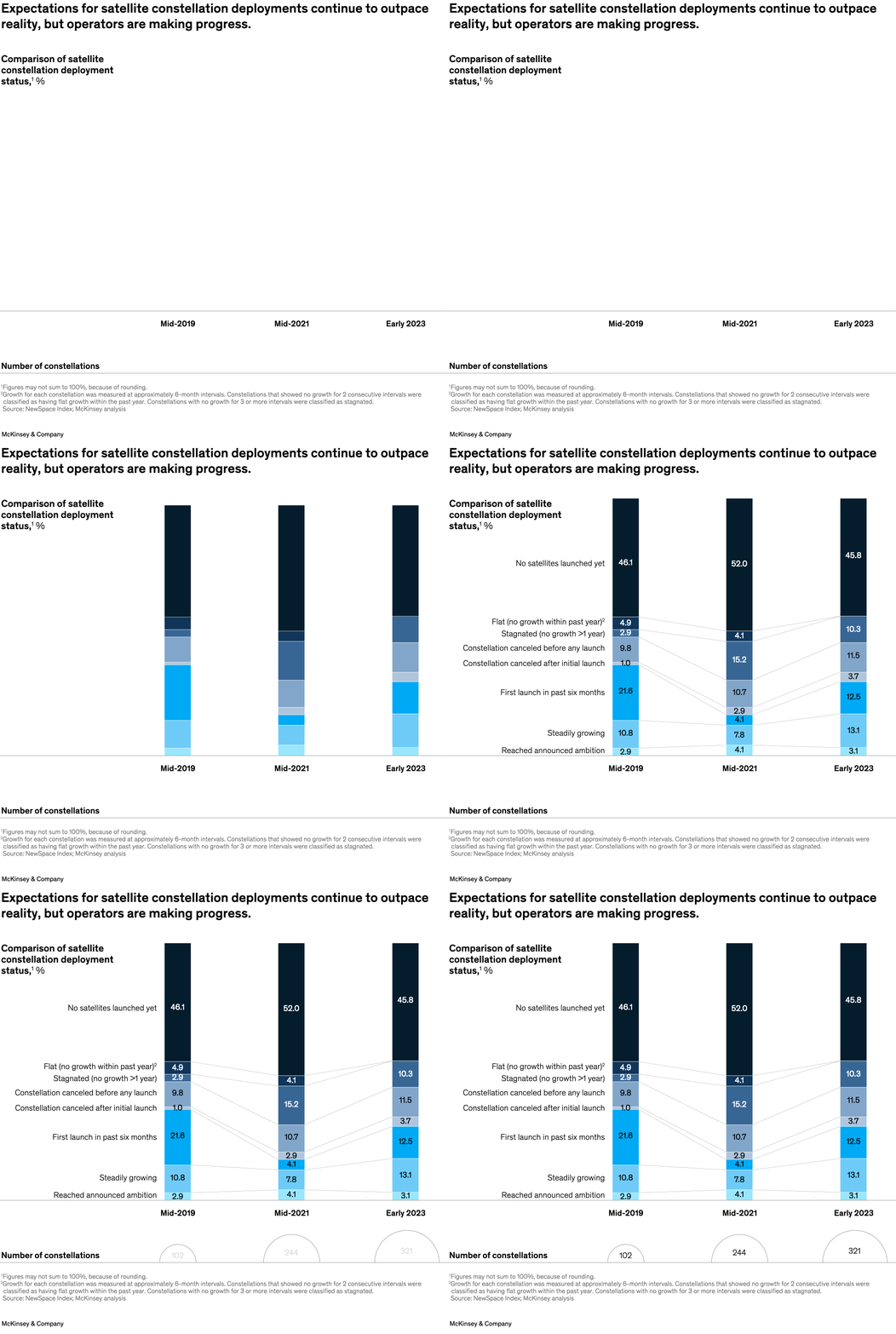
May 30, 2023 – Many commercial satellite constellation operators continue to fall short of their objectives: about 45 percent of announced constellations have not yet had a satellite launch. Yet, there are signs of progress. In a study conducted in early 2023, senior partner Ryan Brukardt and colleagues report that the number of launches has increased to more than 300 from about 250 in mid-2019, and that about 30 percent of constellations were able to launch satellites over the past year, compared with only about 15 percent in mid-2021.
To read the article, see “Expectations versus reality: Commercial-satellite constellations,” April 14, 2023.
customizer here
Visual form
100-percent stacked column comparison.
Layout / body structure
The chart lays out three vertical columns for Mid-2019, Mid-2021, and Early 2023, with each column stacked from bottom to top into deployment-status segments and a second row reserved below for constellation counts.
What is being compared
It compares the deployment status mix of satellite constellations across three time checkpoints, showing how the portfolio of announced constellations has shifted over time.
Measurement system
The top chart is measured as percent of constellation status, and the lower strip signals the accompanying count of constellations for each period.
Visible structure inside the graphic
Each time point is represented by a single stacked bar made of several blue-toned segments capped by a dark top block, so the reader compares how the internal composition changes from one period to the next rather than just the total height.
Main takeaway from the visual
The composition still shows a large stalled or not-yet-advanced segment in every period, but the later columns contain more activity in the middle bands, which supports the page’s message that progress has improved even if expectations still outrun reality.
Key standout values or extremes
The three visible checkpoints are Mid-2019, Mid-2021, and Early 2023, and the source page anchors the improvement with launches rising to more than 300 from about 250 and the share of constellations launching satellites over the prior year climbing from about 15 percent to about 30 percent.
Controls / sequence, when applicable
This is a static chart image with no in-chart controls to operate.
Companion media, when applicable
There is no separate companion audio or video; the chart image is the full visual on this page.