Source page: McKinsey & Company
Commentary
Interchangeable parts
Europe | Defense | Strategy
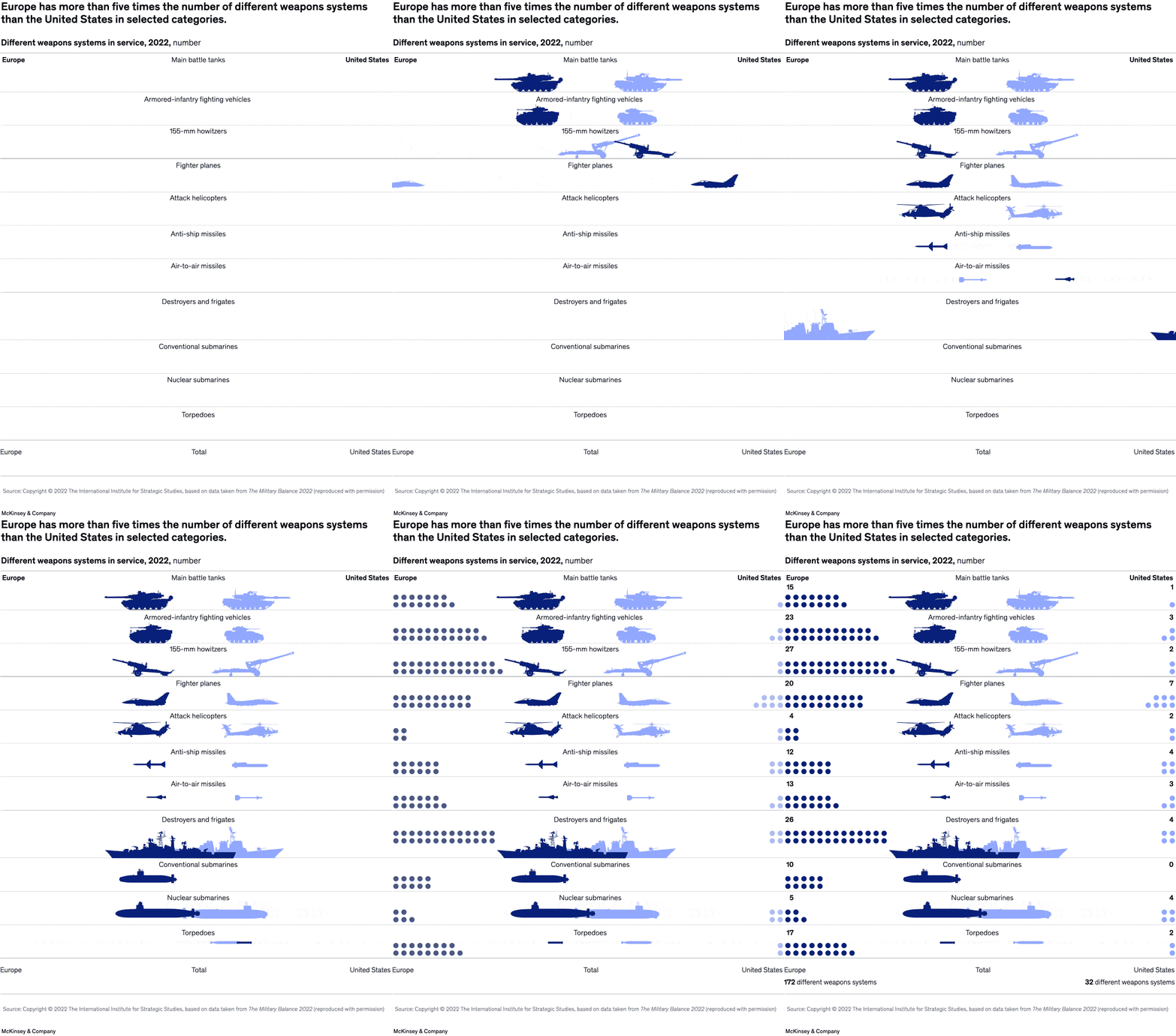
February 21, 2023 – While Europe has increased its defense funding, this alone will not deliver the continent’s defense policy goals, note senior partners David Chinn and Hugues Lavandier and coauthors. As of now, Europe operates more than five times as many weapons systems as the United States across certain categories. To lower costs and help funding go further, European nations might want to ensure greater alignment and collaboration to gain scale.
To read the article, see “Invasion of Ukraine: Implications for European defense spending,” December 19, 2022.
customizer here
Visual form
Icon-and-dot comparison chart.
Layout / body structure
The visual is laid out as a long vertical list of weapons categories. Each row compares Europe on the left with the United States on the right, using equipment silhouettes in the center and dot counts at both ends.
What is being compared
It compares the number of different weapons systems in service in Europe versus the United States across categories such as main battle tanks, armored infantry fighting vehicles, howitzers, fighter planes, attack helicopters, missiles, destroyers and frigates, submarines, and torpedoes.
Measurement system
The values are counts of distinct weapons systems, shown as numeric labels and repeated with dot markers for each side of the comparison.
Visible structure inside the graphic
Each row anchors on a specific equipment illustration, with Europe’s darker silhouettes and dot clusters to the left and the United States’ lighter silhouettes and dot clusters to the right. The repeated row layout makes it easy to compare category by category and then read the total at the bottom.
Main takeaway from the visual
Europe carries a much more fragmented equipment landscape than the United States in nearly every category, so the chart emphasizes duplication and lack of standardization rather than raw platform volume alone.
Key standout values or extremes
Europe totals 172 different weapons systems compared with 32 in the United States. Individual categories also show wide gaps, such as 27 versus 2 for 155-mm howitzers, 26 versus 4 for destroyers and frigates, 23 versus 3 for armored-infantry fighting vehicles, and 15 versus 1 for main battle tanks.
Controls / sequence, when applicable
This is a static chart image with no in-chart controls to operate.
Companion media, when applicable
There is no separate companion audio or video; the chart image is the full visual on this page.