Source page: McKinsey & Company
Commentary
Vietnam’s potential for renewables
Asia-Pacific | Sustainability
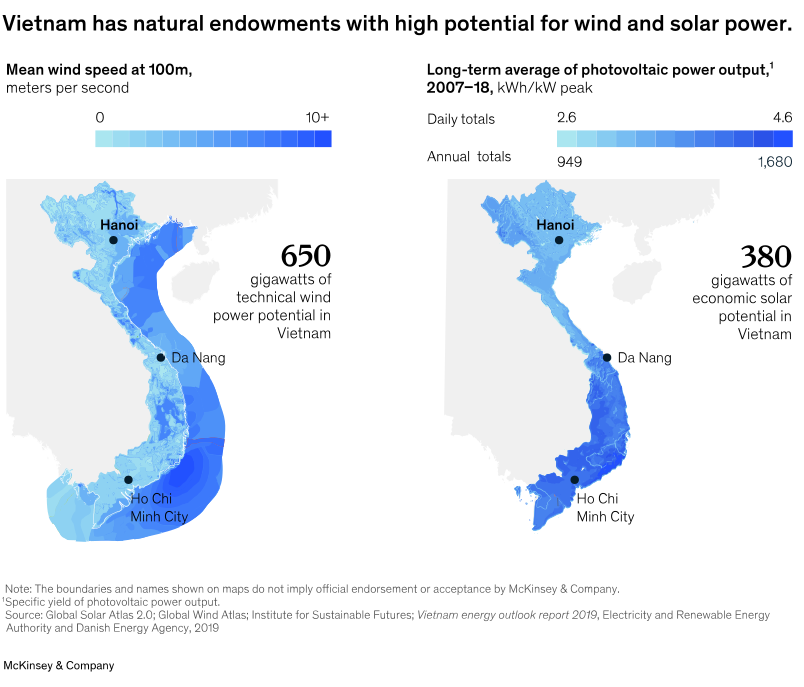
February 10, 2023 – Vietnam is unique among its peers around Southeast Asia with respect to its physical potential to generate renewable energy, say senior partner Vishal Agarwal and coauthors. To reach net-zero emissions by 2050, Vietnam would have to pivot the bulk of its power generation capacity to wind and solar, installing about 150 GW of wind capacity and about 70 GW of solar capacity. While this is an ambitious target for renewables, it captures only a fraction of the nation’s overall renewable-power potential.
To read the article, see “Charting a path for Vietnam to achieve its net-zero goals,” October 14, 2022.
customizer here
Visual form
Two-panel thematic map.
Layout / body structure
The page is split into two maps of Vietnam shown side by side. The left map shows wind potential and the right map shows solar potential, so the reader compares the two geographies across the same country outline.
What is being compared
It compares Vietnam’s technical wind-power potential with its economic solar-power potential.
Measurement system
The left map uses mean wind speed at 100 meters, and the right map uses long-term average photovoltaic power output. Each map also pairs the shading with a single headline estimate in gigawatts.
Visible structure inside the graphic
Both maps use blue intensity to show where the resource is strongest. The wind map emphasizes the coastline and offshore-adjacent zones, while the solar map concentrates deeper blues in the south. City markers for Hanoi, Da Nang, and Ho Chi Minh City anchor the geography.
Main takeaway from the visual
Vietnam has strong renewable endowments in both wind and solar, but the spatial strengths differ: wind is most pronounced along the coast, while solar intensity is strongest in the south. The side-by-side layout makes that contrast easy to read.
Key standout values or extremes
The page highlights 650 gigawatts of technical wind power potential and 380 gigawatts of economic solar potential. The scales above the maps show wind speed running from 0 to above 10 meters per second and photovoltaic output spanning roughly 949 to 1,680 kilowatt-hours per kilowatt peak annually.
Controls / sequence, when applicable
This is a static chart image with no in-chart controls to operate.
Companion media, when applicable
There is no separate companion audio or video; the chart image is the full visual on this page.