Source page: McKinsey & Company
Commentary
AI knows you’re off the clock
Artificial Intelligence | Operations
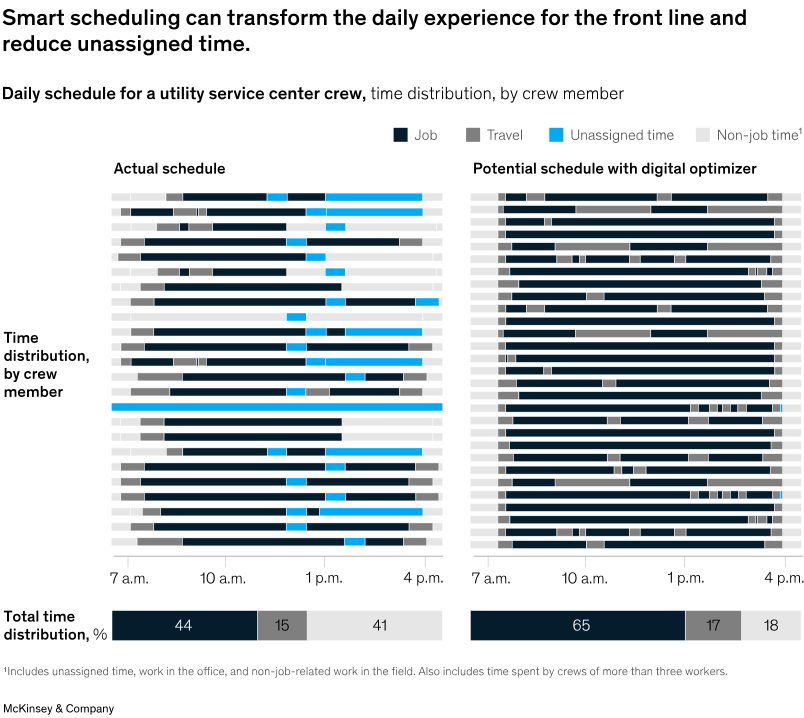
January 12, 2023 – AI is the latest tool for optimizing workforce management. AI solutions schedule crews faster than existing spreadsheet-based models can and they more efficiently track unexpected operational changes, McKinsey partner Jorge Amar and colleagues find. For instance, smart scheduling with AI for a utility service center helped to reduce unassigned times for crew members.
To read the article, see “Smart scheduling: How to solve workforce-planning challenges with AI,” November 1, 2022.
customizer here
Visual form
Before-and-after workforce-scheduling chart.
Layout / body structure
The chart is laid out as an operational comparison that contrasts traditional scheduling with AI-enabled scheduling outcomes. The reading order moves from the current scheduling problem to the improved state, with the front-line workday framed as the main body of the visual.
What is being compared
It compares crew scheduling outcomes before and after AI-based workforce management, especially the amount of unassigned time and the quality of the daily scheduling experience.
Measurement system
The page tracks scheduling efficiency rather than market or revenue size, so the important readings are time allocation and utilization. Labels and operational callouts carry the comparison more than a long numeric axis does.
Visible structure inside the graphic
The main internal pieces are the scheduling states, the crew-time allocation or workday blocks, and the callouts that identify wasted or unassigned time. The structure is designed to make operational friction visible before showing the tighter AI-driven plan.
Main takeaway from the visual
The page makes AI look useful because it improves the shape of the workday, not just the speed of planning. The contrast between idle gaps and a more tightly assigned schedule is the core message of the graphic.
Key standout values or extremes
The visual emphasis falls on the reduction in unassigned crew time after smart scheduling is introduced. The article framing identifies reduced unassigned time as the strongest operational improvement shown on the page.
Controls / sequence, when applicable
This is a static chart image with no in-chart controls to operate.
Companion media, when applicable
There is no separate companion audio or video; the chart image is the full visual on this page.