Source page: McKinsey & Company
Commentary
Helping rural America thrive
Public Sector | Economic Development
May 9, 2022 – Economic development strategies for rural communities in the United States must come from a tailored approach, depending on the needs and makeup of various regions. McKinsey identified five archetypes of local economies, from resource-rich regions to distressed Americana. A focus on particular workforces and connectivity efforts are key to promoting economic success in these areas, according to McKinsey research.
To read the article, see “Rural rising: Economic development strategies for America’s heartland,” March 30, 2022.
customizer here
Visual form
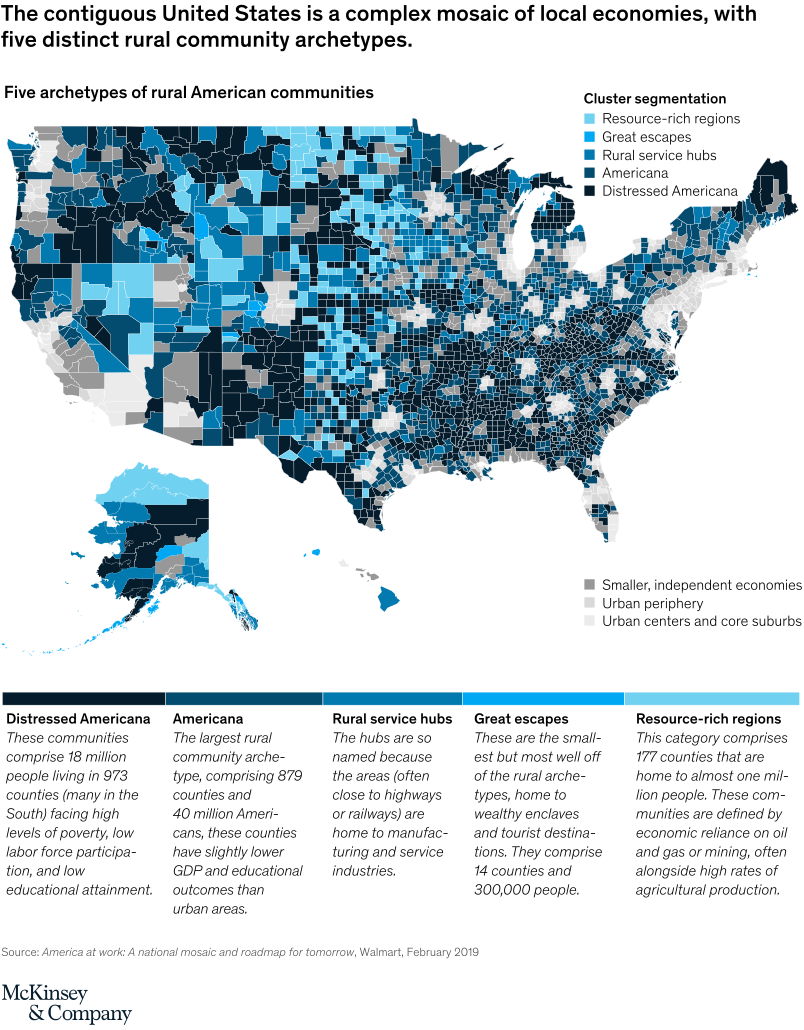
County-level choropleth map with archetype legend and descriptive footer panels.
Layout / body structure
The chart is dominated by a county-by-county map of the contiguous United States, with an Alaska inset below it, a category legend on the right, and a five-part descriptive strip along the bottom. Read the map first to see where each archetype clusters geographically, then use the legend and the bottom descriptions to interpret what each color means.
What is being compared
The map compares rural American counties by local-economy archetype rather than by one numeric score. It separates counties into resource-rich regions, great escapes, rural service hubs, Americana, distressed Americana, smaller independent economies, urban periphery, and urban centers and core suburbs.
Measurement system
The display uses categorical color coding instead of a numeric axis, so the reader tracks geography and cluster membership rather than percentages or time. The bottom strip adds contextual counts and population totals for the five rural archetypes highlighted in the headline framing.
Visible structure inside the graphic
Thousands of counties are tiled across the map in distinct color groups, which makes broad regional clusters visible at a glance. The bottom band reinforces the five main rural archetypes with short narrative descriptions and anchor numbers, turning the page into a map plus legend plus explanatory profile cards.
Main takeaway from the visual
Rural America does not appear as one uniform block on the map; it breaks into several distinct local-economy patterns with clear geographic clustering. Distressed Americana and Americana dominate large swaths of the South and interior counties, while great escapes and resource-rich regions appear in more selective pockets tied to tourism, energy, or mining.
Key standout values or extremes
The bottom descriptors anchor the five rural archetypes with scale: distressed Americana covers 973 counties and 18 million people, Americana covers 879 counties and 40 million people, great escapes include 14 counties and about 300,000 people, and resource-rich regions include 177 counties with almost one million people. Those counts make the map’s darker county clusters read as very different types of rural scale and concentration rather than a single rural category.
Controls / sequence, when applicable
This is a static chart image with no in-chart controls to operate.
Companion media, when applicable
There is no separate companion audio or video; the chart image is the full visual on this page.