Source page: McKinsey & Company
Commentary
Let’s go to the mall
Retail | Consumer
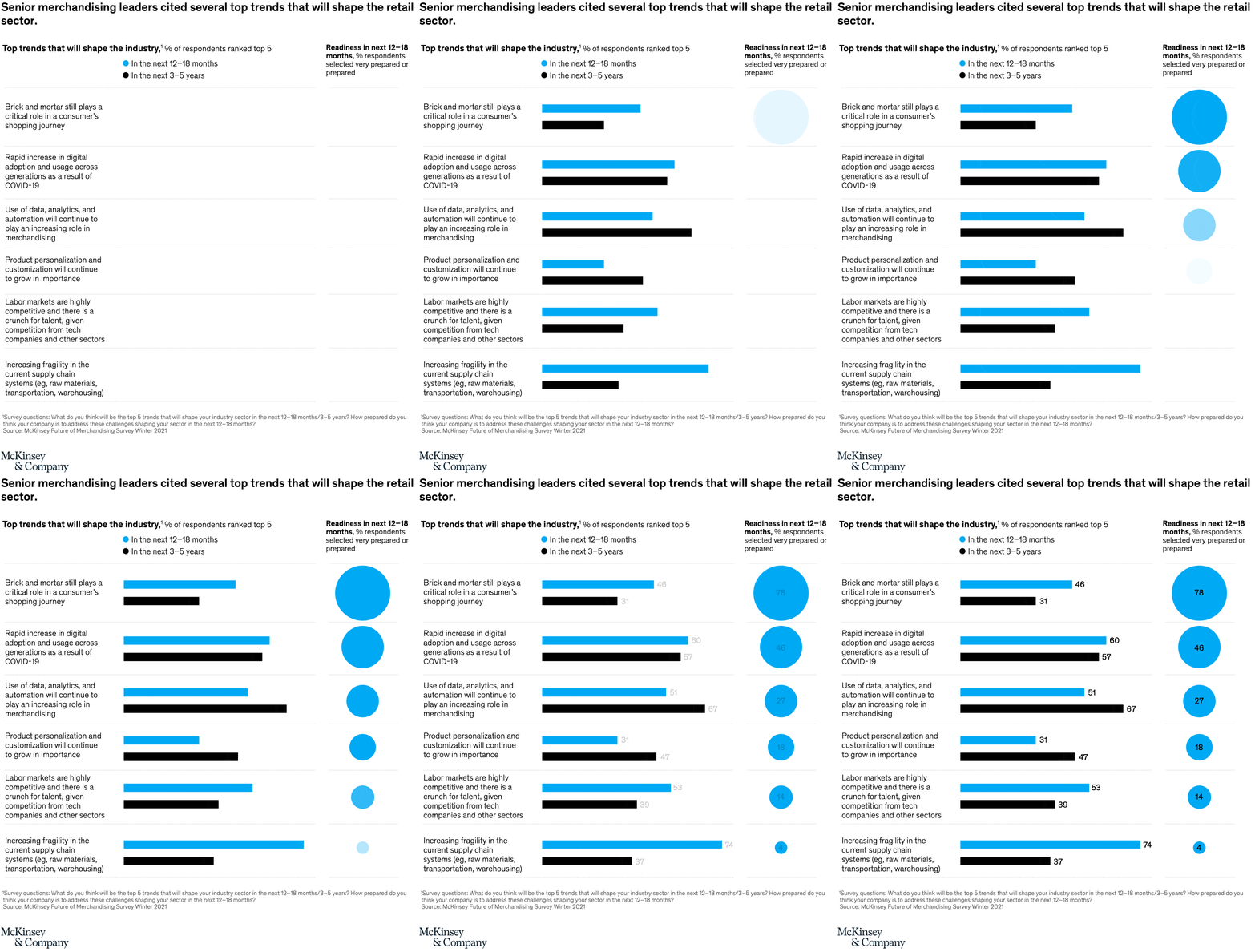
May 5, 2022 – Online spending shows no signs of slowing down, but retail merchant leaders expect brick-and-mortar stores will remain crucial parts of consumers’ shopping habits in the next year, according to a recent McKinsey survey. Respondents also indicated a disconnect between their own priorities—such as ongoing supply chain issues and the tight labor market—and their organizations’ readiness to respond to these challenges in the coming year.
To read the article, see “Six strategic priorities for modern merchant leaders,” March 23, 2022.
customizer here
Visual form
Horizontal bar chart with a readiness bubble column.
Layout / body structure
The chart has two coordinated sections: a left panel of paired horizontal bars for trend importance and a right column of blue bubbles for readiness. Read a trend row across from the two horizon bars on the left to the preparedness bubble on the right before moving down to the next trend.
What is being compared
The chart compares the retail trends senior merchandising leaders rank among the top five issues for the next 12 to 18 months versus the next 3 to 5 years. It also compares how prepared respondents feel their organizations are to respond to each trend in the near term.
Measurement system
The left panel measures the percent of respondents ranking each trend in the top five, with blue bars for the next 12 to 18 months and black bars for the next 3 to 5 years. The right panel uses bubble size and direct numeric labels to show the percent who say their organizations are very prepared or prepared.
Visible structure inside the graphic
Each trend occupies one full row, with two bars of different lengths on the left and one corresponding blue circle on the right. The layout makes it easy to see not only which issues are urgent or long-term, but also whether readiness keeps pace with perceived importance.
Main takeaway from the visual
Supply-chain fragility, digital adoption, labor pressure, and store relevance are all prominent priorities, but readiness is highly uneven across those issues. The most striking mismatch is supply-chain fragility: it ranks highest as a near-term trend, yet the readiness bubble beside it is the smallest on the page.
Key standout values or extremes
Increasing fragility in supply chains leads the near-term ranking at 74 percent but has only 4 percent readiness. Rapid digital adoption scores 60 percent in the next 12 to 18 months and 57 percent in the next 3 to 5 years, while use of data, analytics, and automation is strongest as a longer-term trend at 67 percent versus 51 percent near term; brick and mortar’s continuing role carries the highest readiness score at 78 percent.
Controls / sequence, when applicable
This is a static chart image with no in-chart controls to operate.
Companion media, when applicable
There is no separate companion audio or video; the chart image is the full visual on this page.