Source page: McKinsey & Company
Commentary
Gen Z reluctant to seek behavioral-health help
Gen Z | Mental health
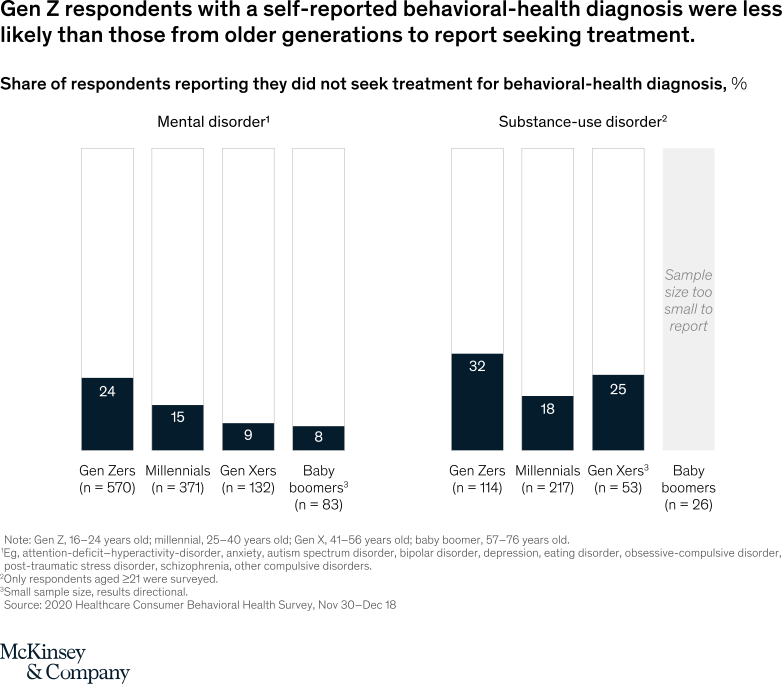
February 8, 2022 – The Generation Z population is more likely to have behavioral-health needs than other age groups but is less likely to seek treatment, according to recent McKinsey surveys. Nearly a quarter of Gen Z respondents said they don’t get treatment for mental-health issues, for reasons ranging from stigma to concerns about affordability of care.
To read the article, see “Addressing the unprecedented behavioral-health challenges facing Generation Z,” January 14, 2022.
customizer here
Visual form
Two-panel grouped bar chart.
Layout / body structure
The chart is split into two side-by-side panels, one for mental disorder diagnoses and one for substance-use disorder diagnoses. Reader compares the generational bars within the left panel first and then repeats the same left-to-right generational scan in the right panel.
What is being compared
The chart compares the share of respondents who did not seek treatment after a self-reported behavioral-health diagnosis across generations. It separates the comparison into two diagnosis types: mental disorders and substance-use disorders.
Measurement system
The measure is percent of respondents reporting that they did not seek treatment. The bars carry direct percentage labels, and the footnotes define the age ranges for Gen Z, millennials, Gen X, and baby boomers while also flagging very small samples where results are directional or not reported.
Visible structure inside the graphic
Each panel uses one bar per generation, with Gen Z, millennials, Gen X, and baby boomers lined up on the same baseline. The right panel includes a visible note where one baby-boomer sample is too small to report, which reinforces that the chart is built from explicit survey-cell sizes rather than abstract trend lines.
Main takeaway from the visual
Gen Z respondents with a behavioral-health diagnosis are less likely to seek treatment than older generations, and that pattern shows up in both diagnosis categories. The tallest bars sit with Gen Z in each panel, so the page reads as a treatment-gap chart rather than a prevalence chart.
Key standout values or extremes
In the mental-disorder panel, Gen Z is labeled at 32 percent, compared with 24 percent for millennials, 18 percent for Gen X, and 15 percent for baby boomers. In the substance-use panel, Gen Z is labeled at 53 percent versus 26 percent for millennials and 17 percent for Gen X, with the baby-boomer sample too small to report.
Controls / sequence, when applicable
This is a static chart image with no in-chart controls to operate.
Companion media, when applicable
There is no separate companion audio or video; the chart image is the full visual on this page.