Source page: McKinsey & Company
Commentary
Driven by climate change
Asia-Pacific | Automotive | Mobility
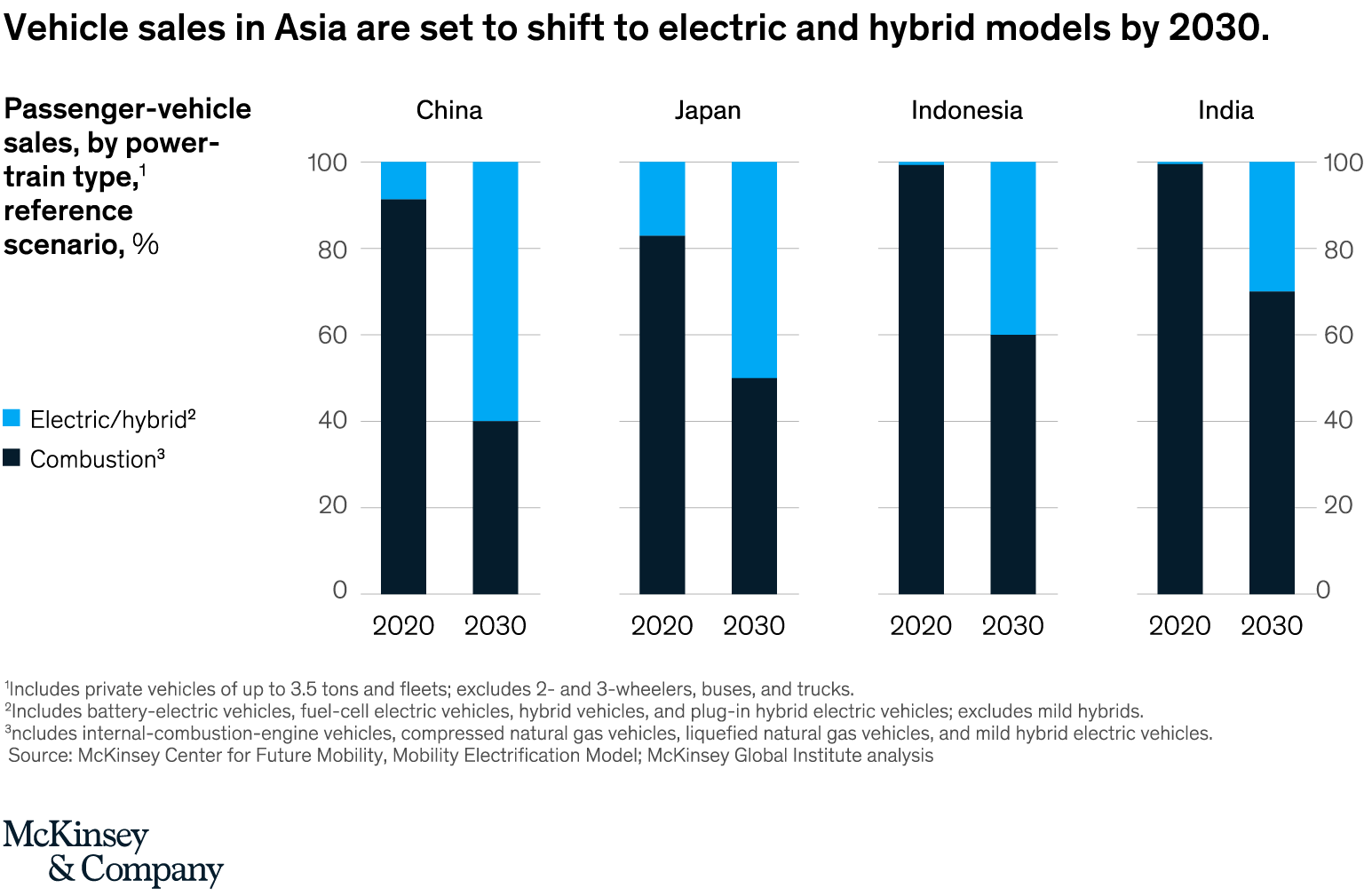
January 21, 2022 – Climate-change concerns are expected to drive a significant rise in electric- and hybrid-vehicle sales across Asia by the end of this decade. In China, for example, only about 10 percent of auto sales were for new-energy vehicles last year. By 2030, that figure is expected to be closer to 60 to 80 percent, as more consumers seek sustainable mobility options.
To read the article, see “Asia’s consumers on the move: The future of mobility,” October 29, 2021.
customizer here
Visual form
Four-panel stacked column chart.
Layout / body structure
The chart is arranged as four small country panels placed left to right for China, Japan, Indonesia, and India. Within each panel, a 2020 column sits beside a 2030 column, so the reader makes a within-country time comparison first and then compares the country panels across the row.
What is being compared
The chart compares passenger-vehicle sales mix by power-train type across four Asian markets. It compares combustion vehicles versus electric and hybrid models in 2020 and under a 2030 reference scenario.
Measurement system
Each column is normalized to 100 percent of passenger-vehicle sales. The dark segment represents combustion, the bright blue segment represents electric and hybrid, and the shared vertical scale runs from 0 to 100 percent.
Visible structure inside the graphic
Each country panel contains two stacked bars, one for 2020 and one for 2030, with the same dark-to-blue split. China and Japan show smaller blue caps in 2020 and much larger upper segments by 2030, while Indonesia and India start almost entirely combustion and then gain more moderate blue shares in the later column.
Main takeaway from the visual
The visual shows a clear shift away from combustion across all four markets, but at different speeds. China and Japan move toward roughly half-electric-or-hybrid mixes by 2030, while Indonesia and India remain majority combustion even after the transition progresses.
Key standout values or extremes
China moves from roughly 9 percent electric or hybrid in 2020 to about 60 percent in 2030, while Japan moves from around 17 percent to 50 percent. Indonesia rises from about 1 percent to 40 percent, and India rises from about 1 percent to 30 percent, leaving India as the most combustion-heavy panel in 2030.
Controls / sequence, when applicable
This is a static chart image with no in-chart controls to operate.
Companion media, when applicable
There is no separate companion audio or video; the chart image is the full visual on this page.