Source page: McKinsey & Company
Commentary
Money matters
Climate change | North America
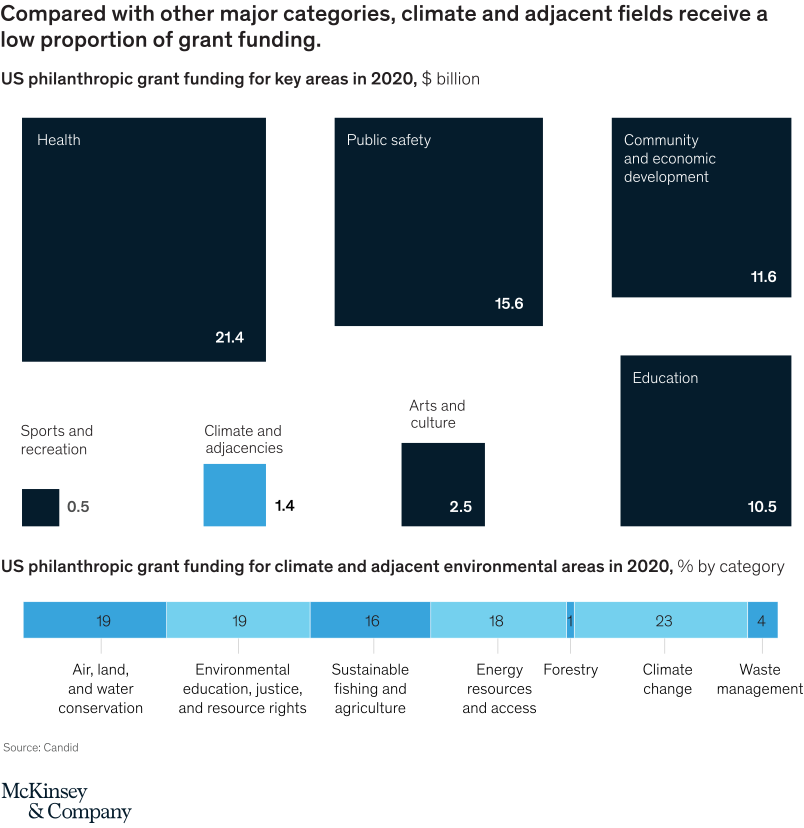
January 11, 2022 – On the philanthropy circuit, supporting the climate and adjacencies is at the bottom of the giving list. Of the $64 billion in US grant money disbursed in 2020, just 0.5 percent or $320 million was allocated directly to climate change. To move the needle toward net-zero emissions by 2050, trillions of dollars of additional capital spending are needed.
To read the article, see “It’s time for philanthropy to step up the fight against climate change,” October 20, 2021.
customizer here
Visual form
Area-proportional square chart with a companion segmented bar.
Layout / body structure
The chart is split into two layers. The top layer is a field of differently sized squares for major philanthropic grant categories, and the bottom layer is a narrow horizontal segmented bar that breaks the climate-and-adjacent bucket into subcategories.
What is being compared
The chart compares US philanthropic grant funding across major issue areas in 2020 and then drills into the composition of climate and adjacent environmental funding. It is comparing both overall category size and the internal mix inside the climate bucket.
Measurement system
The top squares are labeled in billions of dollars, so area and printed values together show the scale of each category. The lower segmented bar is normalized by category share, with percentages printed inside each segment to show how climate-adjacent funding is distributed.
Visible structure inside the graphic
At the top, large dark squares represent health, public safety, community and economic development, and education, while much smaller blocks represent sports and recreation, arts and culture, and climate and adjacencies. At the bottom, the climate bar is divided into labeled segments including air, land, and water conservation, environmental education and justice, sustainable fishing and agriculture, energy resources and access, forestry, climate change, and waste management.
Main takeaway from the visual
Climate and adjacent environmental areas receive a much smaller share of grant funding than the largest major categories. Even within the climate-related bucket, the money is spread across several adjacent themes, so direct climate-change funding is only one part of a relatively small overall pool.
Key standout values or extremes
Health is labeled at 21.4 billion dollars, public safety at 15.6, community and economic development at 11.6, and education at 10.5, while climate and adjacencies are only 1.4 billion. In the lower breakdown, climate change is the largest single climate-related slice at 23 percent, followed by air, land, and water conservation and environmental education and justice at 19 percent each, with forestry at 1 percent and waste management at 4 percent.
Controls / sequence, when applicable
This is a static chart image with no in-chart controls to operate.
Companion media, when applicable
There is no separate companion audio or video; the chart image is the full visual on this page.