Source page: McKinsey & Company
Commentary
Hopes and fears for the hybrid future
COVID-19 | Remote work | Hybrid work
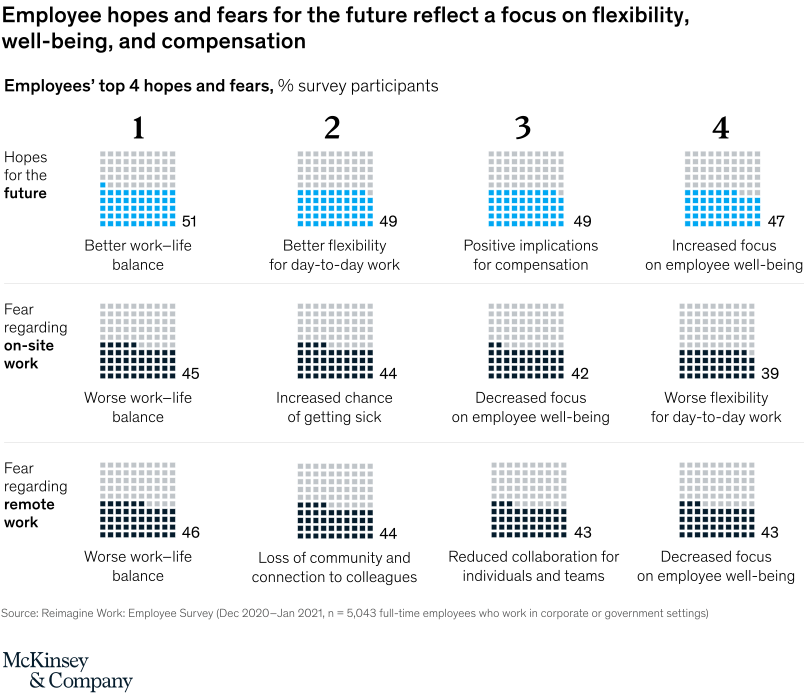
June 1, 2021 – Across the board, employees are eager for more flexibility, competitive compensation, and well-being once the pandemic is over—and conversely, they’re concerned that future work, regardless of whether it is on-site or remote, will fail to meet these needs.
To read the article, see “What employees are saying about the future of remote work,” April 1, 2021.
customizer here
Visual form
Three-row dot-matrix ranking chart.
Layout / body structure
The chart is organized into three horizontal bands – hopes for the future, fear regarding on-site work, and fear regarding remote work – with four ranked dot matrices in each band. Read across each row from rank 1 to rank 4, then move down to the next band to compare how the most common hopes differ from the two kinds of fears.
What is being compared
The chart compares employees’ top four hopes and fears for future working arrangements. It contrasts positive hopes about postpandemic work with fears tied specifically to on-site work and fears tied specifically to remote work.
Measurement system
Each item is shown as a 100-cell dot matrix with the filled cells representing the percent of survey participants selecting that item. The exact percentages are printed beside each matrix, and the rank number above each column marks where the item sits in that row’s top four list.
Visible structure inside the graphic
The page is a regular grid of twelve small matrices, so the reader can compare both rank order and density of filled cells across rows. The top row uses bright blue fills for hopes, while the lower rows use dark fills for fears, and the labels beneath each matrix state the specific item such as better work-life balance or increased chance of getting sick.
Main takeaway from the visual
Employees’ strongest hope is more balance and flexibility, while their strongest fears focus on work-life strain, illness risk, lost community, and weaker collaboration depending on whether work is on-site or remote. The near-equal fill levels across many matrices show that these hopes and fears are all substantial rather than one issue vastly outweighing the others.
Key standout values or extremes
The highest hope is better work-life balance at 51 percent, followed by better flexibility for day-to-day work and positive implications for compensation at 49 percent each, and increased focus on employee well-being at 47 percent. For on-site work, the largest fear is worse work-life balance at 45 percent, followed by increased chance of getting sick at 44 percent. For remote work, worse work-life balance leads at 46 percent, while reduced collaboration for individuals and teams and decreased focus on employee well-being both register 43 percent.
Controls / sequence, when applicable
This is a static chart image with no in-chart controls to operate.
Companion media, when applicable
There is no separate companion audio or video; the chart image is the full visual on this page.