Source page: McKinsey & Company
Commentary
Viruses as a force for good
Biotech | Pharmaceuticals & Medical Products
May 26, 2021 – Excitement about viral-vector gene therapies is growing. Biotech companies have learned to modify adenoviruses (and others) into drug-delivery vehicles to introduce specific DNA sequences—encoding genes, regulatory RNAs, or other therapeutic substrates—into cells. More than 100 such assets were in clinical trials in late 2020, many developed by small- and midsize biotech companies and academic labs supported by venture capital. Big pharmaceutical companies are moving quickly to acquire them.
To read the article, see “Gene-therapy innovation: Unlocking the promise of viral vectors,” May 17, 2021.
customizer here
Visual form
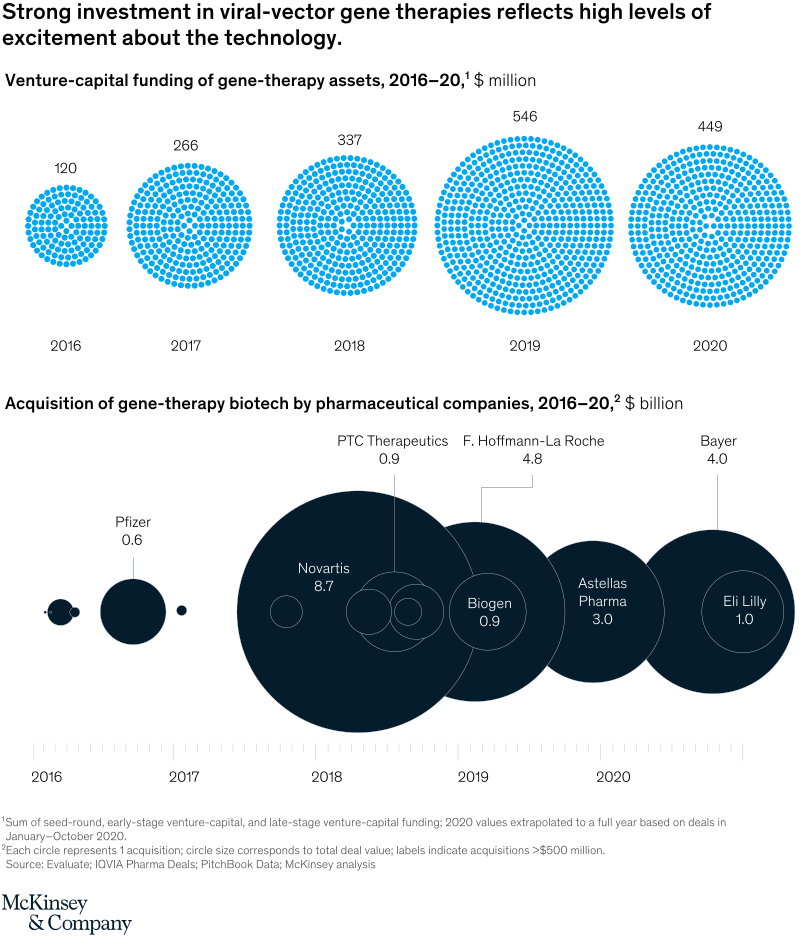
Two-panel bubble-timeline comparison.
Layout / body structure
The chart is split into two horizontal panels stacked top to bottom. Read the upper panel first for venture-capital funding by year, then read the lower panel for acquisition activity by pharmaceutical companies, following both panels left to right from 2016 through 2020.
What is being compared
The chart compares two dimensions of excitement around viral-vector gene therapies: venture-capital funding of gene-therapy assets and acquisition of gene-therapy biotech by pharmaceutical companies. The top panel compares annual VC funding totals, while the bottom panel compares acquisition values and named buyers across the same years.
Measurement system
In the top panel, bubble size and printed labels represent venture-capital funding in millions of dollars. In the bottom panel, bubble size represents acquisition deal value in billions of dollars, the labels identify the acquiring companies, and the horizontal timeline positions the acquisitions by year.
Visible structure inside the graphic
The top row uses one large blue dot cluster for each year, growing from a smaller 2016 circle to a peak 2019 circle before easing slightly in 2020. The bottom row places dark acquisition circles along a year axis, with the largest cluster centered around 2018 and several sizable deals continuing through 2019 and 2020.
Main takeaway from the visual
Investment enthusiasm around viral-vector gene therapies accelerated sharply over the period, first through rising venture funding and then through a series of large pharmaceutical acquisitions. The chart makes that visible by pairing a top-row funding rise to a 2019 peak with a bottom-row deal timeline dominated by billion-dollar transactions.
Key standout values or extremes
Venture-capital funding rises from 120 million dollars in 2016 to 266 in 2017, 337 in 2018, and a peak of 546 in 2019 before remaining high at 449 in 2020. In acquisitions, the largest named deal is Novartis at 8.7 billion dollars in 2018, followed by F. Hoffmann-La Roche at 4.8 billion in 2019, Bayer at 4.0 billion in 2020, Astellas Pharma at 3.0 billion in 2020, Eli Lilly at 1.0 billion, and sub-1-billion deals such as Pfizer at 0.6, PTC Therapeutics at 0.9, and Biogen at 0.9.
Controls / sequence, when applicable
This is a static chart image with no in-chart controls to operate.
Companion media, when applicable
There is no separate companion audio or video; the chart image is the full visual on this page.