Source page: McKinsey & Company
Commentary
Meet them in the middle
Organization
May 25, 2021 – Employees who feel that there is purpose in their work are overall more fulfilled at work. Employers should aim to help meet this need, or risk losing talent to companies that will.
To read the article, see “Help your employees find purpose—or watch them leave,” April 5, 2021.
customizer here
Visual form
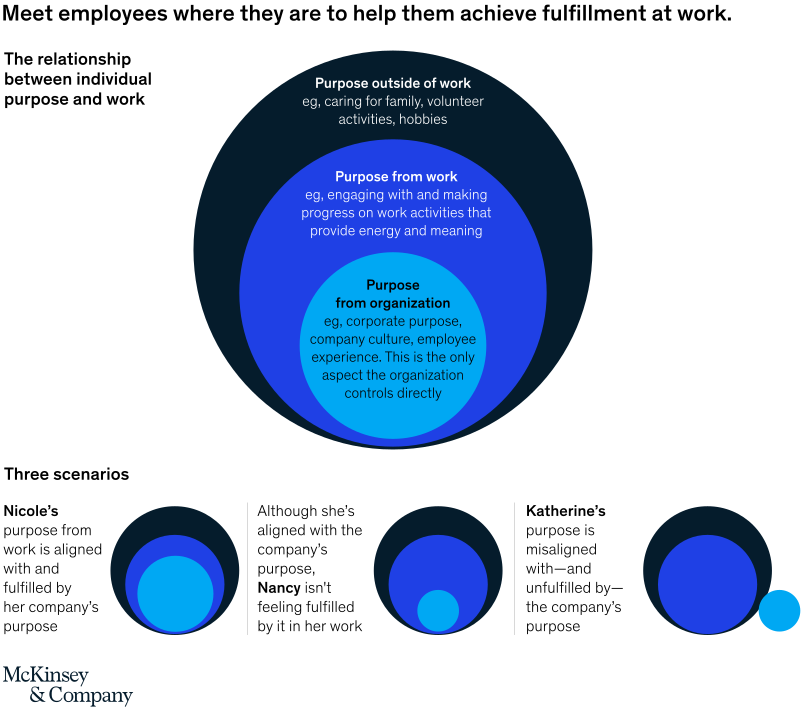
Nested-circle framework with scenario examples.
Layout / body structure
The chart has one large concentric-circle diagram on top and three smaller scenario diagrams along the bottom. Read the nested circles first to understand the hierarchy of purpose layers, then move left to right through the three employee scenarios to see how different alignments or misalignments play out in practice.
What is being compared
The chart compares three layers of purpose: purpose outside of work, purpose from work, and purpose from organization. It then compares three employee scenarios showing different relationships between an individual’s own sense of purpose, the company’s purpose, and whether the employee feels fulfilled by work.
Measurement system
This chart does not use numeric axes or percentages; it uses relative circle size and nesting to indicate scope and control. The largest outer ring represents purpose outside of work, the middle ring represents purpose from work, and the smallest center circle represents purpose from organization, which the caption explicitly says is the only aspect the organization controls directly.
Visible structure inside the graphic
The main diagram is a three-layer bullseye with text embedded inside each ring, making the hierarchy visually explicit. The bottom row repeats the same circle language in miniature, but changes the degree of overlap or separation to illustrate Nicole’s alignment, Nancy’s lack of fulfillment despite alignment with company purpose, and Katherine’s misalignment with company purpose.
Main takeaway from the visual
Organizations can influence only one small part of an employee’s broader purpose system, so they need to meet employees where they are rather than assuming company purpose alone creates fulfillment. The visual makes that clear because the smallest inner circle sits inside much larger personal-purpose layers, and the three scenarios show that similar organizational inputs can lead to very different employee outcomes.
Key standout values or extremes
The strongest visual extreme is the size contrast between the small center circle for purpose from organization and the much larger outer circle for purpose outside of work. In the scenarios, Nicole’s circles are aligned and nested, Nancy’s company-purpose circle is small relative to her larger work-purpose circle even though alignment exists, and Katherine’s bright company-purpose circle is visibly detached from the larger dark work-purpose circle, signaling misalignment and lack of fulfillment.
Controls / sequence, when applicable
This is a static chart image with no in-chart controls to operate.
Companion media, when applicable
There is no separate companion audio or video; the chart image is the full visual on this page.