Source page: McKinsey & Company
Commentary
Employee burnout is ubiquitous, alarming—and still underreported
Organization
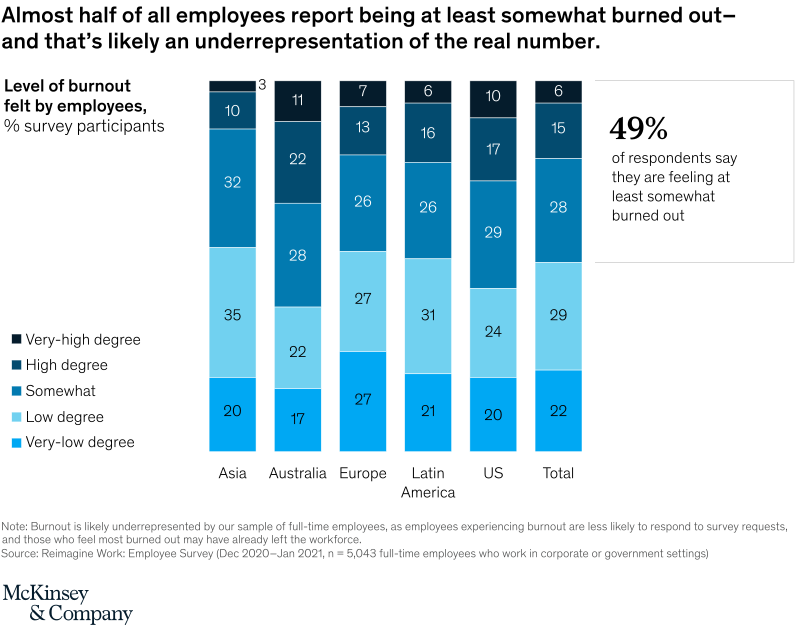
April 16, 2021 – Burnt out employees are less likely to respond to survey requests about said burnout, and the most burned-out employees may already have left the workforce. Of those employees who did respond to our survey, nearly half are experiencing burnout symptoms at work.
To read the article, see “What employees are saying about the future of remote work,” April 1, 2021.
customizer here
Visual form
Regional stacked column chart with side callout.
Layout / body structure
The chart places six stacked columns from left to right for Asia, Australia, Europe, Latin America, the US, and Total, then adds a large summary box on the right. Reader compares the composition of each regional bar first and then uses the 49 percent callout as the overall headline anchor.
What is being compared
It compares levels of employee burnout across regions, separating very-low, low, somewhat, high, and very-high degrees of burnout.
Measurement system
The measure is percent of survey participants. Each column is a full 100 percent stack with segment values printed inside the colored bands, and the side box summarizes the overall share who say they are at least somewhat burned out.
Visible structure inside the graphic
Every regional bar repeats the same five burnout categories in a consistent color order from very low at the bottom to very high at the top. That repeated stack structure lets the reader compare both the overall burden and whether burnout is concentrated more in the middle or upper bands in each region.
Main takeaway from the visual
Burnout is widespread across every region, and nearly half of all employees are at least somewhat burned out overall. The Total column and the right-side 49 percent callout make the issue read as broad and systemic rather than concentrated in one outlier geography.
Key standout values or extremes
The Total column shows 22 percent very low, 29 percent low, 28 percent somewhat, 15 percent high, and 6 percent very high, which yields the 49 percent at-least-somewhat-burned-out headline. Asia has one of the largest somewhat segments at 32, the US shows a combined 27 in high plus very high, and Latin America has 31 in the low-degree band.
Controls / sequence, when applicable
This is a static chart image with no in-chart controls to operate.
Companion media, when applicable
There is no separate companion audio or video; the chart image is the full visual on this page.