Source page: McKinsey & Company
Commentary
The doors may be opening wider, but the halls remain narrow
Diversity & Inclusion | Private equity
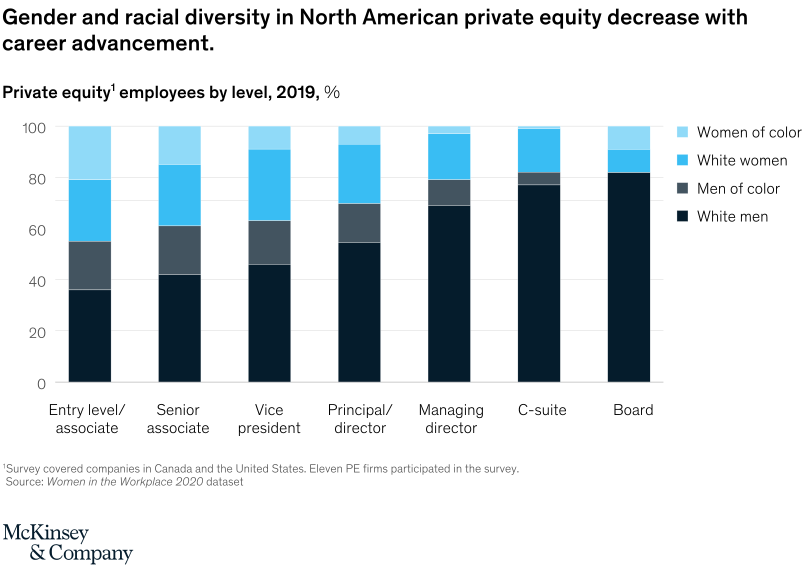
March 4, 2021 – On the whole, gender and racial diversity at private equity firms are stronger in entry-level positions than at the top.
To read the article, see “How private equity can catalyze diversity, equity, and inclusion in the workplace,” March 1, 2021.
customizer here
Visual form
Seven-column 100 percent stacked bar chart.
Layout / body structure
The chart is a single left-to-right career ladder from entry level or associate to board, with one stacked column for each rung. Reader reads across the ladder and compares how the same four demographic segments change size at each step.
What is being compared
It compares the gender and racial mix of North American private-equity employees at seven levels: entry level or associate, senior associate, vice president, principal or director, managing director, C-suite, and board. The four segments are women of color, White women, men of color, and White men.
Measurement system
The measure is percent of employees. Each column totals 100 percent, the y-axis runs from 0 to 100, and the legend ties each stacked color band to one demographic group.
Visible structure inside the graphic
Every column keeps the same stacking order, with White men forming the base, men of color above, White women above that, and women of color at the top. The non-White-male sections visibly narrow as the chart moves right, especially from principal or director onward.
Main takeaway from the visual
Diversity falls as seniority rises. Early-career roles are visibly more mixed, but upper-management, C-suite, and board bars are dominated by the White-men segment, which takes up most of the column by the far right.
Key standout values or extremes
White men rise from a little over one-third of entry-level roles to roughly four-fifths of the board, while women of color shrink from about one-fifth at the start to a sliver by managing director and C-suite. White women are strongest around the middle of the ladder at roughly one-fifth to one-quarter of vice-president and principal or director roles, then drop to under one-tenth on the board.
Controls / sequence, when applicable
This is a static chart image with no in-chart controls to operate.
Companion media, when applicable
There is no separate companion audio or video; the chart image is the full visual on this page.