Source page: McKinsey & Company
Commentary
How you change things is just as important as what you change
Leadership | Change management | North America
February 19, 2021 – New government leaders have a lot on their agendas—and little time to make things happen. One tip from our new memo: choose the approach that best suits the kind of change you seek and how much it will alter the organization.
To read the article, see “America 2021: Making change happen, against the odds,” February 19, 2021.
customizer here
Visual form
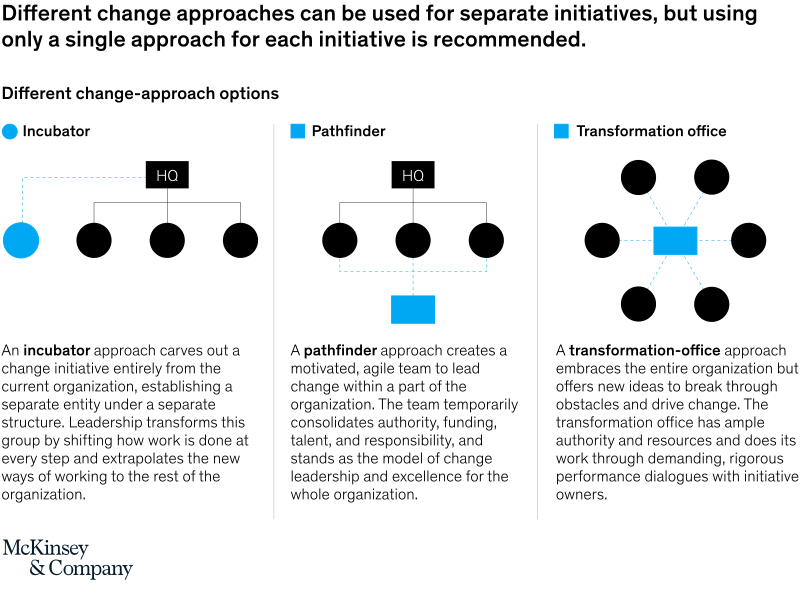
Three-panel organizational-diagram comparison.
Layout / body structure
The chart is split into three side-by-side concept panels labeled Incubator, Pathfinder, and Transformation office. Reader moves left to right across the page, using the repeated node-and-connector diagrams first and then the explanatory paragraphs beneath each panel.
What is being compared
It compares three different change-approach options for organizational initiatives: carving out a separate incubator, creating a pathfinder team inside one part of the organization, and using a transformation office that works across the whole organization.
Measurement system
This visual is structural rather than numeric. The comparison depends on the placement of nodes, the blue highlighted unit in each panel, the connector lines to HQ or surrounding groups, and the descriptive text that explains the role of each approach.
Visible structure inside the graphic
Each panel shows black circles for the surrounding organization and a blue shape for the active change vehicle. In the Incubator panel the blue node sits outside the main reporting line, in the Pathfinder panel the blue node sits below one part of the structure, and in the Transformation office panel the blue square sits at the center with dotted links radiating to the surrounding groups.
Main takeaway from the visual
The chart argues that different initiatives call for different change structures, but each initiative should commit to one operating model rather than mixing several at once. The three diagrams make the distinction visible by showing isolation, embedded leadership, and central orchestration as clearly different structural choices.
Key standout values or extremes
The most isolated design is the Incubator, where the blue node sits outside the main reporting chain. The most central design is the Transformation office, where the blue square connects to six surrounding nodes, while the Pathfinder sits in between as a focused team nested under one branch of the organization and linked back to HQ.
Controls / sequence, when applicable
This is a static chart image with no in-chart controls to operate.
Companion media, when applicable
There is no separate companion audio or video; the chart image is the full visual on this page.