Source page: McKinsey & Company
Commentary
Employees give virtual learning an A for effectiveness
COVID-19 | Capability building | Remote work
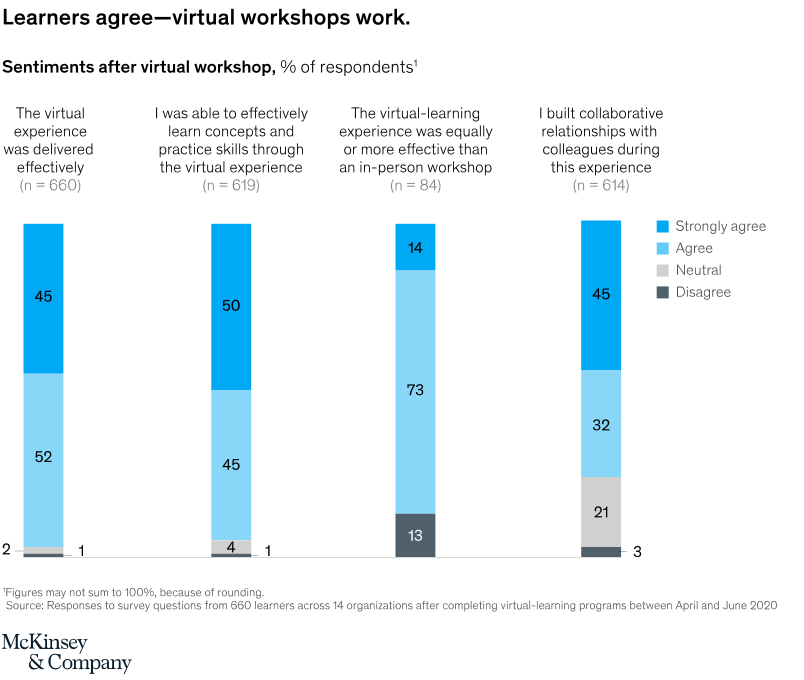
November 25, 2020 – Virtual workshops … work. Almost 90 percent of participants said the experience was equally or more effective than an in-person event. Nearly 80 percent built collaborative relationships with their colleagues.
To read the article, see “Closing the capability gap in the time of COVID-19,” November 13, 2020.
customizer here
Visual form
Stacked bar chart.
Layout / body structure
The chart is a single comparison panel built from stacked response bars. Read each bar left to right across the response segments, then compare the overall balance of positive, neutral, and negative responses across the measures shown.
What is being compared
It compares learner responses about whether a well-designed virtual-learning experience is less effective, equally effective, or more effective than an in-person workshop. The chart is comparing participant sentiment across evaluation categories rather than time periods.
Measurement system
The measure is share of respondents, expressed as percentages within each stacked bar. Segment labels and the left-to-right ordering of the stacks show how much of the audience falls into each response band.
Visible structure inside the graphic
Each bar is subdivided into response segments, with the positive and neutral portions grouped against a smaller negative remainder. The stacks are designed to make the favorable share visually dominant, so the reader can see quickly whether virtual learning clears the in-person benchmark.
Main takeaway from the visual
The chart shows that well-designed virtual learning is not viewed as a weak substitute for in-person workshops. Most respondents cluster in the equally effective or more effective portions of the bars, which makes the overall verdict clearly favorable.
Key standout values or extremes
The strongest numeric anchor is that 87 percent of learners said the virtual experience was at least as effective as an in-person event. The article also notes that nearly 80 percent said they built collaborative relationships with colleagues, reinforcing that the positive side of the stacks dominates the comparison.
Controls / sequence, when applicable
This is a static chart image with no in-chart controls to operate.
Companion media, when applicable
There is no separate companion audio or video; the chart image is the full visual on this page.