Source page: McKinsey & Company
Commentary
Finland sees promising results after nationwide experiment with universal basic income
Public Sector | Europe
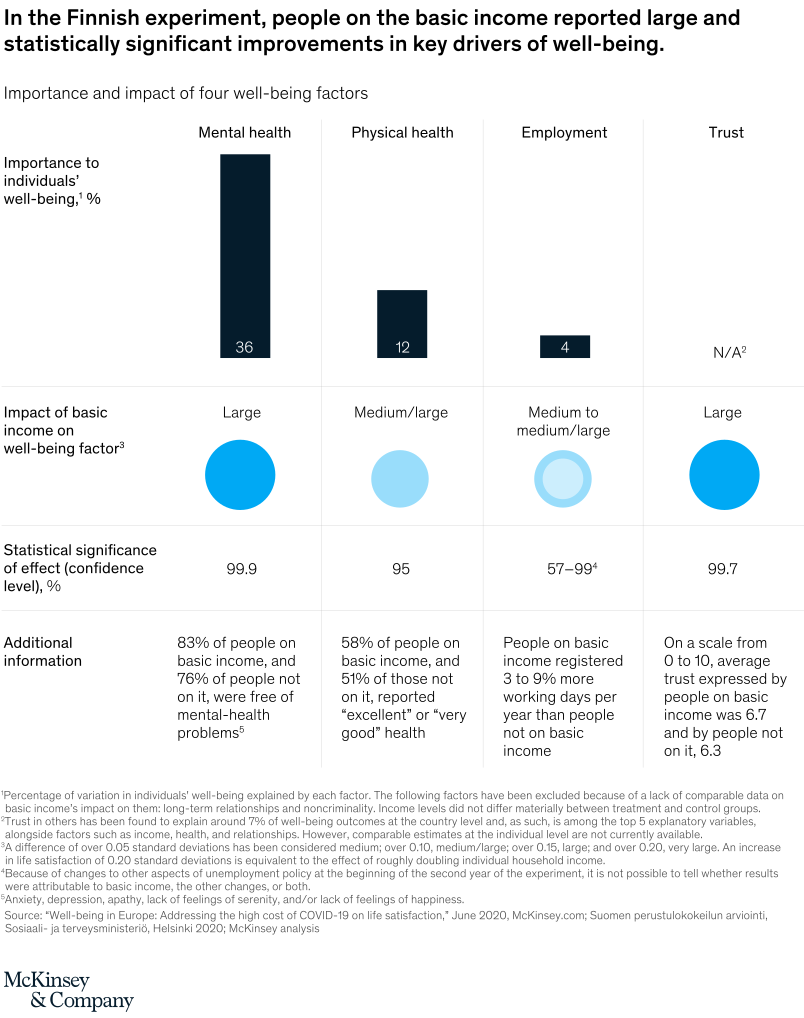
October 6, 2020 – The results of a two-year Finnish study of 2,000 unemployed people who were given a basic income showed a huge increase in life satisfaction versus the control group of all other unemployed people. They reported fewer mental-health issues, better physical health, slightly higher employment levels, and more trust in their future.
To read the article, see “An experiment to inform universal basic income,” September 15, 2020.
customizer here
Visual form
Bar Chart: multi-row treatment-versus-control comparison of universal-basic-income outcomes.
Layout / body structure
The chart is organized as repeated outcome rows. For each well-being measure, the basic-income group is compared with the control group using the same visual structure.
What is being compared
It compares participants in Finland’s universal-basic-income experiment with the broader unemployed control group across life satisfaction, mental well-being, physical health, employment, trust, and related well-being drivers.
Measurement system
The measures are survey-based outcome scores and treatment-control differences. Each row uses the same comparison logic so the viewer can scan which group reports better outcomes.
Visible structure inside the graphic
Most rows tilt in favor of the basic-income group, creating a repeated positive pattern rather than a single isolated result.
Main takeaway from the visual
The chart shows that Finland’s basic-income experiment produced broad improvements in well-being measures, not just a narrow employment result.
Key standout values or extremes
The experiment covered 2,000 unemployed people over two years, with participants receiving EUR560 per month. The strongest pattern is the basic-income group’s better results for life satisfaction, mental health, physical health, and trust in the future.
Controls / sequence, when applicable
This is a static treatment-versus-control bar chart; there are no in-chart controls to operate.
Companion media, when applicable
There is no separate companion audio or video; the universal-basic-income outcomes chart is the full visual on this page.