Source page: McKinsey & Company
Commentary
True zero-emissions cars are possible only if carmakers and customers decide they’re worth the added cost
Automotive | Abatement | Sustainability
September 24, 2020 – As tailpipe emissions decline, the auto industry needs to understand how much it will cost to decarbonize production of the materials that go into electric cars (such as aluminum, plastics, and batteries). Then they have to decide how much added cost they—and their customers—are willing to bear on the path to zero emissions.
To read the article, see “The zero-carbon car: Abating material emissions is next on the agenda,” September 18, 2020.
customizer here
Visual form
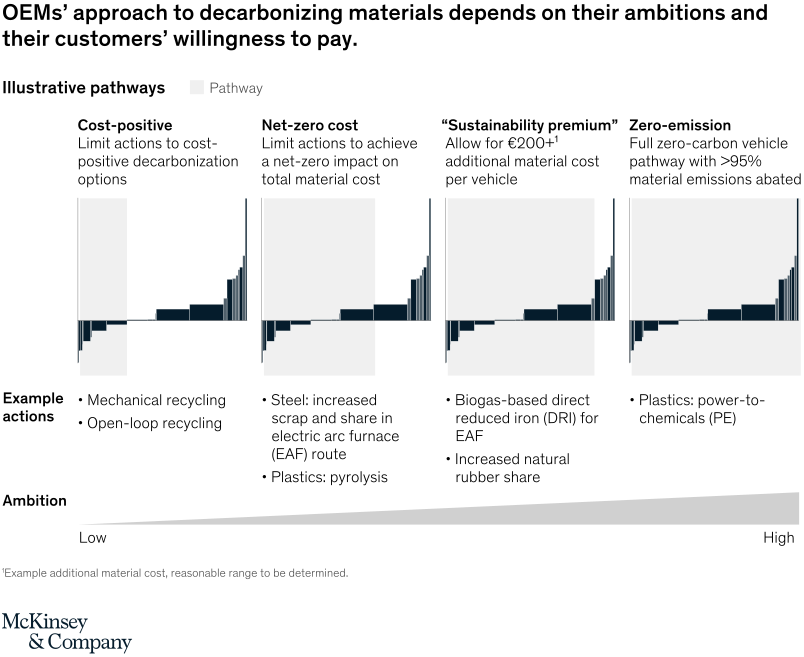
Table (with Visual Encoding): four-row automotive-materials decarbonization pathway matrix.
Layout / body structure
The matrix is organized by ambition level, moving from lower-cost pathways at the top toward the most ambitious zero-emission pathway at the bottom. Each row pairs a pathway label with cost framing and example material actions.
What is being compared
It compares OEM choices for decarbonizing automotive materials, from cost-positive measures through net-zero-cost options, sustainability-premium actions, and full zero-emission ambition.
Measurement system
The framework combines qualitative pathway tiers with explicit cost and abatement cues. The key labels are cost-positive, net-zero cost, sustainability premium, and zero-emission.
Visible structure inside the graphic
The four horizontal rows list actions such as mechanical recycling, open-loop recycling, electric-arc-furnace steel, plastics pyrolysis, biogas-based direct reduced iron, natural-rubber substitution, and power-to-chemicals plastics.
Main takeaway from the visual
The chart shows that material decarbonization for cars depends on how much cost and ambition OEMs and customers are willing to accept. True zero emissions sits at the far end of that pathway.
Key standout values or extremes
The sustainability-premium row allows more than EUR200 of additional material cost per vehicle. The zero-emission pathway is labeled as abating more than 95 percent of material emissions.
Controls / sequence, when applicable
This is a static visually encoded pathway table; there are no in-chart controls to operate.
Companion media, when applicable
There is no separate companion audio or video; the automotive-materials pathway matrix is the full visual on this page.