Source page: McKinsey & Company
Commentary
Carbon capture, use, and storage could create significant ‘negative emissions’ by 2030
Climate change | Abatement
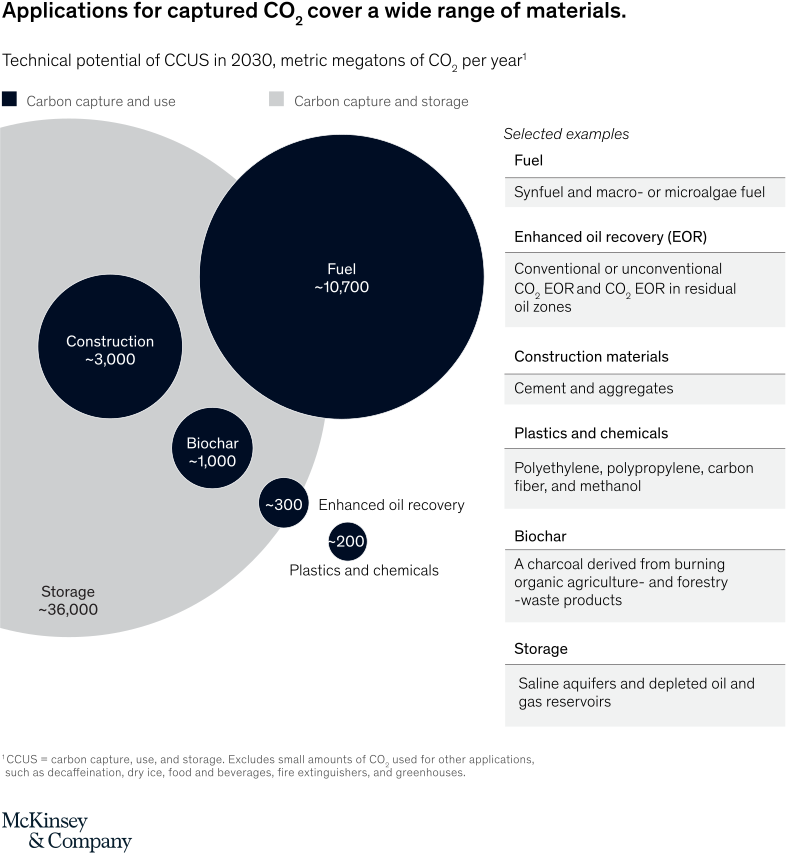
September 23, 2020 – Capturing the CO2 produced by hard-to-abate sectors—such as cement and steel production—helps prevent it from being released into the atmosphere. Then it can be stored or used for making fuel, cement, plastics, or a range of other materials.
To read the article, see “Driving CO2 emissions to zero (and beyond) with carbon capture, use, and storage,” June 30, 2020.
customizer here
Visual form
Table (with Visual Encoding): CCUS application portfolio with category groups and CO2-potential callouts.
Layout / body structure
The graphic is organized into application families across the page. Each family contains selected use examples and a large potential figure, so the reader compares categories first and then the examples inside each category.
What is being compared
It compares the 2030 technical potential of carbon-capture, use, and storage applications including fuel, construction materials, enhanced oil recovery, plastics and chemicals, storage, and biochar.
Measurement system
The measure is metric megatons of CO2 per year in 2030. Large labeled figures show the scale of each application family.
Visible structure inside the graphic
Storage dominates the right side with the largest magnitude, while fuel and construction materials form the next largest groups. Smaller application families include plastics and chemicals, enhanced oil recovery, and biochar.
Main takeaway from the visual
The chart shows that CCUS is a portfolio of pathways rather than one single use case, with storage carrying the largest technical potential and several use-based routes contributing smaller but meaningful capacity.
Key standout values or extremes
Storage is shown at roughly 36,000 metric megatons of CO2 per year, fuel at about 10,700, construction at about 3,000, biochar around 1,000, plastics and chemicals around 300, and enhanced oil recovery around 200.
Controls / sequence, when applicable
This is a static visually encoded category table; there are no in-chart controls to operate.
Companion media, when applicable
There is no separate companion audio or video; the CCUS application portfolio is the full visual on this page.