Source page: McKinsey & Company
Commentary
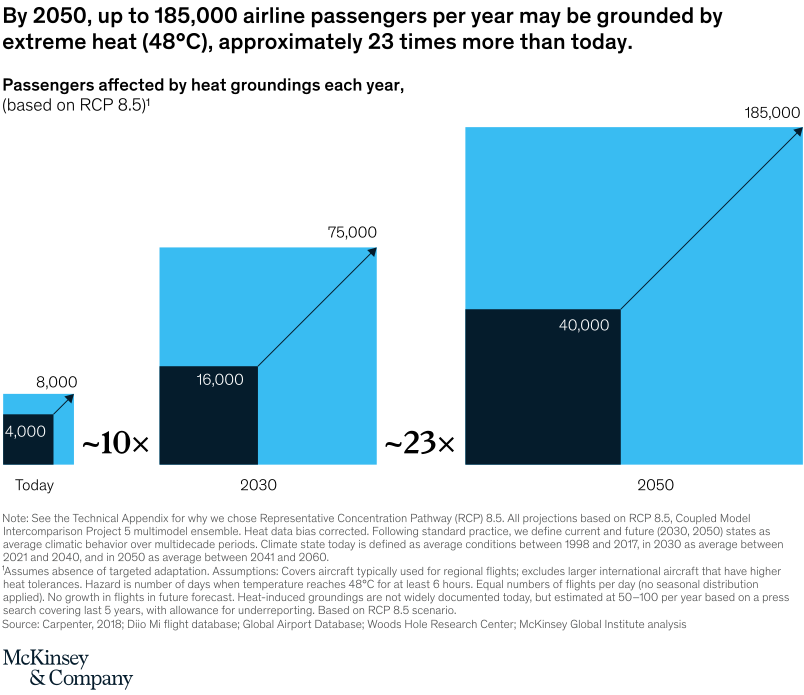
By 2050, extreme heat could ground 23 times more airline passengers than today
Climate change | Travel
September 22, 2020 – Extreme heat already disrupts global air travel, grounding about 4,000 to 8,000 passengers per year today. If airlines and airplanes don’t adapt to the changing climate, up to 185,000 passengers could be grounded per year by 2050.
To read the article, see “Will infrastructure bend or break under climate stress?,” August 19, 2020.
customizer here
Visual form
Bar Chart: three time-point range columns for airline passengers grounded by extreme heat.
Layout / body structure
The chart reads left to right from today to 2030 to 2050. Each time point is shown as a vertical range marker, with boxed callouts explaining the multiplication versus today’s disruption level.
What is being compared
It compares the annual number of passengers affected by heat-related airline groundings across today, 2030, and 2050 under a no-adaptation case.
Measurement system
The measure is passengers affected per year, shown in thousands. Each time point is a range rather than a single estimate.
Visible structure inside the graphic
The current range is short, the 2030 range is much taller, and the 2050 range is taller again. The future callouts translate those range increases into multiples of today’s grounding level.
Main takeaway from the visual
The chart shows that extreme heat could turn from a limited current disruption into a much larger aviation operating risk by midcentury if adaptation does not occur.
Key standout values or extremes
Today is 4 to 8 thousand passengers affected per year, 2030 is 16 to 75 thousand, and 2050 is 40 to 185 thousand. The headline multiplier is up to about 23 times today’s level by 2050.
Controls / sequence, when applicable
This is a static range-column bar chart; there are no in-chart controls to operate.
Companion media, when applicable
There is no separate companion audio or video; the extreme-heat grounding chart is the full visual on this page.