Source page: McKinsey & Company
Commentary
Survey says masks will be on people's faces at least through early 2021
COVID-19 | Public Health
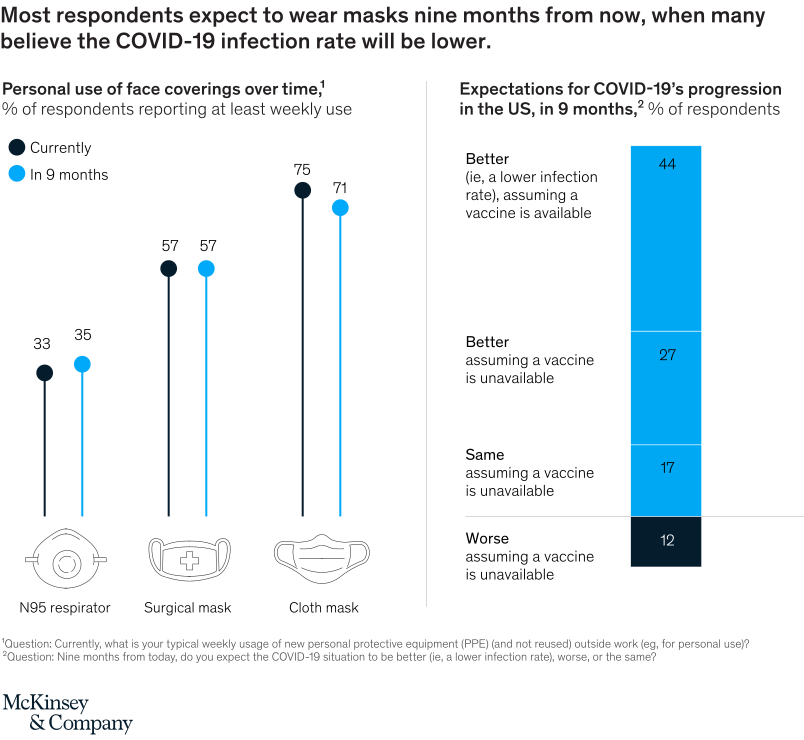
July 14, 2020 – As of late May/early June, 88 percent of respondents in the United States thought the coronavirus infection rate would be the same or lower in the first quarter of 2021—whether there’s a vaccine or not. But most expect to still be wearing masks.
To read the survey, see “Survey: In the US, people say their use of masks may endure,” July 1, 2020.
customizer here
Visual form
Scatter Plot and Stacked Bar / Stacked Column: paired mask-use dots with a stacked COVID-19 outlook bar.
Layout / body structure
The left panel uses paired dots to compare current use and expected use in nine months for N95 respirators, surgical masks, and cloth masks. The right panel uses a stacked bar to show respondent expectations for the US COVID-19 situation nine months out.
What is being compared
It compares current and expected future use of different face coverings, then places those usage expectations beside beliefs about whether the US COVID-19 situation will improve, stay the same, or worsen.
Measurement system
All values are percent of respondents. The mask-use panel reports at least weekly use, while the outlook panel reports shares by expectation category.
Visible structure inside the graphic
Cloth masks have the highest current and future-use dots, surgical masks stay flat, and N95 respirators rise slightly. The outlook bar is dominated by better-outlook segments, even though mask use remains high.
Main takeaway from the visual
The chart shows that respondents expected mask wearing to persist even as many expected the infection situation to improve. Mask behavior was becoming a continuing public-health habit rather than only an immediate-crisis response.
Key standout values or extremes
Cloth-mask use is 75 percent currently and 71 percent in nine months. Surgical masks are 57 percent in both periods, and N95 respirators move from 33 percent to 35 percent.
Controls / sequence, when applicable
This is a static paired-dot and stacked-bar chart; there are no in-chart controls to operate.
Companion media, when applicable
There is no separate companion audio or video; the mask-use and outlook chart is the full visual on this page.