A word is a stable form that bundles multiple distinct meanings, performs specific grammatical functions, occupies a defined position in a semantic network, and embodies the historical path that shaped its structure and use.
Lexical Codex
Lexical Codex is a centralized reference for words and their meanings within a single, structured system. It provides clear definitions, identifies parts of speech, and records core relationships between words to support consistent usage and analysis. The emphasis is on precision, clarity, and reuse rather than stylistic variation. The Lexical Codex serves as the authoritative word reference for the framework, ensuring that terms are defined once, maintained consistently, and interpreted unambiguously.
Verba Disciplinae
Some areas depend on a specialized vocabulary that does more than label things; these words carry the conceptual machinery of entire disciplines. Each term encodes a precise operation—measuring, classifying, relating, constraining, or explaining phenomena. When a word appears, it brings with it a structured way of thinking: a definition anchored in evidence, a role within a theory, and a set of assumptions about how the world works. This section isolates those terms and makes their underlying meaning explicit, showing how the language shapes the structure, logic, and explanatory power of inquiry.
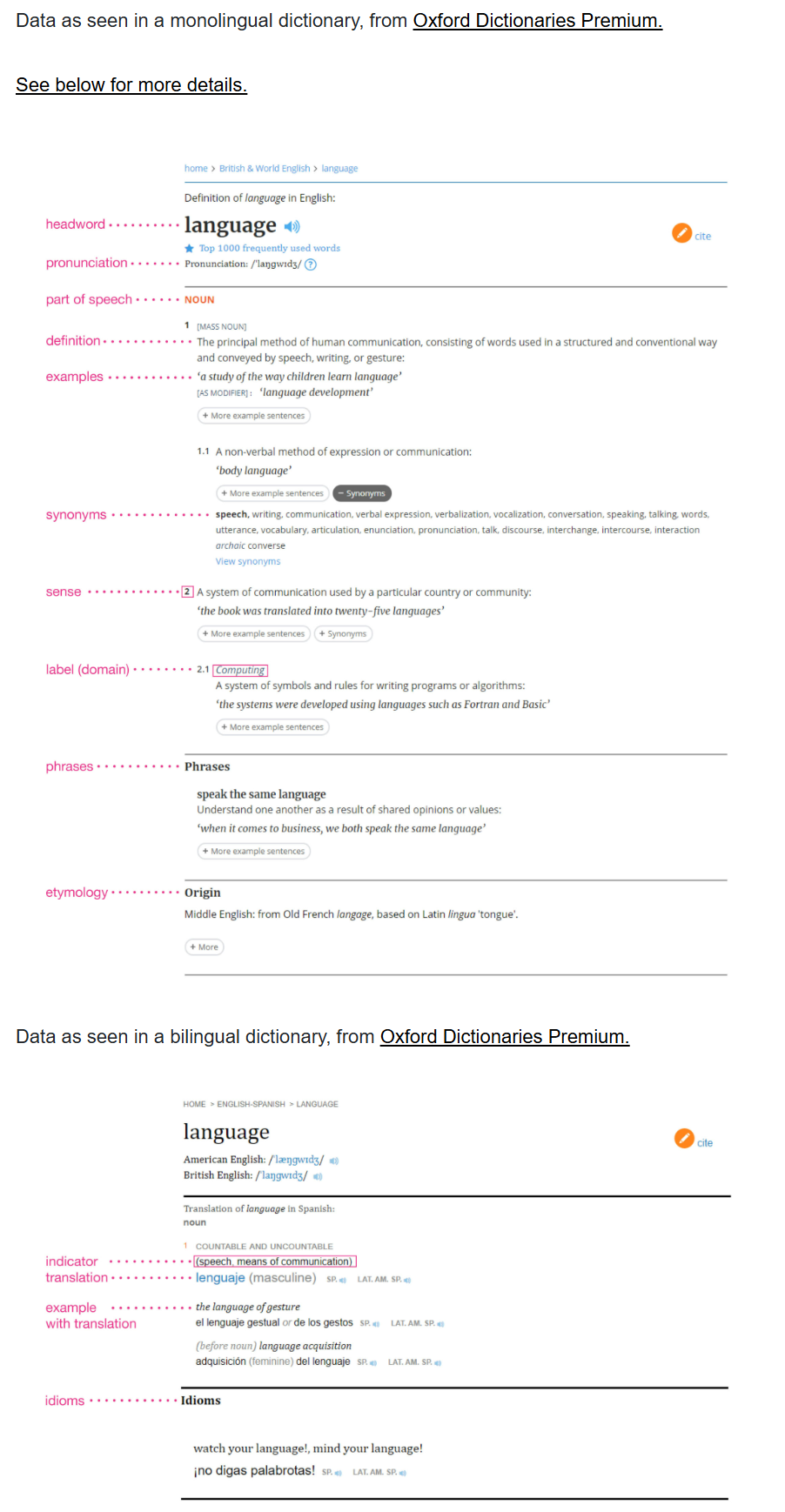
| Entry: | One word in the dictionary with all its information: senses, translations/definitions, examples, etc. |
| Headword: | A headword is a word as you would look it up in a dictionary, e.g. the word cat, but not the word cats. All other features, like examples, phrasal verbs, idioms, etc. are listed under the headword. A headword can be a single word, but also e.g. an abbreviation (ETA), or a compound word (cat flap). |
| Definition: monolingual and semi-bilingual dictionaries only | Explains what the headword means, in the same language as the headword. |
| Translation: bilingual and semi-bilingual dictionaries only | The translation of the headword. This is the equivalent of the headword that would be used in the same position in the sentence with the same function. Sometimes a one-word headword can have a translation that consists of more than one word, e.g. English advisedly has the Spanish translation con conocimiento de causa, or vice versa, e.g. English in any case has the German translation jedenfalls. |
| Part of speech: | Tells you whether a word is a noun, verb, etc. |
| Pronunciation: | Tells you how a word is pronounced, either by IPA, respell, transliteration, or audio. |
| Sense: | Many words have more than one meaning, e.g. table as furniture or table as the periodic table. These different meanings are called senses, and they are separated and each given their own definition or translation. |
| Indicator: bilingual dictionaries only | Gives a short description of each sense. Indicators help the user find the sense of the headword they want to translate and guide them to the right translation. |
| Label: | Gives extra information on word or sense. There are three types of label: Register label: Tells you whether a certain word or sense is formal, vulgar, offensive, etc. These labels are especially important for identifying sensitive content. Region label: Tells you whether a certain word or sense is only found in a particular area, e.g. US or British English. Domain label: Tells you that a certain word or sense is particularly used in a specific field, e.g. Medicine or Law. |
| Gloss: bilingual dictionaries only | If there is no translation for a particular word or sense, a short description can be given in the target language, so speakers of that language still can understand what the word means; e.g. there is no equivalent of the Arabic word musahharati in English, so the Arabic-English dictionary gives person who walks the streets during Ramadan to wake up people for the morning meal, typically using a drum and calling. This is like a definition, but it is in the target language. |
| Glossarial note: bilingual dictionaries only | Gives extra information on the translation; if the translation is less specific than the headword; e.g. harvest moon: pleine lune (de l’équinoxe d’automne). |
| Example: | An example shows the headword inside a sentence or phrase. Usually examples in monolingual dictionaries show a typical use of the headword. Examples in bilingual dictionaries may do the same, or show a use that is particularly noteworthy for learners or translators. In bilingual (and some semi-bilingual) dictionaries, examples usually have translations. |
| Idiom/phrase: | An idiom is a phrase whose meaning can’t be derived from its individual words, e.g. over the moon, upset the apple cart, it’s raining cats and dogs. |
| Phrasal verb: | A phrasal verb is a verb used with an adverb or preposition carrying a specific meaning, e.g. break down, see to, look down on. |
| Etymology: | An etymology explains the historical origin of the word. Depending on the style of the dictionary, an etymology can be as simple as stating the language the word came from or may give an extensive narrative description. |
| Synonyms: | Synonyms are different words which mean the same thing as a headword or sense. Some dictionaries give synonyms as well as translations or definitions. |
| Antonyms: | Antonyms are words which mean the opposite of a headword or sense. Some dictionaries give antonyms, and some thesauruses do. |