Economics is the study of how human beings navigate scarcity, make choices, and coordinate their actions in systems where resources, information, and opportunities are limited. It examines the principles that govern decision-making and the patterns that emerge when those decisions accumulate into markets, institutions, and entire economies. Unlike other social sciences that focus on culture, politics, or social structure, Economics isolates the mechanisms that shape behavior through incentives, constraints, and tradeoffs. Its aim is not to describe what people believe or how societies ought to function, but to explain the forces that determine production, consumption, exchange, and growth across different scales of human activity. This focus on allocation and coordination sets Economics apart and gives it a unified analytical identity across its many applications.

Although Economics spans an enormous range of questions, its concepts fall naturally into three levels of analysis distinguished by the number of decision-makers involved and the scale at which outcomes take shape. At the most basic level lies the domain of choice, where a single individual or firm confronts scarcity and must decide how to allocate limited resources given preferences, constraints, risk, and information. These decisions can be analyzed entirely in isolation; their outcomes depend on no one else. When multiple decision-makers interact, however, a different logic emerges. Prices form, markets coordinate, strategies collide, and institutions must create incentives that align private behavior with collective outcomes. This is the domain of interaction, where the behavior of each participant is shaped by the behavior of others. Beyond local exchanges lies the system-wide perspective of aggregation and dynamics, where millions of individual and strategic decisions accumulate into patterns of output, employment, inflation, growth, and cyclical fluctuations that unfold over time. These three analytical scales—choice, interaction, and aggregation—provide the structural backbone of Economics and determine where each concept properly belongs within the discipline.
| Branch Name | Focus | Examples |
|---|---|---|
| Choice (Microeconomic Foundations) | How individuals and firms make decisions under constraints: preferences, tradeoffs, optimization, marginal reasoning, risk, time, and information. | Utility maximization, production and cost functions, marginal analysis, opportunity cost, intertemporal choice, expected utility, risk aversion, Lagrangian optimization, behavioral deviations (prospect theory, bounded rationality), welfare measures (Pareto efficiency, compensating/equivalent variation). |
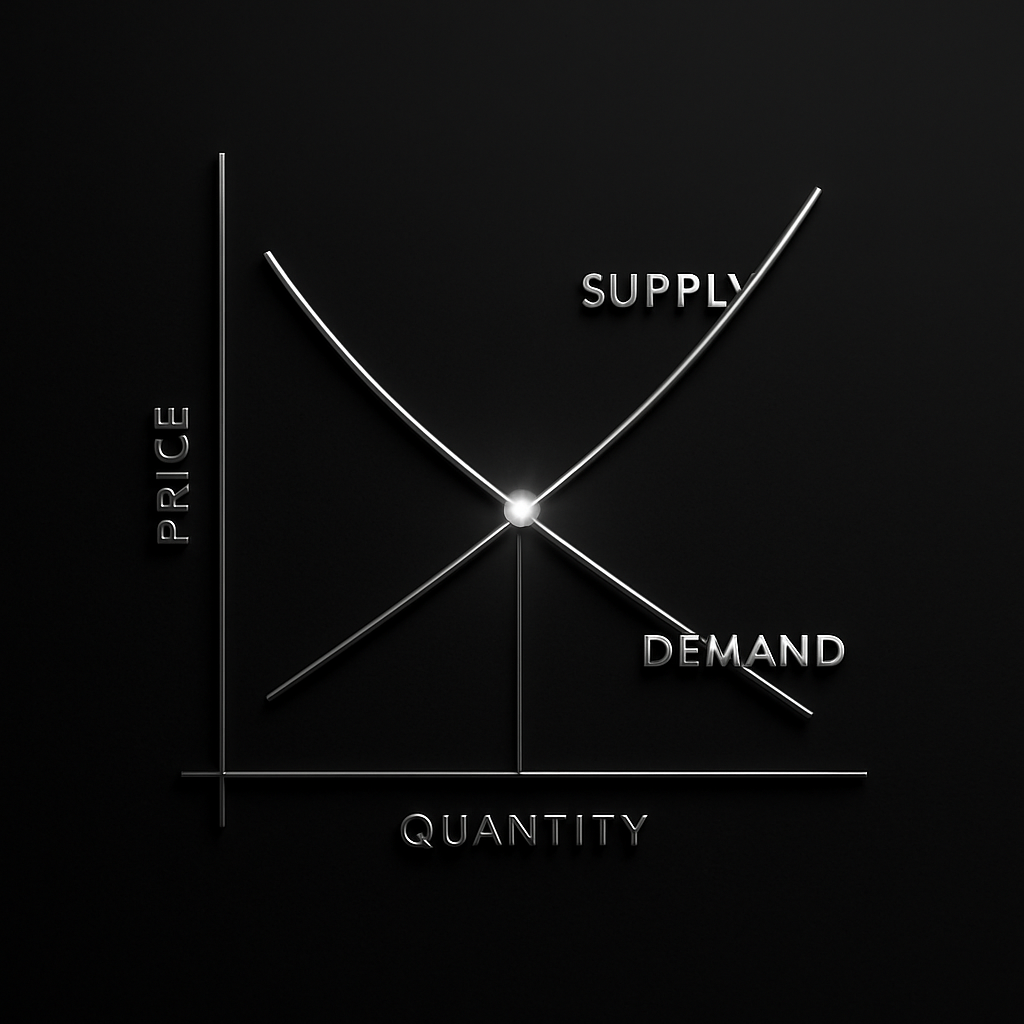
| Interaction (Markets, Strategy & Mechanisms) | How multiple decision-makers coordinate, compete, or strategize through markets, prices, institutions, and engineered allocation systems. | Supply/demand, elasticity, price formation, market power, externalities, public goods, Pigouvian remedies, Coase theorem, Nash equilibrium, game theory, auctions, matching theory, incentive-compatible mechanisms, general equilibrium (Arrow–Debreu), comparative statics, competitive vs. monopolistic market structures. |
| Aggregation & Dynamics (Macroeconomic Systems) | How individual and strategic interactions scale into economy-wide behavior over time, generating growth, cycles, employment patterns, inflation, and dynamic responses to shocks. | GDP and aggregate output, unemployment, inflation, interest rates, IS-LM, AD-AS, Solow growth, endogenous growth theory, RBC and DSGE models, expectations (rational/adaptive), monetary policy (Taylor rule, liquidity traps, QE), fiscal multipliers, debt and deficits, shock propagation, VAR/SVAR, long-run and short-run adjustment dynamics. |
Together, these domains define the operational structure of Economics. Each captures a different layer of how resource allocation and coordination unfold: individual choice establishes the foundational logic of decision-making; interaction explains how those decisions shape and are shaped by markets, strategies, and institutional mechanisms; and aggregation reveals how the combined behavior of many agents generates the large-scale patterns observed in entire economies. Nothing essential to economic inquiry lies outside these three levels, and no concept within them depends on the frameworks of the other social sciences. This structure forms the complete analytical map of the discipline—the framework through which economists interpret decisions, coordination, and the evolution of economic systems over time.






How the Fields of Economics Relate
Economics is built on a vertically layered framework in which each domain expands the scope of analysis without replacing the layers beneath it. Choice provides the micro-level logic through which individuals and firms make decisions under constraints. Interaction explains how those decisions meet, influence, or counteract one another through markets, strategic behavior, and engineered mechanisms. Aggregation and Dynamics extend this logic to the system-wide level, revealing how millions of coordinated and uncoordinated actions generate the broad patterns that characterize entire economies. Each field depends on the one below it, yet introduces new phenomena that cannot be reduced to lower-level components. Together, they form a coherent structure for understanding economic behavior from the individual to the global system.
1. Choice → the foundational logic of economic behavior
Choice provides the basic decision-making calculus underlying all economic outcomes.
It determines how individuals and firms respond to:
- preferences
- constraints
- prices
- risk
- time
- information
This domain generates:
- utility maximization
- cost minimization
- marginal conditions
- welfare measures
Choice supports every higher-level concept because markets, strategies, and aggregates all depend on how individual units behave when faced with scarcity.
2. Interaction → coordination, conflict, and strategic structure
Interaction emerges when multiple agents make decisions simultaneously.
Here, the behavior of each participant depends on the anticipated behavior of others.
This domain introduces:
- supply and demand
- price formation
- market power
- externalities
- Nash equilibrium
- auctions and matching
- mechanism design
- general equilibrium
Interaction cannot be solved by Choice alone, because these outcomes arise from mutual adjustments rather than isolated optimization.
Interaction takes the logic of Choice and embeds it in a multi-agent environment where coordination, incentives, and institutional design determine final outcomes.
3. Aggregation & Dynamics → economy-wide behavior over time
Once interactions accumulate across entire populations, new phenomena appear that cannot be explained at the micro or market levels.
Aggregation and Dynamics study:
- output and growth
- unemployment and inflation
- consumption and investment patterns
- business cycles
- shock propagation
- monetary and fiscal dynamics
- expectations across time
This field treats the economy as a dynamic system whose behavior evolves in response to technology, policy, demographics, and coordinated expectations.
Aggregation relies on both Choice and Interaction, yet introduces new structures—macro identities, propagation mechanisms, equilibrium paths—that do not exist at lower scales.





The Structure in One Chain
Choice establishes how individuals and firms respond to scarcity.
Interaction shows how their decisions shape markets and strategic environments.
Aggregation reveals how these interactions produce the large-scale patterns of economic growth, cycles, and adjustment over time.
Together, these fields form the complete analytic architecture of Economics.