Linguistics is the scientific study of human language as a structured, rule-governed system. It seeks to identify the principles that underlie the sounds, words, and sentences that speakers produce, as well as the mechanisms by which meaning emerges from linguistic form. Unlike the neighboring fields that examine culture, cognition, communication, or social interaction, Linguistics focuses on language itself—its architecture, its constraints, and its generative potential. The discipline aims to reveal the universal properties of human language, the specific rules that differentiate one language from another, and the formal structures that allow finite speakers to produce and understand an infinite range of expressions. Linguistics treats language not as culture, not as behavior, and not as rhetoric, but as a uniquely human computational system encoded in grammar.



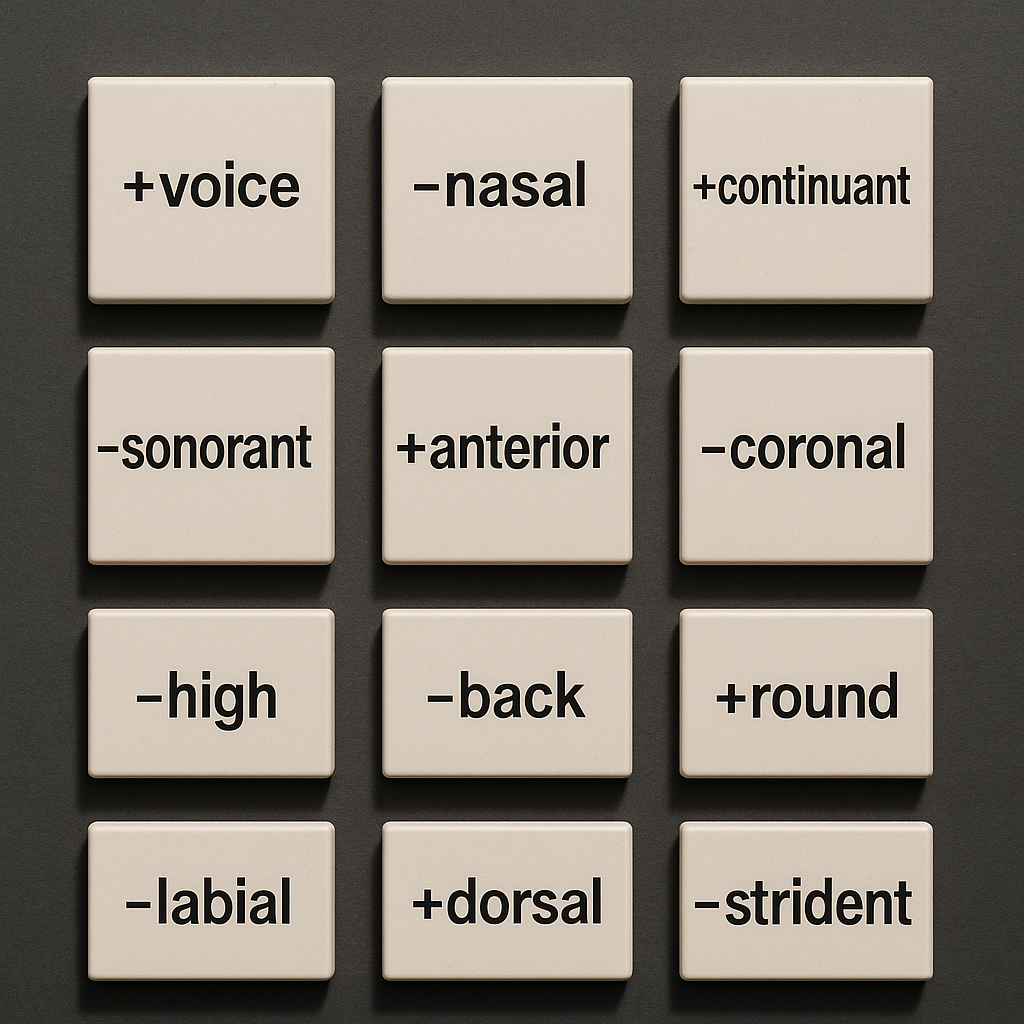

The table below presents the core analytical structure of Linguistics, grounded in the mechanisms that define language as a formal system. While academic departments may organize themselves into a variety of subfields, the scientific foundations of linguistics consistently reduce to the major components of grammatical architecture: the sound system, the structure of words, the structure of sentences, and the systems of meaning encoded and inferred through linguistic expressions. Each of these domains isolates a distinct layer of the language faculty, allowing researchers to analyze the generative rules that shape linguistic form and interpretation. Together, they form a coherent framework for understanding how languages are built, how they differ, and what universal principles underlie their structure.
| Branch Name | Focus | Examples |
|---|---|---|
| Phonetics & Phonology | The physical and cognitive systems that govern the production, perception, and patterning of speech sounds. | Articulatory and acoustic phonetics, phonological features, syllable structure, stress and tone systems, phonotactics, assimilation and lenition, prosody, distinctive features, phonological alternations. |
| Morphology | The internal structure of words and the rules by which meaningful units (morphemes) combine to create complex forms. | Inflection, derivation, compounding, reduplication, morphological parsing, case marking, agreement systems, morpheme ordering, allomorphy. |
| Syntax | The rules and hierarchical structures that govern how words combine into phrases and sentences. | Phrase structure, constituency, recursion, grammatical relations, movement and binding, agreement, case assignment, syntactic trees, generative syntax frameworks. |
| Semantics | The formal mechanisms by which linguistic expressions convey meaning, independent of context. | Truth-conditional interpretation, predicate logic representations, quantifiers, scope, entailment, presupposition (formal), compositional meaning, lexical semantics. |
| Pragmatics | The study of meaning in context—how speakers use language to communicate intentions, draw inferences, and manage interaction. | Implicature, presupposition triggers, deixis, speech acts, conversational maxims, reference, discourse coherence principles, context-dependent interpretation. |
Together, these fields capture the full structural architecture of human language. Each isolates a fundamental component of the linguistic system: the organization of sounds, the internal composition of words, the hierarchical structure of sentences, the meanings derived from linguistic form, and the contextual inferences that make communication possible. Nothing essential to linguistic theory lies outside these domains, and none of them depends on the explanatory frameworks of psychology, sociology, anthropology, or the humanities. By focusing on the mechanisms that make human language both richly expressive and formally constrained, this framework provides a precise and comprehensive foundation for understanding how languages are structured and how their speakers generate and interpret an infinite range of expressions.





How the Fields of Linguistics Relate
Linguistics is structured around the layered architecture of human language. Each field explains one component of the grammatical system, but none of them functions in isolation. Phonetics and Phonology describe the system of sounds and the abstract patterns that govern their organization; Morphology explains how those sound patterns combine into meaningful word forms; Syntax accounts for the hierarchical rules that assemble words into grammatical sentences; Semantics defines the formal interpretations of those structures; and Pragmatics captures how context, intention, and inference refine what speakers mean. These domains form an integrated system: outputs from one level become inputs to the next, and constraints at each level shape the possibilities at all others. Together, they reveal how language operates as a generative, compositional, rule-governed system.
1. Phonetics & Phonology → the sound foundation
Phonetics and Phonology govern the physical realization and cognitive organization of speech sounds.
They define:
- the inventory of sounds in a language, including which contrasts are meaningful and which are not,
- the permissible sound combinations, determining which sequences can form syllables or words,
- stress, tone, and intonation patterns, which contribute to rhythm and prosody, and
- the alternations and sound changes that arise from systematic constraints in the grammar.
Phonological forms provide the raw material for Morphology: the sound units that can be assembled into words, inflected, or derived.
They also influence Syntax by signaling grouping, emphasis, or boundaries through prosodic cues, and by determining how meaning-bearing elements are phonetically expressed in real speech.
Sound patterns form the first layer of linguistic structure.
2. Morphology → the word-formation foundation
Morphology explains how meaningful units combine to create words.
It studies:
- stems, affixes, and roots,
- inflectional and derivational systems,
- compounding and reduplication,
- agreement marking, and
- the rules governing word shape, such as how tense, number, or case are expressed.
Morphology mediates between sound and syntax.
Phonology constrains how morphemes are realized,
while Syntax determines how the resulting words participate in larger structures.
In this sense, Morphology is the bridge connecting phonological form to syntactic function.
Words are the building blocks with which Syntax constructs sentences.
3. Syntax → the structural foundation
Syntax provides the hierarchical blueprint for combining words into phrases and sentences.
It defines:
- constituent structure,
- grammatical relations,
- recursion, which allows for infinite expression,
- agreement dependencies, and
- movement operations, which rearrange elements while preserving meaning.
Morphological properties determine how words behave syntactically,
and syntactic structures serve as inputs for semantic interpretation.
Syntax organizes linear sequences into abstract configurations that support infinite generative capacity.
Syntax is the framework that gives language its combinatorial power.
4. Semantics → the interpretive foundation
Semantics assigns formal meaning to syntactic structures.
It analyzes:
- truth-conditions,
- quantification and scope,
- logical form,
- lexical relations, and
- entailments and presuppositions that arise from sentence structure.
Semantics relies on Syntax to supply structured input,
and it provides the interpretive base upon which Pragmatics operates.
It describes what sentences mean in principle, given their form, independent of speaker intention.
Semantics maps structure onto literal meaning.
5. Pragmatics → the contextual foundation
Pragmatics explains how speakers use linguistic expressions in context to convey intentions, manage inference, and coordinate communication.
It studies:
- implicature, where speakers mean more than they say,
- presupposition in use,
- deixis, which anchors meaning to context,
- reference,
- speech acts, and
- conversational structure that guides interpretation.
Pragmatics depends on Semantics for literal meaning,
draws on Syntax for cues to structure and emphasis,
and interacts with Phonology and Morphology through prosody, word choice, and form.
Pragmatics is where linguistic structure meets human intention.





The Structure in One Chain
Phonology determines the sound patterns languages permit.
Morphology builds words from those patterned units.
Syntax organizes words into structured expressions.
Semantics derives literal meaning from those structures.
Pragmatics embeds them in context to yield communicative force.
Together, these fields form the complete analytic architecture of human language.