Here are a table of major solar calendars, plus image examples.
Solar Calendars – Reference Table
| Calendar Name | Region / Civilization | Approx. Introduction | Structure | Intercalation / Leap Rule | Notes / Legacy |
|---|---|---|---|---|---|
| Egyptian Civil Calendar | Ancient Egypt | ~c. 3000-2500 BCE (Old Kingdom period) World History Edu+2Wikipedia+2 | 365 days: 12 months × 30 days + 5 epagomenal days Wikipedia+1 | No leap day: calendar drifted ~1 day every 4 years; “Sothic cycle” of 1460 years to realign with heliacal rising of Sirius Wikipedia+1 | One of the first purely solar calendars. Influenced later Egyptian-Ptolemaic systems; basis for later Coptic calendar. |
| Julian Calendar | Roman Empire | Introduced 46 BCE under Julius Caesar Wikipedia+2Wikipedia+2 | 365 days + 1 leap day every 4 years (i.e. average 365.25 days) Wikipedia+1 | Leap every 4 years without exception; causes ~1 day drift every 128 years vs tropical year Wikipedia | Used widely in Europe and its colonial empires until Gregorian reform; still used liturgically in some Orthodox churches. |
| Gregorian Calendar | Papal States / Catholic Europe → global | Instituted 1582 CE by Pope Gregory XIII Wikipedia+1 | 365 days + leap year roughly every 4 years, except century years not divisible by 400 (e.g. 1700,1800,1900 not leap; 2000 was) → average year ~365.2425 days Calendar+2Wikipedia+2 | Leap rule as above; helps align calendar with tropical year; reduces drift hugely vs Julian Wikipedia+1 | Most widely used civil calendar globally; standard for international commerce, science, etc. |
| Maya Haabʼ (civil solar year) | Maya civilization, Mesoamerica | In use by 1st millennium BCE / early classical period (~c. 300-100 BCE, certainly by 1st century CE) EBSCO+2Wikipedia+2 | 365-day year = 18 “months” (uinal) × 20 days + 5 extra days (“wayeb” / nemontemi) EBSCO+1 | No leap day: calendar drift relative to tropical seasons over centuries EBSCO+1 | Used in parallel with ritual cycles (Tzolkʼin, Long Count); still has cultural importance among Maya communities; not used for growing seasons in a fixed way because drift exists. |
| Iranian / Jalālī / Solar Hijri | Persia / Iran / Afghanistan | Jalālī calendar established 1079 CE; its descendant, Solar Hijri, reinforced in 20th century Wikipedia+2Wikipedia+2 | Solar year aligned with vernal equinox; typically 12 months whose lengths determined by solar transit or astronomical observation arXiv+2Wikipedia+2 | Leap rules to maintain equinox alignment; precise seasonal keeping; in modern version, year begins at astronomical equinox arXiv | Highly accurate; considered among the best in matching tropical year; used as official calendar in Iran / Afghanistan. |
| Coptic Calendar | Egypt / Christians (Coptic Church) | Derived from ancient Egyptian solar calendar; in current form by ~4th century CE Wikipedia+2Wikipedia+2 | 365 days + leap day every 4 years; 13 months (12 × 30 days + epagomenal days) Wikipedia+1 | Same as Julian leap rule; drift vs Gregorian but used for liturgical purposes in Coptic Church Wikipedia | Still used liturgically and in Ethiopia/Eritrea (Ethiopian calendar) derived from this model. |
| Ethiopian / Geʽez Calendar | Ethiopia / Eritrea | Based on Coptic / Egyptian solar model; widely in use by Ethiopian Orthodox Church and civil in Ethiopia; era and epoch differ; c. early centuries CE for Christian Ethiopia expansion Wikipedia+1 | 365 days + 1 leap day every four years; 12 months of 30 days, plus 5 or 6 epagomenal days; New Year around September based on solar alignment Wikipedia+1 | Same leap rule as Julian/Coptic; one day inserted every 4 years without latter century exceptions; small drift vs Gregorian but modest for many centuries Wikipedia+1 | Used civilly in Ethiopia; its calendar differs by roughly 7–8 years from Gregorian due to different epoch. |
| Other Solar Calendars | Various (e.g. Indian National Calendar, Berber calendar, etc.) | Many solar calendars are reforms or regional civil calendars introduced in medieval or modern times Wikipedia+1 | Often follow Gregorian or Julian structure, sometimes adjust months by zodiac signs or sidereal solar markers Wikipedia+1 | Usually follow Gregorian‐style leap rules or astronomical equinox based rules; occasional regional peculiarities Wikipedia | These are mostly civil/regional calendars; many aligned for festivals, identity, or to keep agricultural timing accurate. |
Solar Calendars – Image Examples
A stylized depiction of the Egyptian solar calendar / zodiac wheel, showing astronomical symbols.
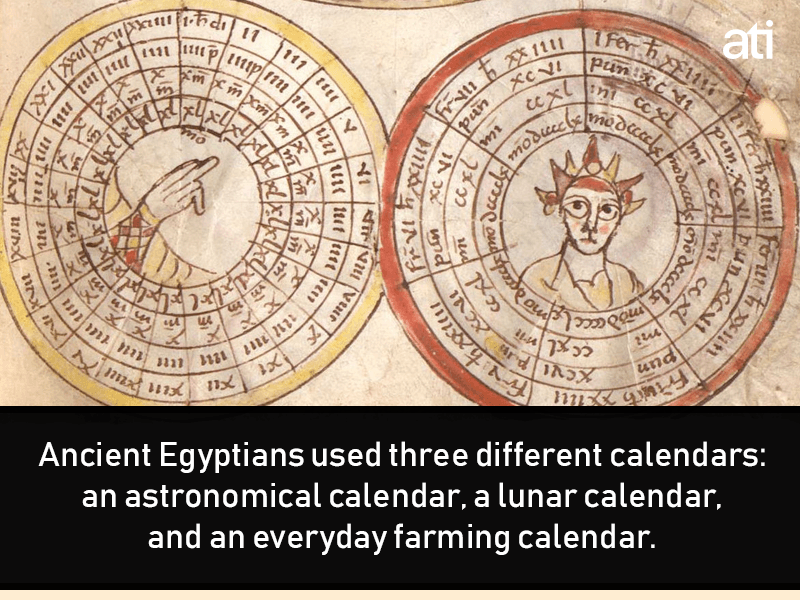
Diagram showing dual circular calendars (perhaps month/day and seasons) referencing the Egyptian civil year structure.
Another stylized Egyptian zodiac calendar painting (Dendera zodiac style) combining solar, astrological imagery.