The Catholic Bible descends from Jerome’s fourth-century Latin Vulgate, the text that unified the Western Church and defined its canon of Scripture. From that single translation came a continuous line of authorized editions, each adapted to new eras of language, worship, and scholarship. For over a thousand years the Vulgate shaped Catholic theology, liturgy, and education. Later revisions—Clementine, Douay-Rheims, Challoner, Confraternity, and the modern Nova Vulgata and New American Bible—carried the same canon forward into print, modern English, and global vernacular use. Each generation sought fidelity to the Church’s teaching while improving clarity, accessibility, and reach.
Catholic Bible Lineage
| Date / Era | Bible Name | Why It Was Used / Historical Role |
|---|---|---|
| 382–405 CE | Vulgate (Jerome’s Latin Bible) | Commissioned by Pope Damasus I to unify scattered Latin translations and provide a single authoritative text for the Western Church. Became the scriptural foundation of Catholic theology, liturgy, and education. |
| 6th–15th centuries | Medieval Vulgate Manuscripts | Used throughout medieval Europe in monasteries, cathedrals, and universities. Served as the scholarly and liturgical Bible of Latin Christendom for nearly a millennium. |
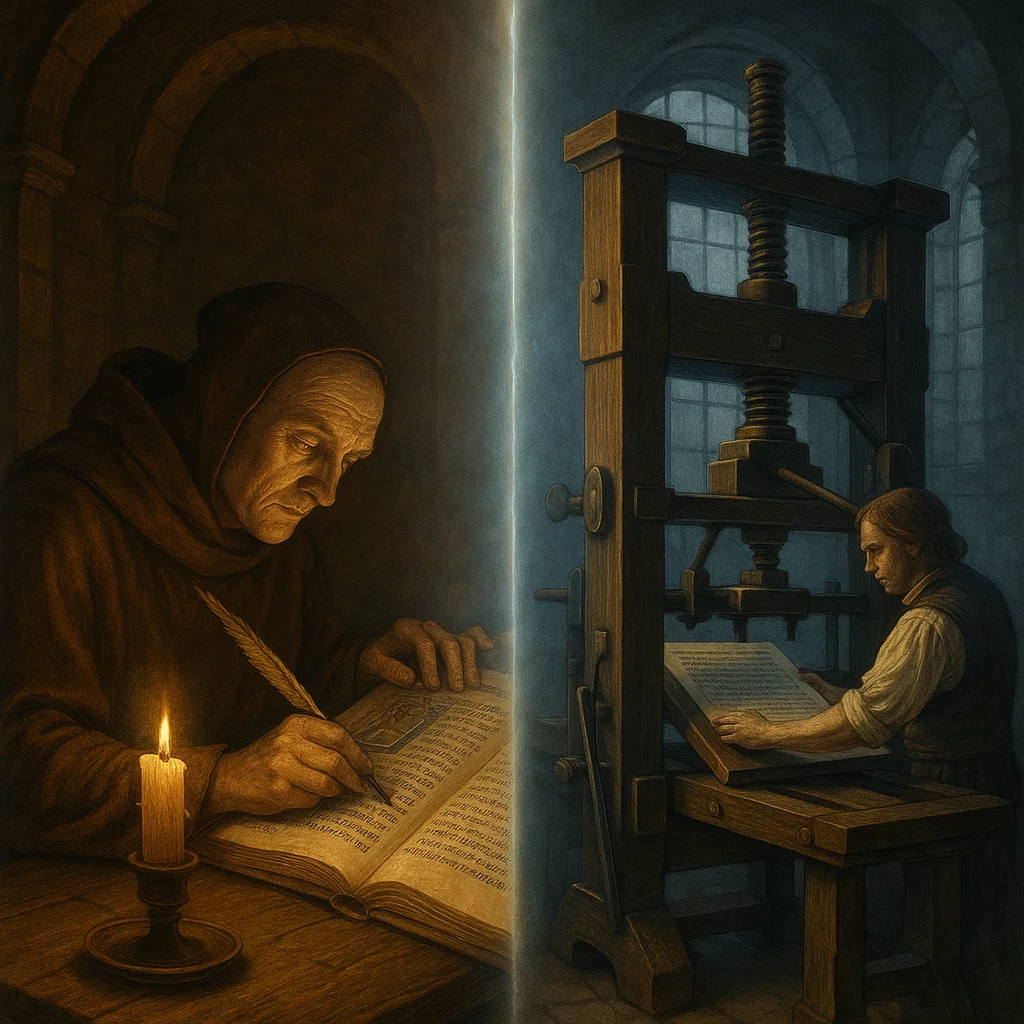
| 1455 | Gutenberg Bible | The first major printed book in Europe; used to standardize and distribute the Vulgate widely. Marked the shift from manuscript copying to mechanical printing, expanding lay access to scripture. |
| 1592 | Clementine Vulgate | Issued after the Council of Trent to stabilize the text and assert Catholic authority amid the Reformation. Became the official Bible of the Church for over 300 years. |
| 1582–1609 | Douay–Rheims Bible | Created by English Catholic exiles to provide an English-language alternative to Protestant Bibles. Used to preserve Catholic doctrine in English-speaking regions. |
| 1750s–1800s | Challoner Revision (of Douay–Rheims) | Updated the archaic English of Douay–Rheims for clarity and modern use while retaining Catholic theological precision. Used by English-speaking Catholics until the mid-20th century. |
| 1941 | Confraternity Bible | Produced by the Confraternity of Christian Doctrine as a modern, American Catholic translation preceding Vatican II. Used for study, catechesis, and early liturgical modernization. |
| 1956 / 1966 / 1985 | Jerusalem Bible / New Jerusalem Bible | Adopted for its literary quality and modern scholarship. Based on the French Bible de Jérusalem, used widely in academic and liturgical settings after Vatican II. |
| 1979 / 1986 (rev.) | Nova Vulgata | Commissioned by the Vatican as the official Latin edition after Vatican II. Used for all formal Church documents and as the textual standard for translations worldwide. |
| 1970 / 1986 / 2011 | New American Bible (NAB / NABRE) | Produced by the U.S. bishops for liturgical and educational use. Serves as the official Bible for Mass readings in the United States. |
| 1999 / 2007 | Catholic Community Bible | Developed by missionaries for pastoral and accessible teaching, especially in developing countries. Focused on comprehension and practical faith application. |
| 21st century (ongoing) | Regional and National Catholic Editions | Numerous translations (e.g., Biblia de Jerusalén, African Bible, Christian Community Bible) used to support vernacular worship and catechesis across linguistic and cultural regions. |
Across sixteen centuries the Catholic Bible has remained stable in structure and doctrine while evolving in form and language. Every authorized edition—from Jerome’s Vulgate to today’s NABRE—serves one purpose: to preserve the same revelation within the living language of the Church. This lineage defines the Catholic scriptural tradition and anchors it as one of the three great streams of the Christian Bible.


Modern Layout of the Catholic Bible
The Catholic Bible today preserves the same 73-book canon affirmed by the early Church. Its organization reflects the ancient Vulgate order rather than the Hebrew sequence adopted in Protestant editions. The Old Testament opens with the Pentateuch—Genesis through Deuteronomy—followed by the Historical Books from Joshua through Maccabees, the Wisdom writings from Job through Sirach, and the Prophets, ending with Malachi. The Deuterocanonical books, recognized by Catholic tradition but omitted from most Protestant Bibles, are interwoven in their historical and literary positions rather than separated or excluded.
The New Testament maintains the familiar structure established by the fourth century: the four Gospels, Acts of the Apostles, the Pauline letters, the Catholic (General) Epistles, and Revelation. Modern editions include introductions, footnotes, and cross-references prepared under episcopal supervision to support both scholarship and catechesis.
In Catholic worship, the Bible’s layout is reflected in the Lectionary, a structured cycle of readings used at Mass and in the Liturgy of the Hours. The New American Bible (NABRE) serves as the approved English source for these readings in the United States, while the Jerusalem Bible and its derivatives fill this role elsewhere. Behind all translations stands the Nova Vulgata, the official Latin text that defines the Church’s reference standard.
Through centuries of revision, the Catholic Bible’s modern form balances fidelity to tradition with clarity for today’s reader—preserving the substance of Scripture while adapting its presentation for study, liturgy, and prayer in every living language of the Church.
Books of the Catholic Bible
| Testament | Section | Book | Traditional Author | Approx. Date / Period | Primary Themes / Focus | Notes on Catholic Canon |
|---|---|---|---|---|---|---|
| Old Testament | 1. Pentateuch (The Law / Torah) | Genesis | Moses | c. 10th–5th century BC | Creation of the world, humanity, sin, covenant with Abraham, origins of Israel’s patriarchs. | First book of the Bible; establishes theological foundations of creation, fall, and divine promise. |
| Exodus | Moses | c. 10th–5th century BC | Liberation of Israel from Egypt, covenant at Sinai, Ten Commandments, divine law, tabernacle. | Central narrative of deliverance; defines Israel as God’s covenant people. | ||
| Leviticus | Moses | c. 10th–5th century BC | Ritual purity, priestly regulations, holiness laws, sacrificial system. | Focuses on priestly holiness and moral conduct; read as part of liturgical law. | ||
| Numbers | Moses | c. 10th–5th century BC | Census of Israel, wilderness wanderings, testing and divine guidance. | Bridges Sinai covenant to entry into Canaan; emphasizes faith and obedience. | ||
| Deuteronomy | Moses | c. 7th–5th century BC | Moses’ farewell speeches, restatement of the Law, renewal of the covenant before entering Canaan. | Concludes the Torah; frames obedience as the condition for life and blessing. | ||
| 2. Historical Books | Joshua | Joshua (with later editors) | c. 7th–5th century BC | Conquest and settlement of Canaan; fulfillment of God’s promises to Israel under Joshua’s leadership. | Continuation of the Pentateuch; emphasizes obedience, divine faithfulness, and covenant inheritance. | |
| Judges | Samuel (traditionally) | c. 7th–6th century BC | Cycles of apostasy, oppression, repentance, and deliverance through divinely appointed judges. | Illustrates Israel’s instability before monarchy; theological pattern of sin and redemption. | ||
| Ruth | Unknown (traditionally Samuel) | c. 6th–4th century BC | Story of Ruth, a Moabite woman whose loyalty leads to her role in the lineage of David. | A short narrative of faith and inclusion; read in Catholic tradition as prefiguring universal salvation. | ||
| 1 Samuel | Samuel, Nathan, Gad (traditionally) | c. 7th–6th century BC | Rise of Israel’s monarchy; Samuel’s leadership, Saul’s reign, and David’s anointing. | Marks transition from tribal judges to kingship; moral contrast between Saul and David. | ||
| 2 Samuel | Same as above | c. 7th–6th century BC | Reign of King David; his triumphs, failures, and covenant with God. | Central to messianic theology; establishes Davidic line central to later prophecy. | ||
| 1 Kings | Jeremiah (traditionally) | c. 6th century BC | Reign of Solomon, building of the Temple, division of the kingdom, early monarchs of Israel and Judah. | Records national division and decline; theological link between faithfulness and prosperity. | ||
| 2 Kings | Jeremiah (traditionally) | c. 6th century BC | Continuation through the fall of Israel (722 BCE) and Judah (586 BCE). | Ends with Babylonian exile; interprets downfall as consequence of covenant disobedience. | ||
| 1 Chronicles | Ezra (traditionally) | c. 5th century BC | Genealogies of Israel; reign of David with focus on Temple worship and priestly order. | Retells Samuel narrative with emphasis on liturgy and divine order; theological re-centering on worship. | ||
| 2 Chronicles | Ezra (traditionally) | c. 5th century BC | Continuation from 1 Chronicles, focusing on the kings of Judah, the Temple, and religious reform. | Ends with the decree of Cyrus allowing the Jews to return from exile; theological emphasis on faithfulness and worship. | ||
| Ezra | Ezra | c. 5th century BC | Return from Babylonian exile; rebuilding of the Temple; restoration of Mosaic law. | Highlights covenant renewal and obedience; foundational for post-exilic Judaism. | ||
| Nehemiah | Nehemiah (with Ezra) | c. 5th century BC | Rebuilding of Jerusalem’s walls; moral and social reform under Nehemiah’s leadership. | Complements Ezra; shows the reconstruction of community identity centered on the Law. | ||
| Tobit | Unknown (Jewish author in Diaspora) | c. 3rd–2nd century BC | Story of Tobit and his son Tobias; divine guidance through the angel Raphael; themes of faith, charity, and providence. | Deuterocanonical; preserved in Greek; emphasizes piety and family virtue under foreign rule. | ||
| Judith | Unknown | c. 2nd century BC | Heroic account of a widow who saves Israel by defeating the Assyrian general Holofernes through courage and faith. | Deuterocanonical; moral allegory of trust in God; likely written for encouragement under oppression. | ||
| Esther | Unknown (Hebrew origin, later Greek additions) | c. 4th–3rd century BC | Story of a Jewish queen who saves her people from destruction in Persia. | Catholic version includes Greek additions (prayers and divine references) absent in Protestant versions. | ||
| 1 Maccabees | Unknown (possibly Hasmonean historian) | c. 100 BC | Historical record of the Jewish revolt under the Maccabees; defense of faith and temple purity. | Deuterocanonical; valued for its historical accuracy and national theology. | ||
| 2 Maccabees | Unknown (Hellenistic Jewish author) | c. 124 BC | Parallel account focusing on martyrdom, resurrection hope, and divine justice. | Deuterocanonical; emphasizes intercession, prayer for the dead, and theological depth beyond 1 Maccabees. | ||
| 3. Wisdom and Poetry | Job | Unknown (possibly ancient sage) | c. 7th–4th century BC | The mystery of suffering and divine justice; endurance of faith amid loss. | Profound poetic dialogue on human suffering and trust in God; read as a universal reflection on righteousness. | |
| Psalms | David and others (Asaph, Korah, etc.) | c. 10th–4th century BC | Hymns, laments, and prayers expressing the full range of human emotion before God. | Core of Jewish and Christian worship; 150 psalms arranged for liturgical and devotional use. | ||
| Proverbs | Solomon and others | c. 10th–4th century BC | Moral wisdom, prudence, family discipline, and fear of the Lord as the beginning of knowledge. | Foundational wisdom text; instructional in ethical living and divine order. | ||
| Ecclesiastes (Qoheleth) | Solomon (traditionally) | c. 3rd century BC | Reflection on the vanity of worldly pursuits and the search for meaning under God. | Philosophical and existential tone; concludes that reverence for God gives life its purpose. | ||
| Song of Songs | Solomon (traditionally) | c. 10th–4th century BC | Poetic dialogue celebrating love and fidelity; allegory of God’s love for Israel and Christ’s love for the Church. | Read allegorically in Catholic theology as divine-human love; used in liturgy and mysticism. | ||
| Wisdom of Solomon | Anonymous Jewish author (Alexandria) | c. 1st century BC | Wisdom, immortality, divine justice, contrast between righteousness and wickedness. | Deuterocanonical; emphasizes afterlife, divine providence, and moral philosophy. | ||
| Sirach (Ecclesiasticus) | Jesus ben Sira | c. 200–175 BC | Practical wisdom, virtue, family honor, and the fear of God; synthesis of Law and daily life. | Deuterocanonical; highly valued for moral instruction; often quoted in early Christian teaching. | ||
| 4. Prophets | Isaiah | Isaiah son of Amoz | c. 8th–6th century BC | Judgment and redemption; messianic prophecies; holiness of God and hope for restoration. | Central prophetic book; source of key messianic texts quoted in the New Testament. | |
| Jeremiah | Jeremiah | c. 7th–6th century BC | Call to repentance before Jerusalem’s fall; new covenant promise written on the heart. | Emphasizes personal faithfulness amid national collapse; pivotal in exile theology. | ||
| Lamentations | Jeremiah (traditionally) | c. 6th century BC | Poetic laments over the destruction of Jerusalem. | Used in Catholic liturgy during Holy Week; expresses grief and enduring hope. | ||
| Baruch | Baruch, scribe of Jeremiah | c. 6th–2nd century BC | Confession of sin, wisdom reflection, and hope for Israel’s restoration. | Deuterocanonical; includes Letter of Jeremiah as an appendix in Catholic canon. | ||
| Ezekiel | Ezekiel | c. 6th century BC | Visions of God’s glory, judgment on Israel, promise of renewal, and the new temple. | Prophetic symbolism and apocalyptic imagery; foundational for later eschatology. | ||
| Daniel | Daniel | c. 2nd century BC | Faith under persecution, divine sovereignty, visions of future kingdoms. | Deuterocanonical additions (Prayer of Azariah, Susanna, Bel and the Dragon) included only in Catholic and Orthodox canons. | ||
| Hosea | Hosea | c. 8th century BC | Israel’s infidelity and God’s steadfast love, symbolized through the prophet’s marriage. | Begins the Twelve Minor Prophets; theme of covenantal mercy. | ||
| Joel | Joel | c. 6th–4th century BC | Call to repentance; the Day of the Lord; promise of the outpouring of the Spirit. | Cited in Acts 2 as prophecy of Pentecost; moral and eschatological focus. | ||
| Amos | Amos | c. 8th century BC | Social justice, divine judgment against corruption, call for righteousness. | Earliest writing prophet; central to Catholic moral teaching on justice and ethics. | ||
| Obadiah | Obadiah | c. 6th century BC | Oracle against Edom for pride and violence toward Judah; affirmation of divine justice. | Shortest book in the Old Testament; emphasizes God’s sovereignty over nations. | ||
| Jonah | Unknown (traditional prophet Jonah) | c. 5th–4th century BC | Story of Jonah’s mission to Nineveh; themes of mercy, repentance, and universal salvation. | Narrative parable illustrating divine compassion; prefigures Christ’s resurrection. | ||
| Micah | Micah of Moresheth | c. 8th century BC | Judgment on injustice and false worship; hope for peace through a ruler from Bethlehem. | Contains key messianic prophecy (Mic 5:2); moral call for justice, mercy, and humility. | ||
| Nahum | Nahum | c. 7th century BC | Oracle of judgment against Nineveh and the fall of Assyria. | Completes the story begun in Jonah; emphasizes God’s justice and power. | ||
| Habakkuk | Habakkuk | c. 7th–6th century BC | Dialogue with God over injustice; faith amid suffering; “the righteous shall live by faith.” | Quoted by Paul in Romans and Galatians; theological bridge between prophecy and faith doctrine. | ||
| Zephaniah | Zephaniah | c. 7th century BC | Proclamation of the coming “Day of the Lord” bringing judgment and purification. | Warns Judah yet promises restoration; used in Advent and penitential liturgy. | ||
| Haggai | Haggai | c. 520 BC | Call to rebuild the Temple after the exile; assurance of God’s presence. | Short, practical prophetic message; renewal through obedience. | ||
| Zechariah | Zechariah | c. 520–480 BC | Apocalyptic visions, encouragement to rebuild, prophecy of the messianic king. | Often paired with Haggai; heavily cited in the New Testament passion narratives. | ||
| Malachi | Malachi (“My messenger”) | c. 450–400 BC | Rebuke of priestly corruption; announcement of the coming messenger before the Lord. | Last book of the Old Testament; anticipates John the Baptist and Christ’s advent. | ||
| New Testament | 1. The Gospels | Matthew | Matthew (the Apostle, former tax collector) | c. 70–90 AD | Presents Jesus as the fulfillment of Old Testament prophecy and the new Moses who establishes the Kingdom of Heaven. | Written for a Jewish-Christian audience; emphasizes law, discipleship, and Church authority. Contains the Sermon on the Mount and Great Commission. |
| Mark | John Mark (associate of Peter) | c. 60–70 AD | Fast-moving narrative of Jesus’ ministry, passion, and resurrection emphasizing suffering and servanthood. | Considered the earliest Gospel; source for Matthew and Luke; focuses on action and immediacy. | ||
| Luke | Luke (physician, companion of Paul) | c. 70–90 AD | Portrays Jesus as the universal Savior bringing mercy, healing, and inclusion of the poor and marginalized. | First volume of a two-part work (with Acts); highlights prayer, women, and the Holy Spirit. | ||
| John | John (the Apostle, “Beloved Disciple”) | c. 90–100 AD | Theological portrait of Jesus as the eternal Word made flesh; themes of light, truth, and divine love. | Distinct in structure and tone; emphasizes Christ’s divinity and the mystery of faith; cornerstone of Catholic theology on incarnation and sacrament. | ||
| 2. Acts of the Apostles | Luke (physician and companion of Paul) | c. 70–90 AD | Continuation of Luke’s Gospel, describing the descent of the Holy Spirit, the birth and expansion of the Church, and the missionary work of Peter and Paul. | Serves as the historical bridge between the Gospels and the Epistles. Central to Catholic understanding of apostolic succession, the universality of the Church, and the power of the Holy Spirit guiding its mission. | ||
| 3. Pauline Epistles | Romans | Paul the Apostle | c. 56–58 AD | Systematic exposition of salvation through faith in Christ, justification by grace, and the unity of Jews and Gentiles in God’s plan. | Most theologically comprehensive of Paul’s letters; cornerstone of Catholic doctrine on grace, faith, and moral life. | |
| 1 Corinthians | Paul the Apostle | c. 54–57 AD | Addresses divisions, immorality, and worship in the Corinthian Church; affirms the resurrection and unity in Christ. | Key source for Catholic sacramental theology and charity; includes the “Love Chapter” (1 Cor 13). | ||
| 2 Corinthians | Paul the Apostle | c. 55–57 AD | Defense of Paul’s apostleship, encouragement amid suffering, and call for generosity and reconciliation. | Personal and pastoral; reveals Paul’s humility and authority; stresses strength through weakness. | ||
| Galatians | Paul the Apostle | c. 54–57 AD | Contrast between Law and faith; justification through Christ rather than works of the Law. | Highlights freedom in Christ and the role of the Spirit; essential to Catholic teaching on faith working through love. | ||
| Ephesians | Paul (possibly written by a disciple) | c. 60–62 AD | Unity of the Church as Christ’s body, spiritual blessings in Christ, and moral exhortations for Christian living. | Celebrates the Church as universal and sacramental; foundational for Catholic ecclesiology. | ||
| Philippians | Paul the Apostle | c. 60–62 AD | Letter of joy and encouragement; Christ’s humility and exaltation as the model for believers. | Written from prison; contains the “Christ Hymn” (Phil 2:6–11); emphasizes joy in service and unity. | ||
| Colossians | Paul (possibly with Timothy) | c. 60–62 AD | Supremacy of Christ over all creation and warning against false teachings. | Christological focus—Christ as head of the Church and image of the invisible God; complements Ephesians. | ||
| 1 Thessalonians | Paul the Apostle | c. 50–52 AD | Encouragement to persevere in faith and holiness; teaching on the Second Coming of Christ. | Considered Paul’s earliest letter; emphasizes hope and moral integrity amid persecution. | ||
| 2 Thessalonians | Paul the Apostle | c. 51–54 AD | Clarifies misunderstandings about Christ’s return; calls for steadfastness and responsible living. | Reinforces Catholic teaching on eschatological readiness and orderly Christian life. | ||
| 1 Timothy | Paul (to Timothy, his disciple) | c. 63–65 AD | Guidance on Church leadership, prayer, and pastoral conduct; warnings against false doctrine. | Part of the Pastoral Epistles; basis for Catholic teaching on clerical order and moral instruction. | ||
| 2 Timothy | Paul the Apostle | c. 64–67 AD | Final exhortation to faithfulness, endurance, and defense of the Gospel. | Paul’s last letter; deeply personal; read as his spiritual testament. | ||
| Titus | Paul (to Titus, his disciple) | c. 63–65 AD | Instructions for Church organization and good works consistent with sound doctrine. | Another Pastoral Epistle; foundation for Catholic pastoral governance and virtue ethics. | ||
| Philemon | Paul the Apostle | c. 60–62 AD | Appeal on behalf of Onesimus, a runaway slave, urging forgiveness and Christian brotherhood. | Shortest Pauline letter; demonstrates reconciliation and equality in Christ. | ||
| Hebrews | Anonymous (traditionally attributed to Paul) | c. 60–90 AD | Christ as the eternal High Priest, mediator of the new covenant, and fulfillment of the Old Testament. | Theologically rich; essential to Catholic understanding of priesthood, sacrifice, and covenantal continuity. | ||
| 4. Catholic (General) Epistles | James | James the Just (brother of the Lord) | c. 60–80 AD | Faith expressed through works, moral integrity, social justice, and control of speech. | Stresses that authentic faith produces action; essential to Catholic teaching on faith and works. | |
| 1 Peter | Peter the Apostle | c. 60–90 AD | Encouragement amid persecution; holiness, humility, and hope in Christ’s suffering and resurrection. | Foundational for Catholic understanding of redemptive suffering and baptismal identity. | ||
| 2 Peter | Peter the Apostle (possibly compiled posthumously) | c. 70–100 AD | Warning against false teachers; affirmation of apostolic tradition and Christ’s return. | Affirms apostolic authority and the reliability of Scripture; among the latest NT writings. | ||
| 1 John | John the Apostle | c. 90–100 AD | Love as the mark of true faith; warning against heresy; assurance of eternal life in Christ. | Reinforces Johannine theology of light, love, and truth; key text for Catholic spirituality. | ||
| 2 John | John the Apostle | c. 90–100 AD | Exhortation to walk in truth and love; caution against deceivers denying Christ. | Brief pastoral letter; complements 1 John; highlights fidelity to doctrine. | ||
| 3 John | John the Apostle | c. 90–100 AD | Personal note on hospitality and Church order; contrast between faithfulness and arrogance. | Illustrates early Church structure and authority; emphasizes hospitality and discernment. | ||
| Jude | Jude (brother of James) | c. 60–80 AD | Warning against false teachers and moral corruption; call to persevere in the faith. | Closely related to 2 Peter; stresses spiritual vigilance and trust in divine protection. | ||
| 5. Revelation (Apocalypse of John) | John the Apostle | c. 90–100 AD | Visionary prophecy of the struggle between good and evil, final judgment, and the new creation. | Concludes Scripture; symbolic depiction of divine victory; cornerstone of Catholic eschatology and liturgy. | ||