A Comprehensive Study of St. Christopher: Legend, History, and Legacy
Legendary Narratives of St. Christopher
Saint Christopher’s story is rooted in legend and rich symbolism. According to the most popular medieval account (found in the 13th-century Golden Legend), the saint was originally a fearsome giant born in the land of Canaan, named Reprobus (or Offerus) before baptism[1][2]. Reprobus was extraordinarily tall (some sources say 5 or even 12 cubits, over 7 feet) and had a terrifying appearance[3][4]. Seeking to serve “the greatest king in the world,” he first entered the service of a mighty earthly king, then left to serve the Devil upon learning the king feared Satan[5][6]. However, when Reprobus observed the Devil’s fear of the Christian cross on the roadside, he realized an even higher power – Christ – must exist[7][8]. He then abandoned the Devil’s service to find Christ.
Reprobus encountered a holy hermit who instructed him in the Christian faith. Because the giant admitted he could not master typical devotions like fasting or long prayers, the hermit gave an alternative task: use his great strength to help travelers cross a dangerous river, as a service pleasing to Christ[9][10]. Reprobus built a hut by the river and carried people safely across on his shoulders for some time[11]. One day, a little child asked to be carried across. As Reprobus forded the swollen river with the child on his back, the child grew unbearably heavy, nearly crushing the giant. Upon safely reaching the far bank, Reprobus exclaimed that it felt like he had borne “the whole world” on his shoulders[12][13]. The child then revealed Himself: “You had on your shoulders not only the world, but Him who created it”, declaring that He was Christ the King[14][15]. In proof of His identity, the Christ Child told Reprobus to plant his staff in the ground; miraculously, by next morning the staff had blossomed into a fruit-bearing palm tree[16][17]. Having literally carried Christ (in Greek Christophoros means “Christ-bearer”), Reprobus was baptized and given the new name Christopher, signifying his role as one who carries Christ[18][19].
Christopher’s legend continues with his missionary zeal and martyrdom. He traveled to Lycia (in Asia Minor) and converted thousands to Christianity through his preaching and miracles[20][21]. The local king (named Dagnus in the legend) tried to make Christopher renounce his faith, even using bribes and sending two women to seduce him – but Christopher converted the women instead[22][23]. Enraged, the king subjected Christopher to horrific tortures: he was beaten with iron rods, made to sit in a fiery iron chair, and shot with dozens of arrows – yet Christopher survived unharmed, and one stray arrow even struck and blinded the king[24]. Christopher promised the tyrant that he would be healed upon Christopher’s death. Finally, around the year AD 250, Christopher was beheaded, dying as a martyr; the repentant king allegedly regained his sight by anointing his eyes with the martyr’s blood[25][26]. In some versions, the formerly pagan king then converted to Christ[27][28]. Thus, the legendary narrative ends with Reprobus – once a “reprobate” giant in league with the Devil – transformed into Saint Christopher, faithful servant of Christ and martyr for the faith[29].
Historical and Scholarly Analysis
Unsurprisingly, such dramatic legends invite scrutiny of their historical basis. Historical evidence for St. Christopher is scant and often obscured by myth. Early Christian records do reference a martyr named Christopher – for example, he is listed in the Roman Martyrology as having died under Emperor Decius around 250 AD in Lycia[30][31]. Churches and monasteries bearing his name appeared by the 5th-6th centuries, suggesting an authentic cult of a martyr Christopher existed. Notably, Pope St. Gregory the Great (d. 604) mentioned a Monastery of St. Christopher in his writings, and a 7th-century Mozarabic liturgy (attributed to St. Isidore) included an office in the saint’s honor[32][33]. Such references indicate there likely was an early Christian martyr behind the name, even if we know nothing certain of his life. Indeed, one scholar observed that “the existence of a martyr St. Christopher cannot be denied,” given the early veneration evidence, though all details of his Acts are legendary[33]. Originally, Christopher was probably venerated simply as a martyr named on a list, without any elaborate story[34].
The legends about Christopher began to take shape a few centuries later. Greek hagiographical traditions about a giant ferryman-martyr named Christopher appear by the 6th century, and these stories spread to Latin West by the 9th century[35][34]. Over time, simple accounts grew in the retelling: by the 11th century, the bishop Walter of Speyer had composed a popular Latin tale in verse, and in the 13th century Jacobus de Voragine’s Golden Legend compiled the full narrative that became standard[36][37]. Scholars note that Christopher’s very name likely inspired the legend: Christophoros (“Christ-bearer”) may initially have been understood spiritually (one who bore Christ in his heart), but around the 12th century it was taken literally, spawning the tale of carrying the Christ Child on his shoulders[38]. Likewise, Christopher’s epithet as a “great martyr” may have led to imagining him as literally gigantic in size[39]. In this reading, the arduous river crossing and the crushing weight of the child symbolize the trials and burdens of a soul accepting the yoke of Christ[39]. Thus the legend can be seen as an allegory of spiritual truth: through charity and service, one may find Christ, and bearing His weight is both challenging and redemptive[40].
Modern historians have tried to peel back the layers of myth to identify a real individual. A compelling theory by historian David Woods suggests that “St. Christopher” may actually be a distorted memory of St. Menas of Egypt, a well-documented 3rd-century martyr. Woods argues that early texts describe Christopher as coming from a North African tribe – the Marmaritae of Cyrenaica (Libya) – known in late Roman lore as a race of “dog-headed” people[41][42]. According to Woods, a man from this tribe was captured into the Roman army, stationed at Antioch, converted to Christianity, and was executed around 308 AD under Emperor Maximinus Daia[43][41]. After his martyrdom, local Christians didn’t know his original name and honored him by the appellation Christopher (“Christ-bearer”) as an honorific for his steadfast faith[44]. Meanwhile, back in his homeland in Egypt, a martyr Menas was venerated who had also been a soldier executed abroad and miraculously returned for burial[45]. Woods proposes that these two cults – Menas in Egypt and Christopher in Antioch – might actually refer to the same person, with Christopher essentially a nickname that evolved into a separate saintly persona[46]. This hypothesis remains speculative, but it illustrates how hagiography can intertwine and echo historical figures. At the very least, it underscores that Christopher’s legend has a “genuine historical core,” even if encrusted with medieval imagination[47].
Another fascinating aspect for scholars is the cynocephalus (dog-headed) imagery in the Eastern tradition. Early Greek accounts describe Christopher as coming “from the land of cannibals and dog-headed people,” language possibly meant figuratively or ethnographically[42]. Byzantine readers, however, interpreted it literally, hence icons depicting St. Christopher with the head of a dog (often a mastiff-like head) arose from the 6th century onward[48][49]. This odd image may have multiple origins. Some researchers trace it to ancient accounts of monstrous races at the edges of the world (as described by Pliny and others), which were incorporated into saintly lore[50][51]. There is also an apocryphal story of the Apostles encountering a dog-headed cannibal named “Reprobus” who converts and is baptized, which might have been conflated with Christopher’s tale in some texts[52][53]. In a number of legends, the dog-headed convert is granted a human appearance upon baptism, suggesting Christopher’s ferocious visage was “cured” by Christ[54]. Linguistically, it’s pointed out that the Latin word Cananeus (“Canaanite,” referring to his origin) might have been misread as canineus (“canine”) by scribes, reinforcing the error[55]. Whatever its genesis, the dog-headed St. Christopher image, while jarring to modern sensibilities, was sufficiently accepted in the East that it appeared in Orthodox iconography and painters’ manuals for centuries[56][50]. (The Russian Church eventually banned it in the 18th century as too fanciful[57][58].) This evolution from obscure tribal reference to literal beast-headed saint vividly illustrates how hagiographical legend can mutate through mistranslation and cultural imagination.
In sum, scholarly analysis finds that behind the myth of St. Christopher likely lies an authentic early martyr (possibly from 3rd-century Lycia or even Roman North Africa), whose memory was elaborated into a symbolic tale over time[59][60]. The legend’s elements – the name “Christ-bearer,” the giant stature, the perilous river, the miraculous child, and even the dog-headed guise – all seem to be later accretions that convey spiritual lessons or arose from interpretive quirks. While we cannot treat the traditional biography as historically factual, it “conveys essential truths” in a mythic mode[61]. As one modern commentator put it, the story tells a profound truth, whether it actually happened or not[62].
Theological and Liturgical Significance
Despite uncertainties about his life, St. Christopher’s significance in Christian devotion is profound. He is honored across multiple traditions – Catholic, Orthodox, Anglican, and others – as a model of faith, service, and martyrdom. In Greek, he is called Hagios Christophoros (“Holy Christ-Bearer”), and in Latin, Sanctus Christophorus. His feast day is traditionally July 25 in the West (recorded in the Roman Martyrology on that date[63]) and May 9 in the Eastern Orthodox Church[64]. (Other local calendars vary: for example, German dioceses celebrated him on July 24, and the Coptic Church on 2 Parmouti in spring[65].)
In the Catholic Church, St. Christopher was long commemorated on July 25. He was never formally “canonized” by a Pope (as his veneration predates the canonization process), but was acknowledged as a saint through the Church’s tradition (pre-congregation). For centuries, he was part of the General Roman Calendar as a minor feast. However, in 1969, the Catholic Church removed St. Christopher’s name from the universal liturgical calendar (along with a number of other saints) as part of a post-Vatican II streamlining of the calendar[63][66]. This led to widespread popular confusion that “St. Christopher was de-sanctified,” but that is not the case – he remains recognized as a saint. The calendar reform aimed to prioritize feast days of universal importance and historical certainty; many saints with only local cults or largely legendary biographies were left to local veneration rather than obligatory worldwide celebration[67][68]. Church officials noted that Christopher’s legends were “legendary” (not historically verified) and his “wobbly historical status” was a factor in relegating him to local calendars[69][70]. Nevertheless, the Church never declared he didn’t exist, and he was not “unsainted.” In fact, the Roman Martyrology (the official list of saints) still includes “Saint Christopher, Martyr” on July 25[63]. Catholics are free to venerate him, and many parishes and regions continue to observe his feast day. Thus, in Catholic doctrine, Christopher remains a saint in good standing, even if not a universal liturgical memorial[71][72].
For Catholics, the theological meaning of St. Christopher centers on charity and Christ’s presence in the lowly. The image of the giant humbly carrying a little child who is actually Christ incognito resonates with Gospel themes (Matthew 25: “whatever you did for one of the least, you did for Me”). Christopher’s story is often cited as a parable of service: he found Christ not in regal splendor but in serving others, and literally bearing Christ to the world. This has made him an emblem of the Christian duty to carry Christ in our lives and help others along life’s dangerous journeys[61]. Doctrinally, there is no specific dogma connected to Christopher, but he is invoked as an intercessor for travelers and all who seek safe passage through life’s perils. Catholic devotional practice has long included St. Christopher medals, worn or carried for protection (more on this below), reflecting a theological understanding of saints as friends and protectors in the communion of saints[73][74].
In the Eastern Orthodox Church, St. Christopher is venerated as a Great Martyr. The Orthodox liturgy for his feast on May 9 includes hymns (troparia and kontakia) praising his courage. One kontakion references Christopher’s intimidating physical strength and appearance, yet how he surrendered himself to Christ and converted those sent to tempt him: “Thou who wast terrifying in strength and countenance… didst surrender thyself for Christ; for thou didst persuade those women sent to arouse lust, and they followed thee in martyrdom. In torments thou wast courageous. Therefore we gained thee as our great protector, O great Christopher.”[75][76]. This hymn encapsulates the Eastern Christian esteem for Christopher’s spiritual strength conquering brute strength. The Orthodox iconography often depicts him in soldier’s armor (sometimes with a dog’s head, as noted) to signify his role as a soldier-martyr. Orthodox faithful honor him as a powerful intercessor and “protector” – especially for travelers. In some places, the May 9 feast of St. Christopher is celebrated with processions or the blessing of vehicles, similar to Western customs. The Orthodox service books also recall that he suffered under Decius (or Dacian) and emphasize his bold confession of Christ even unto death[64]. Thus, Christopher is held up as an exemplar of fortitude and hospitality in Eastern Christian spirituality.
Anglicans, Lutherans, and other Protestants with traditional calendars also commemorate St. Christopher, usually on July 25 alongside St. James. For example, many Anglican churches (Episcopal parishes) bear his name, and he often appears in Anglican calendars as an optional lesser feast. Though Protestants generally downplay invocation of saints, St. Christopher’s story is appreciated as an edifying legend. Anglican devotion tends to focus on the moral lesson of Christopher’s service and the idea of “carrying Christ to others”[77]. Some Lutheran calendars list him among commemorations of ancient martyrs. In these traditions, he is not doctrinally controversial, since his legend can be seen metaphorically and he is not tied to any particular post-biblical miracle that would conflict with Protestant theology. He stands as a cultural and spiritual symbol of Christian kindness.
Across all traditions, St. Christopher has accumulated a long list of patronages reflecting his role as helper on life’s journeys. Chiefly, he is the Patron Saint of Travelers – a status that in modern times extended to motorists, pilots, and even astronauts. Since the early 20th century, with the rise of automobiles, he has been popularly regarded as the patron of drivers and motorists, and small Christopher visor clips or keychain medals are common in cars[59][78]. More broadly, he is counted among the Fourteen Holy Helpers – a group of saints venerated in medieval Europe as special protectors in times of need (others in this group include saints like George, Blaise, and Catherine)[79]. St. Christopher’s patronage also includes sailors and mariners (logical for one who safely carries across water), as well as occupations like ferrymen, travelers, and transportation workers[80]. In folk tradition he was invoked against sudden death, storms, and plagues, since being a “Christ-bearer” he was thought to secure Christ’s protection[81]. Various regions and cities have claimed him as patron as well – for instance, the island of St. Kitts (short for St. Christopher) in the Caribbean was named after him by Columbus[82]. He is also patron of places like Brunswick in Germany and townships in Italy and Spain[83]. Unusual patronages, accrued through legend, include protection against toothache and epilepsy, and even patron of bachelors and gardeners in some lists[80]. Such associations might spring from pious imagination or wordplay (for example, an old story says a pagan idol shattered like a tooth when Christopher prayed, hence toothache). While not all patronages are officially recognized, they illustrate the widespread affection for the saint. Christopher’s name itself, meaning “Christ-bearer,” has made it a perennially popular Christian name – symbolizing one’s hope to also carry Christ.
Liturgically, though Christopher’s feast is no longer universal in the Latin Rite, many localities still celebrate a Mass or service in his honor on July 25. Traditional Catholic missals included a collect asking God that “we who celebrate the memory of St. Christopher, Thy Martyr, may through his intercession be strengthened in faith.” Even where not officially on the calendar, churches often display his image or have side altars dedicated to him, where the faithful light candles and seek his prayers. The persistence of his veneration, even after being “demoted” in 1970, attests to his enduring role in popular piety. As one Catholic writer remarked, Christopher’s broad “devotion was so widespread” that it arguably gave him “truly universal significance” as a saint, despite the calendar change[68]. This shows how, theologically, the sensus fidelium (the sense of the faithful) has kept Christopher among the beloved saints, seeing in him a reflection of Christ’s call to serve others and trust in divine providence on every journey.
Iconography and Symbolism in Art and Culture
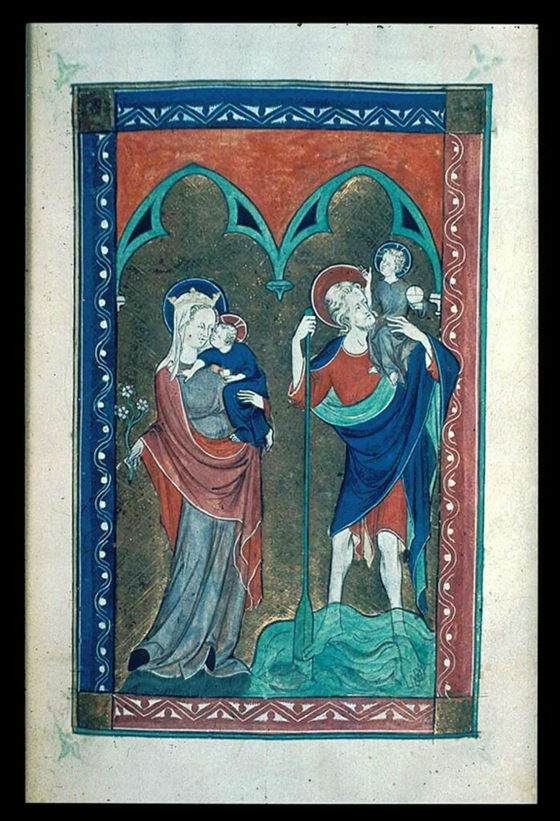
Medieval mural depicting St. Christopher carrying the Christ Child across a river. In Western art, he is typically shown as a giant or strong man with a staff, bearing the infant Jesus on his shoulders.
From the Middle Ages to the present, St. Christopher’s image has been a familiar sight in Christian art – often as a towering figure fording a river with the Christ Child on his shoulder. This iconography directly springs from the legend. In Western depictions, Christopher usually appears as a powerfully built man, sometimes with a hermit’s cloak or a soldier’s attire, holding a long staff or tree trunk for support. On his shoulder sits the small child Jesus, who may hold an orb (symbolizing the world that weighed upon Christopher)[84]. The scene often includes visual cues: flowing water up to the saint’s knees, fish at his feet, and the opposite bank of the river with perhaps a hermit holding a lantern (as some versions include a hermit guiding Christopher). The staff that Christopher carries is sometimes portrayed as miraculously blooming with leaves or flowers, recalling the legend of it turning into a palm tree[85][17]. This flowering staff became one of his primary attributes in art, symbolizing new life and divine grace.
During the medieval period, St. Christopher’s image was not only devotional but also considered apotropaic – offering protection. There was a widespread belief in Europe that seeing an image of St. Christopher would safeguard one from sudden death that day[86][87]. As a result, huge murals of St. Christopher were painted on the walls of churches, often opposite the main entrance or on an exterior wall, so that the first thing a traveler or worshiper saw was the giant saint carrying Christ. A 1904 survey in England found more wall paintings of St. Christopher than of any other saint[88], underscoring his popularity. These murals were typically life-sized or larger, showing the saint in mid-stride through the water. An inscription sometimes accompanied them, such as: “Whoever shall behold the image of St. Christopher shall not faint or fall on that day.”[87] This practice made Christopher a kind of spiritual “warning sign” at church doors – reminding viewers to stay in a state of grace, since sudden death could be forestalled by his intercession. In addition to church art, his image appeared on bridges, gatehouses, and city walls (fittingly, at points of crossing and travel)[89]. By the late Middle Ages, small devotional tokens and badges with his likeness were also common for pilgrims.
Painters of the Renaissance and Baroque continued to portray St. Christopher in their own styles. For instance, Hieronymus Bosch painted an imaginative scene of St. Christopher (c.1490) with an idyllic landscape behind the giant saint, and Hans Memling included him in altarpieces. The Venetian master Giovanni Bellini depicted a serene Christopher carrying Christ in a sacra conversazione painting. In these, the fundamental iconography remained: the giant with the Child. Some variations might show Christopher interacting with the hermit or experiencing the weight of the Child mid-stream. By the Baroque, artists like Peter Paul Rubens and Jacob Jordaens painted dynamic versions of the moment, emphasizing the muscular strain and the illumination of Christ’s identity. Because of the legend’s dramatic visuals, St. Christopher holding Christ became one of the most instantly recognizable saint images in Christian art.
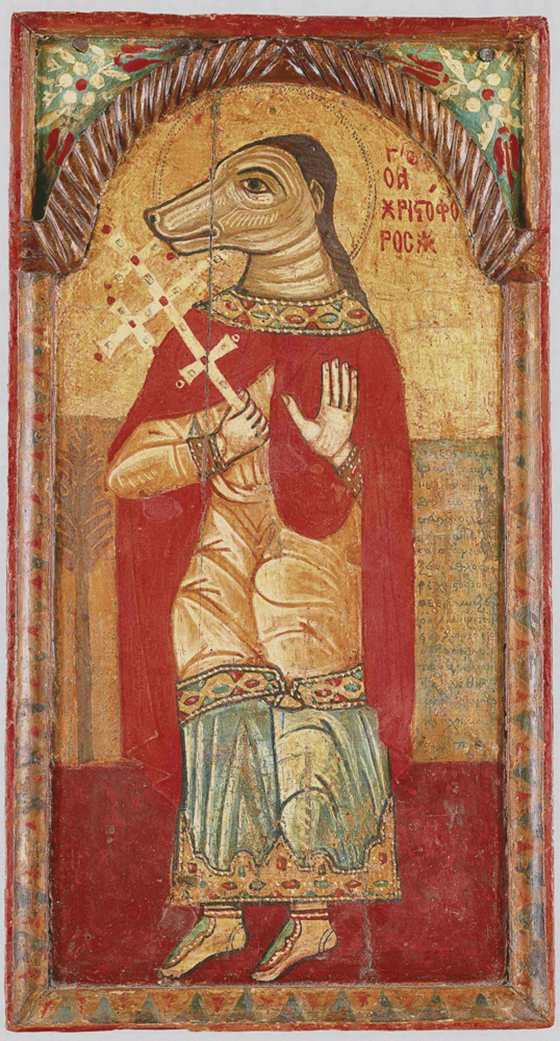
Eastern Orthodox icon (16th–17th c.) depicting Saint Christopher with a dog’s head (Cynocephalus). Such imagery arose from a literal reading of the legend that he came from a “dog-headed” people.
In Eastern Christian art, St. Christopher’s iconography sometimes took a very different turn with the Cynocephalus icon. A number of Byzantine and post-Byzantine icons portray Christopher as a standing warrior saint with the head of a dog (often akin to a greyhound or jackal)[90][42]. He is usually garbed in military attire – armor, cloak, spear or sword, and shield – reflecting his martyrdom as a soldier under Decius. This startling depiction stems from the aforementioned legend that Christopher hailed from a land of dog-headed cannibals (kyonokephaloi). Rather than interpret this symbolically, some Eastern artists rendered it quite literally. The Orthodox tradition at times embraced fantastical imagery if it carried spiritual meaning. In this case, the dog-headed Christopher was seen as illustrating the transformation of a “barbarous” nature into a Christ-bearing saint[91][50]. One thread of the story (from later Cypriot tradition) even suggests Christopher was so handsome that to avoid temptation he prayed for a disfigured face – and God gave him a dog’s head to protect his purity[92]! Whether taken as allegory or fact, icons of “Christopher Kynokephalos” circulated especially in Eastern Europe. Some icons show him holding a cross or the Christ Child despite the canine visage. This iconography was never part of Western art, and by the 18th century it was officially discouraged in the East (the Russian Holy Synod in 1722 ordered it stopped, though Old Believers kept producing them)[93]. Today, the dog-headed saint image is mostly a historical curiosity, but it testifies to the medieval mindset that accepted exotic human-animal races and folded them into Christian narratives. It also highlights the universality of the Gospel: even a “monster” can receive Christ and be sanctified – a potent symbol of salvation reaching the most alien and outcast beings.
Apart from these dominant motifs (the giant ferryman and the dog-head), St. Christopher’s symbols in art include the palm tree (from the staff miracle) and occasionally a wheel or arrows (reference to the attempted executions in the legend). Some images show a small pocket of water or fish at his feet, reinforcing his role as a helper across water. In Orthodox icons where he is not dog-headed, he may be shown holding a martyr’s cross or with a martyr’s crown. On devotional medals, which became very popular from the early 20th century, Christopher is almost always shown in profile carrying the child, sometimes with the words “Saint Christopher Protect Us.” These medals and charms have themselves become cultural icons – often hung in cars, carried by soldiers, or given to travelers as a tangible token of protection[94][95]. The cultural image of St. Christopher, therefore, lives not just in fine art but in everyday objects and folklore. In many Catholic homes and vehicles, a St. Christopher visor clip or dashboard statue is a familiar sight, reflecting the belief that the saint watches over one’s journey. The phrase inscribed on French medals, “Regarde St Christophe et va-t’en rassuré” (“Look at St. Christopher and go your way reassured”), encapsulates the enduring sentiment[74].
Over the centuries, artistic representations of St. Christopher have been found in a vast array of media: frescoes, panel paintings, illuminated manuscripts, roof boss carvings, stained glass windows (he was frequently included among saintly figures in church windows), and sculpture. A notable example is a 15th-century statue at Notre-Dame Cathedral in Paris (now in the Louvre), which was an immense stone figure of St. Christopher with the child – it became so beloved that Parisians would pray there daily until it was sadly destroyed in the French Revolution. In Italy, likewise, large statues of San Cristoforo guarded bridges and city gates. The repetition of the image across Christendom made St. Christopher a visual shorthand for protection and hospitality. Even in modern culture, one sees his iconography adapted: for instance, some travel agencies, sports teams, and institutions use St. Christopher in logos or names (St. Christopher’s Hospital, etc.), invariably depicting him carrying a child or symbolizing safe passage. Thus, through art and symbol, St. Christopher’s legacy “looms large” (often literally) in Christian cultural memory as the giant who carried God and now helps carry us through life’s dangers.
Evolution, Reinterpretation, and Modern Legacy
The tale of St. Christopher has continually evolved – told and retold to suit changing times, occasionally reinterpreted or questioned, yet never fading from the collective imagination. One major development in Christopher’s modern history was the aforementioned 1969 reform of the Catholic calendar. At the time, debates swirled about how to handle saints like Christopher and St. George, whose legends are colorful but historically unverifiable. The Church opted not to “abolish” these saints, but to scale back their compulsory celebration. In the decree Mysterii Paschalis (1969), Pope Paul VI explained that some saints’ feasts would be removed from the General Calendar to make room for newer saints and to ensure Christ’s mysteries remained central[96][97]. St. Christopher’s feast was one removed, which led to widespread public misconception. Newspapers even ran headlines like “Pope Abolishes St. Christopher,” prompting many to think he was declared a non-entity[98]. The Church had to clarify that “Christopher is still a saint” – his cult was simply left to local choice[99][100]. This episode reflects a modern tension: how to reconcile cherished popular devotion with rigorous historical scholarship. The Church never said Christopher didn’t exist, only that his veneration wasn’t supported by sufficient historical evidence to merit universal feast. Even so, many faithful felt a sense of loss or annoyance, since Christopher was and remains one of the most beloved helper saints. In time, the furor died down, and today most Catholics understand that carrying a St. Christopher medal or celebrating his feast is perfectly acceptable (and common), even if Rome doesn’t mandate his memorial. Ironically, the legend’s lack of verifiable history – the very reason for his “demotion” – is part of what gives it timeless, parable-like power. It stands outside precise dates and places, conveying a spiritual lesson that any era can appropriate.
Indeed, modern Christian writers often reinterpret St. Christopher’s story metaphorically. For example, Christopher’s search for the greatest king and eventual service to Christ is likened to the journey of every soul seeking meaning: we might chase power or worldly masters, but ultimately find rest in God. His carrying of the Christ Child is interpreted as a call to see Christ in the vulnerable – to literally “carry” others in charity. In pastoral homilies, St. Christopher is sometimes invoked as a symbol that Christ travels with us even when He seems hidden as a burden. The Golden Legend itself explicitly gave a multi-layered allegory for the name Christopher: he carried Christ physically, but also in his body (by mortification), in his mind (by devotion), and in his mouth (by confessing Christ)[101][102]. Modern reflections continue in this vein, encouraging Christians to “be a Christopher” – i.e. a Christ-bearer to those around you[77].
The legend has also shown resilience by adapting to culture. In some contemporary retellings for youth, the more fantastical elements (like the dog-head or the king’s eye healed by blood) might be toned down, while the core message of service is emphasized. There have even been literary and artistic works inspired by Christopher’s imagery: for instance, literary allusions to “carrying the world on one’s shoulders” hearken back to him. Some authors draw parallels between St. Christopher and ancient mythical figures like Atlas (who bore the world) or Charon (the ferryman) as an interesting syncretism – though clearly Christopher’s story is given a Christian twist, with the giant humbled by the true God’s weight[31][60]. There is no direct connection to these myths, but it shows how the Christopher legend taps into archetypal themes of bearing burdens and safe passage.
Culturally, despite secularization, St. Christopher remains iconic. One visible sign of this is the continued sales of St. Christopher medals and goods. As noted in a 2004 Los Angeles Times article, Catholic gift shops report that whenever there is a surge of anxiety (for example, soldiers deploying to war), St. Christopher medals see a jump in sales as people cling to the assurance of his protection[103][104]. Travelers of various faiths (and even some with no particular faith) often carry these medals as talismans on journeys. He has also been informally adopted as a patron by some groups not originally listed – e.g., surfers have jokingly called him their patron, since he once carried someone over water (in fact, “patron of surfers” appears in some modern lists)[105]! While not official, it illustrates how his protective aura extends to any activity involving risk and travel.
Interestingly, some modern historians and hagiographers have attempted a demythologizing of St. Christopher, pointing out inconsistencies and improbabilities in the legend. Yet, as one Catholic Answers apologist notes, even if Christopher’s legends are fanciful, it “would not matter” in terms of the value of his veneration – since what the Church honors in such cases is the witness of faith the person (real or not) represents[71][106]. In other words, Christopher as a symbol of virtue has merit regardless. That said, ongoing research like David Woods’ hypothesis shows that history and legend are not mutually exclusive; there could be a real story waiting to be uncovered that explains how this cult arose[47][107]. Our understanding of Christopher may continue to be refined by future findings (for example, new archeological evidence of his cult in the early centuries – like the 5th-century church inscription to him found at Chalcedon[108][109]).
Finally, the modern relevance of St. Christopher endures in the core human experience: travel, transition, and the hope of safe arrival. In an age of constant mobility – cars, airplanes, space travel – Christopher has fittingly become a patron saint of the journey in the broadest sense. Pilgrims may not ford rivers on foot as he did, but we navigate crowded highways and turbulent flights, still prone to fear and seeking God’s protection. In that regard, St. Christopher is as relevant as ever, his medal a quiet reminder of faith amid modern journeys. And metaphorically, all of us are on a life journey, carrying our burdens. The image of Christopher carrying the hidden Christ child suggests that God is with us in our heaviest burdens – a message that never loses relevance. It’s no wonder that, despite being semi-retired from official liturgy, St. Christopher “hangs in there” in popular devotion[110][95]. Statues of him still stand by roadsides in Europe; churches and hospitals bear his name; and his story is told to children to spark imagination about finding Jesus in unexpected places.
In conclusion, St. Christopher stands at the crossroads of myth and history, folklore and faith. His legendary narrative – from Reprobus the giant to Christ-bearer and martyr – has captured Christian hearts for over a millennium. Historically, he exemplifies how a possibly obscure martyr can be magnified into a universal symbol of Christian charity. Theologically, he reminds believers that Christ can be encountered in service and that the least likely person can become a vessel of grace. In art and iconography, he bridges the earthly and the fantastical, whether depicted as a gentle giant with a child on his back or as a wild “dog-head” tamed by baptism. And in modern practice, he continues to be invoked for protection on the road and in life’s turbulent waters. St. Christopher’s saga, though legendary, carries a weight of truth – much as the Christ Child weighed on his shoulders – that has not diminished with time. As long as people journey and seek safety, the Christ-bearer will remain a relevant and reassuring figure, encouraging each of us to “Behold St. Christopher and go on our way in safety.”[74]
Sources:
- Catholic Encyclopedia (1913), “St. Christopher”[111][16][39][87]
- The Golden Legend of Jacobus de Voragine (trans. Caxton, 1483), “Life of St. Christopher”[17][101]
- Wikipedia, “Saint Christopher” (summary of legend and veneration)[112][63]
- Los Angeles Times – J. Ricci, “In Spite of It All, St. Christopher Hangs In There” (July 31, 2004)[69][43]
- Catholic Answers – “Did the Church declare that St. Christopher is a myth?”[67][72]
- DailyArt Magazine – “Gentle Giant in the River: Medieval Representations of Saint Christopher”[86][88]
- Orthodox Arts Journal – J. Pageau, “The Dog-Headed Icon of St. Christopher”[113][55]
- Scribal Terror blog – “St. Christopher Cynocephalus and other dog-headed people” (citing D. Woods and A. Orchard)[42][91]
- Encyclopædia Britannica, “St. Christopher” (rev. 2025)[59][60]
- Vatican News, “Saint of the Day – St. Christopher, Martyr (July 25)”[114][115]
- Jameson’s Legends of the Monastic Orders (1863) – iconographic traditions of St. Christopher (not directly quoted above but providing context).
[1] [2] [4] [16] [32] [33] [34] [37] [38] [39] [40] [81] [82] [85] [87] [89] [111] St. Christopher
[3] [5] [7] [9] [11] [12] [14] [18] [22] [25] [35] [36] [48] [63] [64] [65] [73] [74] [75] [76] [79] [80] [83] [94] [105] [108] [109] [112] Saint Christopher – Wikipedia
https://en.wikipedia.org/wiki/Saint_Christopher
[6] [8] [10] [13] [15] [17] [19] [20] [21] [23] [24] [26] [27] [28] [84] [101] [102] Golden Legend: Life of Saint Christopher
https://www.christianiconography.info/goldenLegend/christopher.htm
[29] [62] The True Story of St Christopher
https://www.belmontabbey.org.uk/the-true-story-of-st-christopher
[30] [31] [59] [60] [78] St. Christopher | Patron Saint Of, Catholic, & Facts | Britannica
https://www.britannica.com/biography/Saint-Christopher
[41] [43] [44] [45] [46] [47] [66] [69] [70] [95] [103] [104] [107] [110] In Spite of It All, St. Christopher Hangs In There – Los Angeles Times
https://www.latimes.com/archives/la-xpm-2004-jul-31-me-beliefs31-story.html
[42] [49] [52] [53] [54] [91] Scribal Terror: St. Christopher Cynocephalus and other dog-headed people
https://scribalterror.blogs.com/scribal_terror/2008/01/st-christopher.html
[50] [51] [56] [92] [93] ICON SAINTS WHO NEVER WERE: CHRISTOPHER “DOG-HEAD” – ICONS AND THEIR INTERPRETATION
[55] [57] [58] [90] [113] Understanding The Dog-Headed Icon of St-Christopher – Orthodox Arts Journal
[61] Saint Christopher: Legend, Symbolism, and Enduring Devotion
[67] [68] [71] [72] [96] [97] [99] [100] [106] Did the Church declare that St. Christopher is a myth? | Catholic Answers Q&A
https://www.catholic.com/qa/did-the-church-declare-that-st-christopher-is-a-myth
[77] Saint Christopher and Carrying Christ to Others
http://fromseason2season.blogspot.com/2015/07/saint-christopher-and-carrying-christ.html
[86] [88] Gentle Giant in the River. Medieval Representations of Saint Christopher
[98] The saint who wasn’t … but still is –
[114] [115] Saint of the Day – Calendar of Saints of 07/25 – Vatican News